Why Too Much Is Too Little: Marc Chandler on America’s Surplus
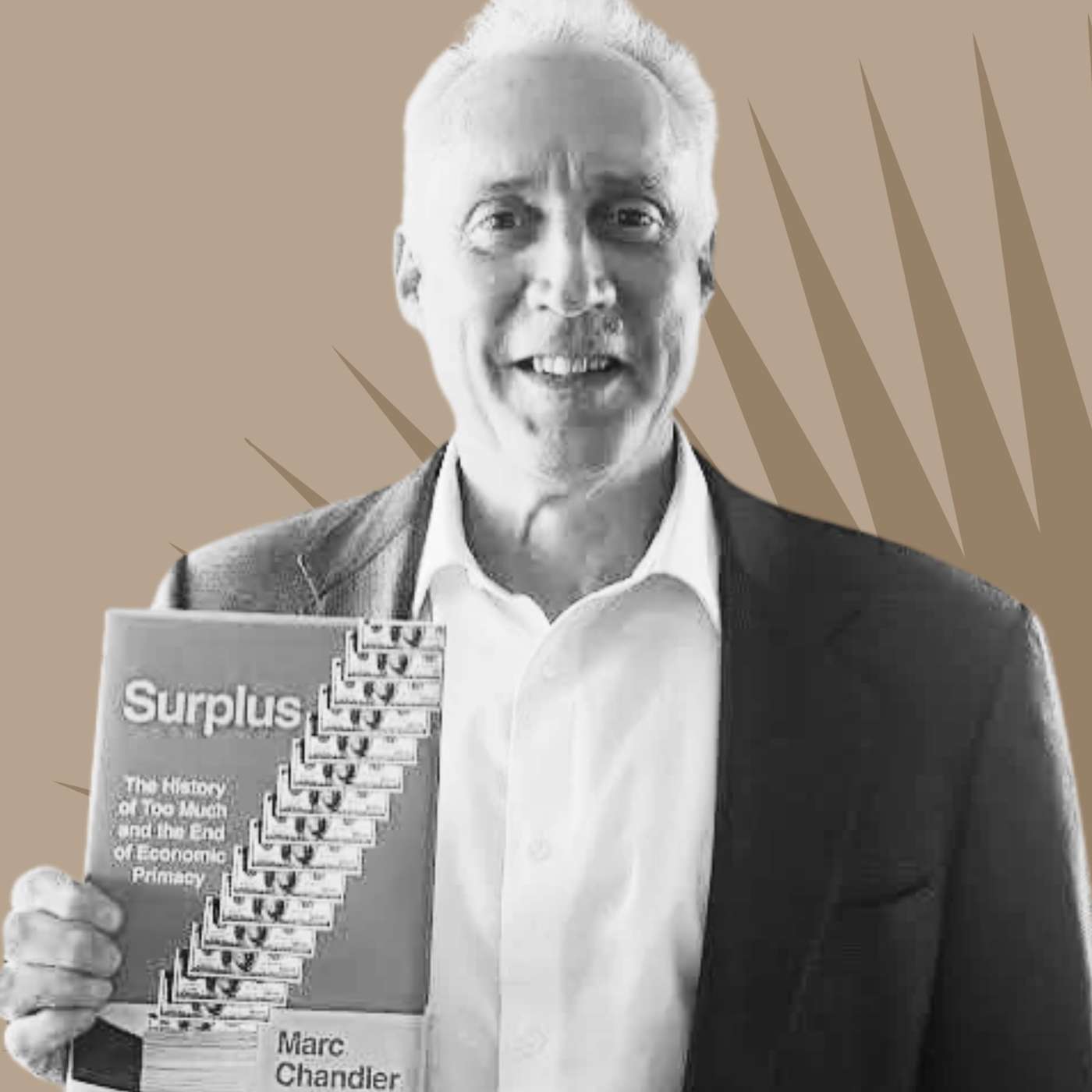


“Bezos said he had so much money he couldn’t spend it all on Earth. And I think to myself, well, cut your prices.” — Marc Chandler
INTRO
Jeff Bezos, our Amazon overlord, once complained that he had so much money he couldn’t spend it all on Earth. Hence his toy rockets. My guest today has a more down-to-earth suggestion. Cut your prices. Pay your workers more. Let them unionize.
Marc Chandler is no dreamy Bolshevik. He’s spent his life as a currency strategist. Every day for the last forty years he’s tracked the trillions of dollars sloshing around the foreign exchange markets. And what he sees, he argues in his new book, Surplus, is too much. Too much stuff, too much capacity, too much capital with nowhere useful to go. Keynes thought the economic problem of scarcity might be solved by 2030. We comfortably beat that Keynesian deadline, Chandler says. But Bezos’s toy rockets are stopping us from getting to it.
So what to do? The hard-headed Chandler doesn’t fall into the trap of imagining America can become Denmark. Instead, he wants it to return to the founders’ marriage of freedom and equality, and to end the collapsing of economic and political power. No more Muskian buying or selling of elections. It’s a familiar argument from an unfamiliar quarter. America has changed. Even money guys like Chandler have had enough.
Marc Chandler ends Surplus with a parable of heaven and hell. In hell, there’s a banquet table full of food, but everyone has spoons too long to feed themselves with. So they all starve. In heaven, they feed each other across the table with these spoons. Too much, then, doesn’t have to be too little. It all depends on how we use our spoons.
FURTHER READING
• Surplus: The History of Too Much and the End of Economic Primacy (Prometheus), by Marc Chandler.
• Marc to Market, Marc Chandler’s market commentary.
• “Economic Possibilities for our Grandchildren” (1930), by John Maynard Keynes.
• The End of Economic Man (1939; Routledge), by Peter F. Drucker.
• KEEN ON AMERICA episodes cited: Mordecai Kurz on the trouble with trillionaires, Scott Curran on Musk, Bezos and MacKenzie Scott, Dennis Rasmussen on Frederick Douglass, and Anthony Badger on Hoover, Roosevelt and the making of the American state.
ABOUT THE GUEST
Marc Chandler is managing partner and chief market strategist at Bannockburn Global Forex. He was previously head of global currency strategy at Brown Brothers Harriman, and before that at HSBC and BNY Mellon. He teaches at New York University and is the author of Making Sense of the Dollar and Political Economy of Tomorrow. He writes the market commentary Marc to Market. Surplus: The History of Too Much and the End of Economic Primacy is published by Prometheus.
ABOUT KEEN ON AMERICA
Nobody asks more awkward questions than the Anglo-American writer and filmmaker Andrew Keen. With 3,000 episodes since the show launched on TechCrunch in 2010, Keen On America is a daily conversation about the ideas, books and arguments shaping the United States. New episodes every day.
LIVE IN SAN FRANCISCO: How to See America. Who Stole America’s Pride? Arlie Russell Hochschild in conversation with Andrew Keen, Manny’s, December 8. Tickets: https://www.eventbrite.com/e/how-to-see-america-who-stole-americas-pride-tickets-2003996604791
00:00 - Intro
00:31 - AK: a wealthy country, and how to redistribute its wealth
01:36 - The wealthiest 100 Americans, from a quarter of 1% to 7.5%
02:46 - AK: a market strategist is hardly a Bolshevik
03:24 - Capitalism’s problem grows out of its successes
05:25 - Bezos can’t spend it all on Earth
06:00 - AK: does money make us happier?
06:48 - Diminishing returns, and the surplus of capital
08:49 - A pizza a day, and the AI build-out
10:07 - AK: what is economic primacy?
10:24 - Keynes, Drucker, and The End of Economic Man
11:17 - Buybacks, and what the market should decide
13:05 - AK: should Americans become Danes?
13:36 - Frederick Douglass and the Constitution
16:35 - AK: which founding ideas, concretely?
17:12 - Freedom, liberty and three breakfast cereals
18:32 - AK: do we do away with the market?
19:15 - Oligopoly, Coke and Pepsi, and two parties
20:55 - AK: the midterms
21:05 - An anger that hasn’t been resolved
21:41 - AK: Abundance, and what Keynes teaches
22:16 - We beat Keynes’s 2030 deadline
22:56 - Charles Conant and capital congestion
23:41 - AK: what tradition? How do we redistribute?
24:33 - Decoupling economic power from political power
25:40 - AK: Musk spent big and lost
26:19 - Limits on the market, from drugs to gambling
27:10 - AK: aren’t you a Puritan?
27:33 - A political question, not a moral one
29:12 - Seeing the forest, from the currency markets
29:47 - AK: what do you see from the front seat?
30:15 - $9.6 trillion a day, crypto, and the financial superstructure
32:21 - AK: does AI offer a fork in the road?
33:17 - Technology reinforces, and seeds change
34:35 - AK: Bobby Kennedy and the critique of GDP
35:10 - Heaven, hell, and the long spoons
37:01 - AK: should this come from local communities?
37:19 - Enlightened self-interest, and celebrating the surplus
39:09 - Closing
00:00:31 Andrew Keen: Hello, everybody. I don't think there's any doubt that America is a wealthy country, but the question, particularly after the election, is how to distribute or redistribute all that wealth. My guest today on the show has been spent— has spent the last forty years as a chief market strategist. He's an analyst of the dollar, so he's a hardcore finance guy. And he has a new book out which addresses perhaps, some of the key questions now in, post-midterm America. It's called Surplus: The History of Too Much and the End of Economic Primacy. Marc Chandler is joining us from Ocean Grove, New Jersey, just up the road from Asbury Park, Bruce Springsteen territory. The book came out a few days ago. Marc, congratulations. Did you do— did you time it well, Marc? Did you know that this election would happen before your book came out, so everyone's worrying about how to redistribute American surplus?
00:01:36 Marc Chandler: Yeah. I'm not so sure that everybody's, on board with the idea of redistributing the American surplus, but I do think that the election was really a key part of really the essence of the argument. You know, back in 2000, the top 100 Americans accounted for about a quarter of 1% of contributions to the national— of federal elections. .25%, a quarter of 1% in 2000. In 2024, they contributed seven and a half percent. They amounted to seven and a half percent of the money that funded the national campaigns. And to me, this is just— it— it's like the— illustrates the issue and what's happened. We've gone so far in favor of liberty, which are property rights. Produce as much as you can as fast as you can. And I'm afraid that this has led to a concentration of wealth that is undermining, like, the essence of what America stands for. When founding fathers were heavily influenced by political philosophy that tried to bring together both freedom and equality, and we've separated them. Much to, I think, to our dismay.
00:02:46 Andrew Keen: Yeah. And it's interesting, Marc. I mean, I— I'm not entirely sure what your politics are, but as I said, you work for Bannockburn Capital. You're the chief market strategist. You've been doing this for forty years. So you're hardly a Bolshevik. And when a guy like you is reminding Americans that there's a deep unfairness about the American economy, something is very troubling. Is that what triggered you to write this book, Surplus: The History of Too Much and the End of Economic Privacy— Primacy? Were you driven by a sense of injustice?
00:03:24 Marc Chandler: I think so. I think that, I've— you know, this is a— I think what I'm doing is continuing a dialogue that began middle of the eighteen hundreds or so. And I found this guy in the United States who was an adviser to several presidents, and he ended up working for the bank— same bank I did about a hundred years before I did. And he had this idea of— about capitalism. And, you know, a lot of my friends on the left and the right, they think that there's some problem with capitalism. They think they can reform away. But with this tradition, this analysis back from the middle of the nineteenth century is that, ultimately, the problem with capitalism grows out of its successes. You might know some people like this where they— we'd say that their greatest strength is also their greatest weakness. And that's true, I think, for the economy as a whole. What we've done is we can produce so much more than we can consume. People talk about more plastics in the ocean than fish. I see it. My wife and I, it's just the two of us living together, and I see how much garbage we generate. Solid waste. Right? Mostly packaging. I see how we have, like, built-in obsolescence. I see when I— not recently, but before when I do buy a cell phone, we had to buy all the new, like, attachments with it, which is one of the reasons why I never liked Apple because it wasn't so universal the way that Android or PCs are. And so I do think that we live in a society in which we— we've solved what Keynes thought was the economic problem, scarcity. And now I think, in some ways, what I'm doing is really retelling the story of King Midas. Remember him from Greek mythology? Everything he touched turned to gold. What a great deal that would be, until he tried to hug his daughter or drink some wine. We have a guy who's the CEO of one of the largest companies in the United States, and he said that he was making so much money. He couldn't spend it all on Earth. I asked him—
00:05:23 Andrew Keen: Said we had a guy? What do you mean?
00:05:25 Marc Chandler: Bezos from Amazon said that he had so much money, he couldn't spend it all on earth. And I think to myself, well, cut your prices. Allow your workers to get paid more by unionization or something like that. A lot of things you could do if you have too much money, you can't spend it all on earth. I think that sort of crystallizes the problem that really struck me. To your point, a profound sense of unfairness that I think is widely shared across demographic groups, socioeconomic status, all the different identity politics. I think that a lot what they have in common, a profound sense of unfairness.
00:06:00 Andrew Keen: Marc, we've done many shows on this subject. As you can imagine, it's a subject of infinite debate, curiosity, both from the left and the right. One of the issues that come up— that comes up often is this idea that the surplus that you write about in your book, a history of too much, where people have more and more stuff, it actually hasn't made us any happier. If anything, we live in an age, not just of what you call surplus of massive wealth. Not everyone obviously is as wealthy as Bezos or Musk, but most people have enough. And misery, what's the connection in your view in terms of your history between wealth and happiness? Does money buy a smile? You seem a fairly cheerful fella.
00:06:48 Marc Chandler: Well, I— you know, I— we looked into this as we try to, pull together the arguments of the book, and it doesn't seem to be like a, consistent theme in the literature. It seems like something like this, that it's not a linear relationship. When you have nothing, getting something is very meaningful. And this is really part of the point of the book is that we've reached a point where capital itself, money itself is in surplus. Different ways to measure it. Like, for example, in the United States right now, our inflation is around 3.7%. The ten-year bond yield is about 5%. So when you subtract the inflation rate from the bond yield, it tells you what economists would call a measure of real interest rates. They are low. And the reason that money could be low in real terms that is adjusted for inflation is because there's so much of it. And I think that the last several generations, we've put money sort of on a pedestal. You know, if you're in an argument and you say this is an economic way or this way is more profitable, it sort of could carry the day, but not anymore. You know, those election results, those— in the midterm, they're not just for electing people, of course, but there were a lot of community initiatives. And many communities— I think that nearly all the communities that voted on an initiative did not want to have or put some kind of controls on data centers. Even though the data centers might be the key to AI, might be the key to wealth, might be the key to the future, he said, hey. Wait a minute here. Same thing in New York state. There's the geological formations for fracking. But the citizens of New York said, we don't wanna do that for environmental reasons. And so I think that capitalism produced a lot of goods and services. Capital itself has now become in abundance. It comes like what we— economists would say is declining marginal utility. Sort of like, you know, when I first moved to New York from Chicago, I was broke. I'd have a pizza and a Coke every day. It was about $2.50 at the time.
00:08:47 Andrew Keen: This was in the mid eighties?
00:08:49 Marc Chandler: Mid eighties. And by the end of the week, you couldn't pay me to have another slice of pizza. It reached a point of diminishing returns. And it sounds kinda strange, but the same things happen with capital. Businesses— I'll give you an example. Everybody thinks about the AI build-out as such a huge, consumption of capital. The S&P 500 companies can do that, can fund all the AI build-out that's projected with about two and a half years of profits. That's to me that the— for me, that— that's the key issues. First, we have to come to grips with the idea that you can have too much capital. In— the price of capital, you know, back when, COVID first broke, the price of oil— and this is really a story I begin the book with. The price of oil fell in the negative territory. You had to pay somebody to take the oil off your hands. Same thing happened with money. You know, when— at the, pinnacle, there were about $17 trillion of negative-yielding bonds. Bonds we— you'd give money to a government, and they would tell you we're gonna give you only 95% or 98% of your money back, but you can be— you can count on us giving your money back. Capital was in surplus, and I suggest it still is. And that's what I think that we need to, like, get our heads around.
00:10:07 Andrew Keen: So this is the idea of the end of what you call economic primacy. I kept on misreading that and saying privacy. Of course, it's primacy. What exactly is economic primacy, and what does it mean that we're at the end of this if you're correct?
00:10:24 Marc Chandler: Yeah. So I sort of think I'm continuing a, like, a dialogue that begins with Keynes
00:10:30 Andrew Keen: Mhmm.
00:10:31 Marc Chandler: Who's talked about the end of laissez-faire. And the end of laissez-faire, he meant that there's a role for government in the economy. And then, several years later, Peter Drucker, who we know as a big economic management guru
00:10:45 Andrew Keen: Yeah. Viennese, originally from Vienna. I used to go to his annual conference every year in Vienna.
00:10:50 Marc Chandler: Yeah. What an incredible guy. And he was writing as a young man watching the rise of fascism in Germany. And it was this— it was— and so I think that his book was called The End of Economic Man. So we have The End of Laissez-Faire. We have The End of Economic Man, and I think I'm, like, part of this— if I could be, immodest and say I'm continuing that dialogue of those giants.
00:11:13 Andrew Keen: Yeah. You're allowed to be immodest, Marc, on this.
00:11:17 Marc Chandler: So that the economic— end of economic primacy means that we know— because capital is in surplus, the marginal utility has gone down, businesses are giving it back to investors when they buy back their shares. They say, we don't have no place more profitable to put our money. We're giving it back to you investors. You guys figure it out. We've reached this point, and I think that means that economics is not— doesn't have to be this driver of all of our activity. I'll give you an example. The average in the United States, a guy who's in the top 10% of the income bracket lives about ten to twelve years longer than a man in the bottom 10% of the income bracket. It seems to me it's fine for the marketplace to decide what kind of ties, whether it's thinner or wide next year, whether the hemlines are up or down, or whether the popular color of the car is pink or blue or black. I have no problem with that. But do we really wanna have the market, especially talk about twenty-second century [as spoken]. You know, you know, do we really want the market to be determining how long people live for? I don't think so. I think that, like, I think I learned this during COVID that my family could not be safe if there was a homeless guy sleeping on my doorstep who had COVID. And so I— in some ways, I just— it's like a complete circle. Like, so you say we have a social responsibility. Imagine in World War II, the Germans are bombing Britain at night. And so everybody in your apartment building agrees, let's not— let— everybody keep the lights off after dark. And someone says, well, I wanna keep my lights on, but pull down my shade. Doesn't work that way. And I think we— in a society, that's where we are.
00:13:05 Andrew Keen: Marc, I've had this argument number of times before on the show about social responsibility and the ideal of sharing all too often. And the authors, the people who come on the show tend to be academics, usually progressive, although sometimes they're self-made people. And they always say, well, the American way doesn't seem to work anymore. We need to become like those Europeans, maybe like the Danes or the Swedes. Is that your argument?
00:13:36 Marc Chandler: Not at all. You know, before I got involved in the markets in graduate school, I studied American history. I have a master's in American history. And I— my master thesis was on Frederick Douglass, who's, as you know, was a slave who escapes, from slavery into the North, and he becomes an abolitionist. And he later becomes what we call antislavery Republican. He took that abolitionist, that sort of, religious call for virtue, if you will, and turn into a political process. And the key to that transformation of the abolitionist movement to the antislavery movement was no longer arguing that the Constitution itself was proslavery. Come on. We all know that the Constitution was proslavery because it took three amendments to get rid of it. But it made sense at the time for Frederick Douglass and the abolitionists to say, fighting the slaveholders in the South, the Confederacy was difficult enough. But why do we have to fight the Constitution at the same time? So I would say to those friends of yours who push back, say it's not the American way and the American system doesn't work anymore. I say, let's go back to the founders, their idea of freedom and equality. I mean, think about the, you know, the— what the freedom of, the First Amendment, freedom of speech means. The Supreme Court has reinterpreted to mean— to cover campaign financing. We have a system that's— I mean, we all know the kind of revolving door between executive officer, legislative office, to the regulator, to the agent that they're supposed to be regulating. How it's a revolving door? This is the issue. And I think that you don't have to practice, what Denmark practices or Germany. I think that we can just go back to our own traditions. I mean, think about what happened. You know, we had a horrible Great Depression, for our parents' generation in the twenties and thirties— late twenties and thirties. And out of that came the New Deal. That was how we're gonna fix it. It was a new unification of freedom and equality. And since at least the late seventies, early eighties, there's been a push against those programs, an unwinding event that we no longer owe each other anything. People who get things are called— they're called entitlements, not a basket of goods that citizens of the richest country in the world should have. Like, we have, say, roads, legal system. we should have, sort of— I think a basic sense of goods that people need. Maybe for our grandparents, the telephone wasn't needed. My grandparents were still having to go out of the house to get plumbing for the bathroom.
00:16:21 Andrew Keen: Where were your grandparents?
00:16:23 Marc Chandler: My grandparents were in Eastern Europe.
00:16:25 Andrew Keen: Oh, so they weren't— they hadn't come to the US?
00:16:28 Marc Chandler: They hadn't come to the US, but you'd be surprised that when we got— like, we didn't get rural electrification in the United States till the Great Depression.
00:16:35 Andrew Keen: Yeah. We did a show recently on the dramatic changes in America in the twenties and thirties. And it's interesting you bring up Frederick Douglass. We did a show on him specifically on this shift from being a former slave and, obviously, highly skeptical of the American Constitution to embracing that Constitution. So I take your point, Marc, that Americans shouldn't wanna become like Danes, but how concretely is this gonna work? When you look back to the founders, what ideas in particular? Is it something like Jefferson and his skepticism on growth? Where do we look?
00:17:12 Marc Chandler: Well, I think, for me, I go to the fundamental concepts of what freedom and equality mean. I think that's why American— why we call it a revolution. It wasn't just a war for independence from Great Britain. It was a revolution. We changed the political structure, and I think that we can go back to those seeds of what freedom meant. Free— you know, I taught at NYU. They have a center for global affairs. I taught for many years. And every year, I would ask my students. I would give them a scenario. I would say that the— to imagine that the government decides that there's too many breakfast cereals. From now on, there'll be something like, say, a Cheerios things that doesn't get soggy milk, some cornflake thing that does get soggy milk, and then some kinda healthy, granola kinda thing. Three breakfast cereals. How many of my students thought that would be a loss of their freedom? Every year, a vast majority of it thought that they would be less free. Freedom cannot lie in consumer choices. That's liberty. Freedom is self-determination, participating in the community in which you live in. And you can only participate if you're equal with other people. And so that's that unity of freedom and equality becomes the key. But I think you're right. How do— it's always the key issue, I think, too, is how do we get from here to there?
00:18:32 Andrew Keen: Right. And I take your point. I don't think anyone's gonna disagree in principle, although the— what people, of course, will be scratching their heads about is how to get there. You're the, quote, unquote, chief market strategist for, Bannockburn Capital. You're an analyst of foreign markets. Are you suggesting that we do away with the market? I mean, the reason why when you go to the supermarket, there are more than three cereals is because there are lots of companies that, produce cereals, and they believe that their cereal is better, cheaper, healthier than the next one. So are you suggesting that we limit them, or are you suggesting that people rethink their relationship with cereals?
00:19:15 Marc Chandler: Well, I— you know, it's kinda funny because I kinda wonder, you know, we go down the— we go down that aisle at the grocery store, we see a lot of breakfast cereals. But it's sort of like— don't you think it's a bit like Coke competing with itself with Diet Coke and then Coke Zero and then Coke that and Coke this? It's this— we really have a— many of the key consumer sectors, we have oligopolies. They make it look like competition. And sometimes I wonder if that's not what our political system is too. You know, we talked— you talked about Denmark. Many countries who have US say, standard of living, you know, they're around our standard of living. More than two political parties. We give people a choice between Pepsi and Coke and tell them, this is your choice. This is what freedom means. So— no. I think that the real challenge is how do we get there. But for me as a strategist, it's not just, like, the upside, but I also think about the downside. Sort of like when you go to a theater, they say, oh, know where the exits are. We're on an airplane. Know where the exits are. I think the same thing, and I think that where are we, a society that has property and wealth and income so concentrated and allows that power that emanates from that control, from that ownership to influence politics to such a degree that undermine both freedom and equality, and the system has lost some legitimacy. And what I'm afraid of, and this is how my book ends, is Drucker is seeing something that— when you read Drucker's book, The End of Economic Man, it sounds eerily familiar with some things going on today, post-truth. The, you know, the idea of telling farmers they'll get them more money for their food and then telling consumers they'll get lower prices.
00:20:55 Andrew Keen: Yeah. But those guy— but that character just got— I mean, he didn't get voted out of office, but he's certainly not someone particularly popular in America. So why should this—
00:21:05 Marc Chandler: I'm sorry. I just think America is still very angry, and I don't think it's been resolved by the mid— midterm elections. It was a dramatic development. Yes. But one is I'd say, political scientists talk about swing elections. And we can't tell from this election, from one midterm election that this is a swing election. Remember, a lot of people that voted for Trump also voted for Obama. I'm not sure I wanna, like, extrapolate from this election. But I do think that there's a anger that's below the surface. And we see this not just in the United States, but in a lot of high-income countries in Europe. Where in recent weeks, we've seen demonstrations in at least half a dozen European countries.
00:21:41 Andrew Keen: Yeah. France and Germany, of course, in particular. Your book is very much in the vein of best-selling books like, Ezra Klein and Derek Thompson's Abundance, which talks about the failure to, build or rebuild America. I think they're less concerned with the idea of surplus than you are. You also talked about Keynes. What have we learned from Keynes? Keynes was already writing about the idea of AI more than a hundred years ago. What does Keynes teach us?
00:22:16 Marc Chandler: Well, I think Keynes recognize the surplus. He— Keynes says, at the very end of his big treatise, The General Theory, he says that the problem of economics, which he understood to be scarcity, he says is gonna be solved by 2030 [ed.: the 2030 forecast comes from Keynes's 1930 essay "Economic Possibilities for our Grandchildren," not The General Theory]. I say we beat them. We beat that little deadline, if you will. And I think that my book begins with the idea that there's already a surplus. The Abundance book begins with why there isn't an— why there isn't a surplus. So I think we were looking at things from different ends of the telescope.
00:22:47 Andrew Keen: It's ironic that the Klein-Thompson book is called Abundance, but it's not actually about abundance. They stole your title. You should be suing them.
00:22:56 Marc Chandler: Yeah. No. No. This idea of surplus, though, you know, this guy who I use as my protagonist, the guy named Charles Conant, who worked at that bank that I did, a hundred years before me, he talked about it in the United States. He called it capital congestion. Ruinous competition. Around the time that he was writing, US Steel was formed. 12 different steel companies formed the largest company at the time, and they did it purposely to reduce ex— excess capacity. They knew that there was surplus. And so I really think in some ways, while the book sounds new, I'm really pulling on threads of old discussions that have fallen out of favor, sort of like a friend of mine that wears a bow tie. I just sort of, like, hard to tell him that it's out of fashion.
00:23:41 Andrew Keen: So what is that idea? If you're not, quote, unquote, a socialist, there's a lot of, socialist energy now, in the Democratic Party. It'd be interesting to see how that debate goes between perhaps, pro-market Democrats and so-called market socialists. What is the tradition that you're trying to pick up? Is it Teddy Roosevelt? Is it FDR? Is it the New Deal? I'm still not entirely clear, Marc, how this works. You mentioned Jeff Bezos. We can also talk about Marc, about Elon Musk, both—
00:24:13 Marc Chandler: Yeah.
00:24:19 Andrew Keen: Worth many hundreds of billions of dollars. Sometimes Musk is worth a trillion dollars. How are we supposed to take their excess and redistribute it? Are you talking about taxing? How does this work?
00:24:33 Marc Chandler: Yeah. So I think that's really the— I think that's that should be like the— one of the top issues. That's what we should debate as a society. It's not so much that the people are wealthy. I think that's like the wrong course of action. I think that the issue is do— does that economic wealth have to be used? Do they have a legal right? Do they have a moral right to use it to change politics? Why should— in some ways, you know, these people who gave so much money to the campaigns, they get to vote all the time. You and I get to vote every, you know, midterms, every two years, presidential, every four years. They have— they have to exercise more political power than we do. And I wanna break that— I wanna decouple that again. Economic power should not lead to the political power. I think it's already breaking down. I think there's a big backlash against this. I think it's gonna grow. And so— and it's just a part of this idea that economics has sort of overplayed its hand. So I don't have— I just am afraid that if we do not try to solve, if we do not try to bring liberty, excuse me, freedom and equality back together, we're gonna go down that same road that Drucker was witnessing.
00:25:40 Andrew Keen: So I have a couple of questions. On the one hand, it sounds to me like you're making the fairly standard campaign financing argument that we need to— or America needs to change its campaign financing laws so that men worth hundreds of millions or hundreds of billions of dollars can't buy elections, which I don't think most people would disagree with. On the other hand, Musk, in this last election, put hundreds of millions into Republican campaigns, and the Republicans got trounced. So can one argue sometimes that wealth don't actually make any difference to democracy?
00:26:19 Marc Chandler: Well, I think you're right. I mean, sometimes, you know, the, sometimes the race does not go to the swiftest. Sometimes the political campaign does not go to the richest or the biggest spender. But this is part— I mean, this is only like— I break— I make this— mention this about campaign finance partly, but it's part of the broader picture, like rich people living longer— rich men living longer than poor men. I just think that we used to have limits on the market, things that the market couldn't do. And look at what we've done now in the last couple of years. We've legalized drugs. We've legalized gambling— sports gambling for high school. Is this really the kind of society that we wanna live in, or is this a society in which liberty, the rights of money has really swung so far that it's really not helping society anymore.
00:27:10 Andrew Keen: You— you're sounding more and more— I don't mean this critically as a—
00:27:11 Marc Chandler: Okay.
00:27:14 Andrew Keen: As a Puritan, Marc. But who determines other people's Puritanism? Who— who's to say whether or not people should or shouldn't gamble?
00:27:24 Marc Chandler: It's not about whether they should gamble or should gamble. I have no— I gamble myself. It's whether this—
00:27:28 Andrew Keen: But that's your job. You're the chief strategist at a— in a finance company.
00:27:33 Marc Chandler: Yes. It's just like gambling, I suppose, in many ways. The risk control is important. But the real point really is I think it's— I have no problem people gambling. It's not a moral issue. It's whether the government should help, like, foster this activity. I mean, think about it. You know, our lottery money, who buys lottery tickets? Who gambles? You can see what happens to neighborhoods when they have a new casino or a new, instead of off-site gambling place. I think it's not a moral question at all to me. I think it's really more— to me, it's political issue. How should we decide these issues? And what about— you know? And how should we do it, equally so that the people who have a vested interest are controlling the regulators instead of, fixing the dice, so to speak? Because I think that the point, though, is that if we don't come up with a way, if we don't discuss this as society, and we phrase it like, oh, you have to— how are you gonna take money away from rich people? How do you make this redistribution? That already presupposes a certain answer to the question. It's sort of like what our Federal Reserve chairman, Warsh, has done. You know, he says he's gonna appoint these five task forces, and he's already beginning to change how the Fed operates before those task forces report. So I just— pointing out, I think, in my book that we— we're at a— like a fork in the road. If we continue the path we're on now, power becomes more concentrated. Wealth becomes more concentrated. More people will be born on third base and think that they deserve to be there, think that they got a triple.
00:29:06 Andrew Keen: Yeah. And you're a big Cubs fan, so you know all about being born on first— third base, don't you?
00:29:12 Marc Chandler: So I think that this is where we are in society, but I think it has to be framed right. You know, many people think that the problem of China overproducing or— you know? And to me, what I'm trying to do is a lot of people have looked at the trees, and I'm trying to see the forest. And that I— that ability or that desire to do that grows out of my job. Watching the foreign exchange market is just an amazing average daily turnover in the foreign exchange market. There's people trading currencies like euros and yen and Canadian dollars and US dollars. That average daily turnover is $9.6 trillion a day.
00:29:47 Andrew Keen: A day? Yeah. And that's one of the reasons why I invited you on the show because most people who write about these sorts of things, as I said, are either academics or extremely wealthy retired people who believe they have a particular kind of wisdom. You have a front seat, Marc, a daily front seat on global capitalism, on the global financial markets. What do you see that the rest of us don't see? What's it like?
00:30:15 Marc Chandler: Well, I think two things. One is, as I mentioned, the sheer size, 9.6 trillion. Everything the world produces in a year is— what is it? A hundred and twenty, hundred and thirty trillion dollars? We do that in a couple of weeks in foreign exchange. Global trade, in a year, all the goods and services crossing borders, commodities, widgets, autos, pharmaceuticals, everything combined is around $40 trillion. We do that in a week in the foreign exchange market. I see vast sums of money sloshing around the world. It's sort of like— I think it's sort of how I try to figure out what the role of crypto is in all this. I sort of think that what crypto has done is it's sort of like I compare it to what trees do to carbon. It sucks the carbon out of the air and puts it in a safer place, wood. Crypto takes money that would be chasing equity markets or house prices or maybe, betting markets, and it shifts it someplace where it is doing less harm. And I think that this in some ways, the Reagan-Thatcher revolution did. Rather than try to build more factories for things that we don't need, create a financial superstructure that could absorb that excess savings, stock and bond market. You know what? I'm not that old, but I do remember when we shifted from a defined benefits program where my employer would give me a pension, like my— like our fathers had or our mothers had, to this defined contribution where they give us some money if we're lucky. But we're told we can— we've gotta manage it ourselves if we get this, a menu of different things we can put it into. This— by creating this financial superstructure, what we're proud of, this equity culture, we're able to absorb the savings that would otherwise be going to building more capacity. That's what China does. They take their surplus savings and they reinvest it into building plants at capacity and then exporting their goods. Japan takes their surplus savings and they export it. They buy US Treasury bonds. They buy US equities.
00:32:21 Andrew Keen: Marc, you've talked about, and I'm quoting you here, this fork in the road. Does AI offer us, an opportunity in this fork of— in the road to take, to make the right choice in terms of, the future? We've talked about Keynes. Keynes imagined AI a hundred years ago. He didn't imagine the technology, but he imagined a world where people wouldn't need to work. On the one hand, AI offers that opportunity. This is something that, Klein and Thompson address in Abundance and many other writers as well. On the other hand, of course, with the AI economy, we've already talked about this. We have massive billions, hundreds of billions of dollars now being invested in data centers, wealthier and wealthier companies becoming richer and richer. So how does AI play into this in terms of your fork in the road?
00:33:17 Marc Chandler: Sure. I mean, I think there's, maybe oversimplified a bit, but there might be two camps. One camp that's like a technological determinist. And a lot of Americans seem to be like this if you scratch them. They sort of think that technology is gonna come and save us. We got some problems. We got a new technology that'll save us. And in my experience and partly just reading as a historian, I see technology— a new technology both reinforcing current social relationships as well as setting the seeds for changing them. You know, you think about, did the Internet really change things? Well, sure it did. Change— it creates new jobs, destroyed jobs, created companies, destroyed companies. Right? They're called creative destruction process. But did the— did these— did the problem of surplus go away? And I say again, it hasn't gone away. It's growing. And it's producing these, like, these weird things that happen. We need places to put it. But that's why one of the things that we're gonna be absorbing it is in the arms race. New arms races. And I say, no. Let's think about this more rationally than just go back to these things as finding places that dump this cash, dump this capital that we've created such a surplus of. I don't wanna be like King Midas. I don't want our children to have to be like King Midas.
00:34:35 Andrew Keen: It sounds to me like you're calling less for a rethink of economics more in a philosophical sense in surplus. It reminds me in a way of a famous speech that Bobby Kennedy, when he was running for president, made in Kansas in 1968, where I think he was the first American politician or certainly somebody running for president to call into question the idea of GDP, of quantifying economic progress. Is that the tradition that you're placing, your thoughts in surplus?
00:35:10 Marc Chandler: No. I mean, I do think that, you're right that there's a moral element to this. But partly, I— you know, again, this is another older tradition that I find myself rooted in, and that is— it's not that an economy doesn't just produce goods and services, but it also generates values. And, you know, I— I'm not a very observant person, but I came across a story, and I end my book with the story of the first time I ever heard it. It was about a person that gets to see, heaven and hell. And there's no mention of God. There's no— it's not a denominational or religious thing. Person gets to see heaven and hell. They see hell first. And it's this long banquet table full of food, but the people are crying. They're miserable. Because at the end of their arms, these long cutlery has been attached. Imagine that you have a long fork and a long spoon at the end of your arms. You can't eat. You're miserable, but you're surrounded by food. The other— the person then goes to see heaven, and it's the same thing. Big banquet table, tons of food, but instead the people are happy. They still also have these long utensils tied to the end of their arms. They realize they could feed each other across the table. And I think that— you know, I think about that civic responsibility, civic duty. And I— and like I said, I'm not a very observant person. But I do think about where in the Bible, it says about, the Cain asked, am I my brother's keeper? And in this world, the surplus that I think we've created, I wanna celebrate it. See, now that we have the surplus, aren't we our brother's keeper in a way— can't we afford to be our brother's keeper? Can we choose to be our brother's keeper in a way that we couldn't before we conquered scarcity?
00:37:01 Andrew Keen: Should this thing come perhaps not so much from the federal government, but from local communities? People recognizing that their neighbor, even if they don't have as much money, have as— has— should have as many rights as they do and so that we help feed them or we hate— help clothe them.
00:37:19 Marc Chandler: You know, I think that it also— I wanna say that I— I'm not opposed to this idea that people are, like, motivated by self-interest. That's what I say about that homeless man in front of my house with COVID. My family can't be safe. And so by taking care of each other, instead of— I would say it's not, like, altruism. It's enlightened self-interest. So it's nice. So it's really about— for me, it's really a celebration. I know that, you know, there's a lot of— there's a big growth camp out there. There's a camp that's, you know, we should have billionaires. I'm not like that. I really— the book is really more like we've achieved so much. Capitalism has been so successful, more successful than our wildest dreams. When you say about Keynes anticipating AI, who could imagine that? I was there when they took away my electric— when I had a manual typewriter type of master thesis, took that away, got an electric typewriter, took that away, got a word processor, took that away, got a laptop or a PC, got a laptop. And now I'm told that my cell phone has more power than the computers that took man to the moon for the first time. So we live in this world of incredible surplus. I mean, how many pairs of shoes? I mean, when I was growing up, I grew up in a very low middle class and sort of a typical type of situation, I think, for many people. Single mom, kids, father who had, like, no longer felt responsible. My brother and I shared for one winter, brother who's a year younger, we shared a pair of dress shoes and gym shoes. Whoever had PE classes got the gym shoes. And I think now my own son had half a dozen pairs of gym shoes. They were like status symbols. Right? And so I think that we forget about how far we've come. And I wanna celebrate how far we've come. See, what next?
00:39:09 Andrew Keen: Well, that may be the point of Marc Chandler's new book, Surplus: The History of Too Much and the End of Economic Primacy. What's next for American capitalism? What's next for America? Is the question, I think, that Marc asks. And I think, Marc, over the next couple of years, as we, get ready for the 2028 election, more and more people will be talking about that. So congratulations, on the new book, and best of luck making your fortune on the currency markets.
00:39:46 Marc Chandler: Yeah. I think there's only one way to make a small fortune in foreign exchange, and they have to begin with a large one.
00:39:54 Andrew Keen: Yeah. It's rather like having an aircraft or a yacht.
00:39:57 Marc Chandler: Yeah. Exactly.