The Last Humans: Alexander Wendt on UFOs, Global Security and the Threat to State Sovereignty
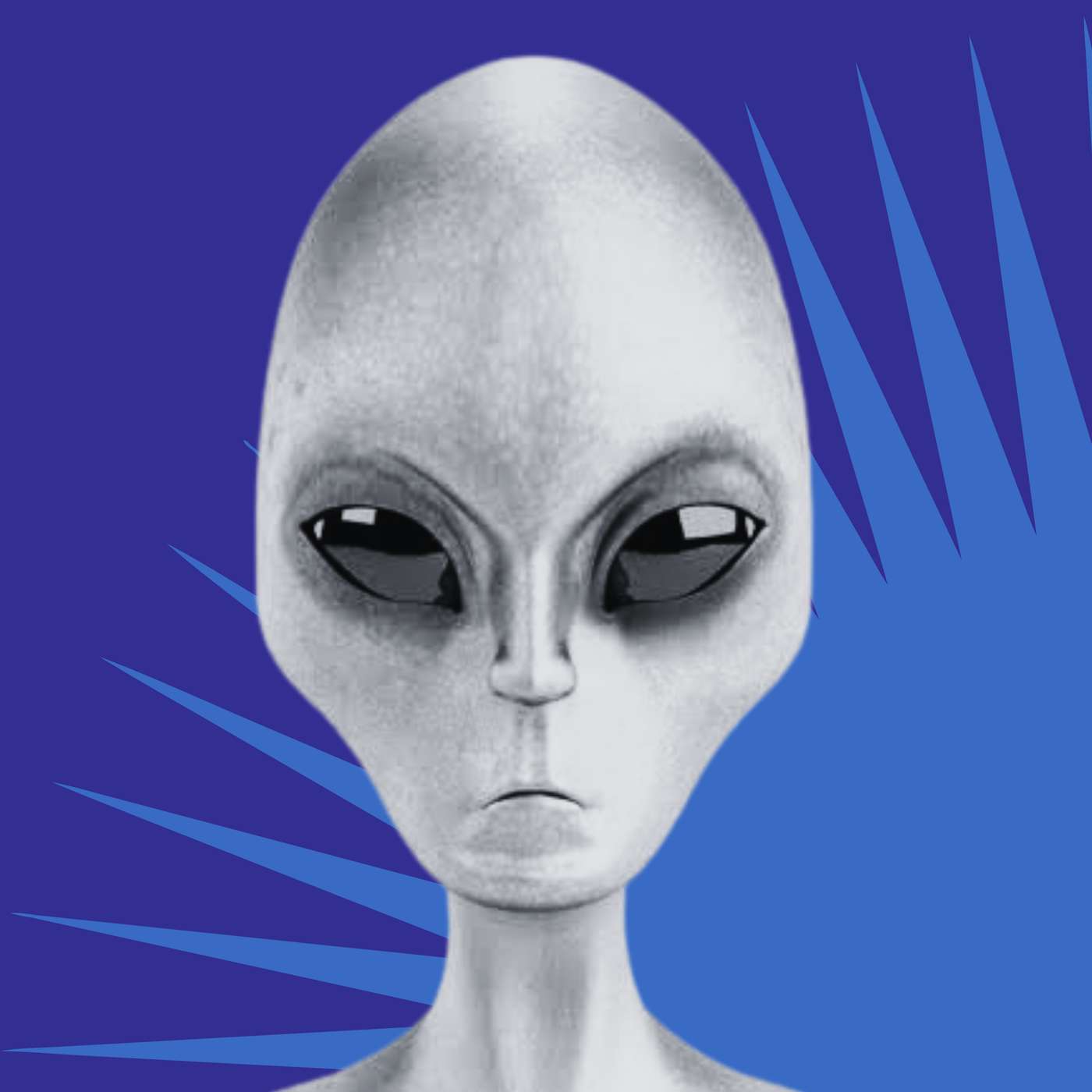


Last month Adam Kirsch was on the show arguing that our current obsession with UFOs represents a new kind of religion. Today’s guest, the international relations expert Alexander Wendt, argues that today’s UFO obsession is the least of our problems. In his new book, The Last Humans (out today), Wendt’s worst-case scenario is that the UFOs are already here — and have been for some time.
While the Pentagon has conceded only that the objects are real and that it cannot identify them, Wendt extrapolates further. A recognition of the presence of UFOs would bring, he warns, both a crisis of global security and the demise of the traditional state system. Worst of all, he fears, would be a descent into a Hobbesian-style war-against-all.
Wendt is less worried about the invasion of the earth by little green men. If they had wanted to attack, he says, they would have done it when we fought with sticks rather than nukes. Instead, he worries about the social contract we have with the state. We obey the laws of the state because they keep us safe. Spacecraft that the Pentagon cannot identify, in airspace the Pentagon can’t defend, would leave that contract in tatters. What follows is not war with aliens but Hobbes’s great fear of a return to his dreaded state of nature.
So, as Wendt notes, “the threat of UFOs is not them. It’s actually us.” Rather than a new religion, they represent an old nightmare. Beam me up, Thomas Hobbes.
FURTHER READING
• Alexander Wendt, The Last Humans: UFOs, Global Security, and the Threat to State Sovereignty (Oxford University Press, out 15 October 2026)
• Adam Kirsch on We Want to Believe — the case that this is a religion, not a security problem: listen or watch
• Wendt’s 1992 article “Anarchy Is What States Make of It”, the piece that launched constructivism, and his Social Theory of International Politics — both listed at his Mershon Center page
• The June 2021 Preliminary Assessment: Unidentified Aerial Phenomena from the Office of the Director of National Intelligence — the report that, on Wendt’s account, changed the game
FIVE TAKEAWAYS
1. His thesis is that the danger is on our side of the encounter. He separates the craft from the question of who is flying them, and says the Defense Department has settled the first — after seventy-five years of denial it changed its mind, which he finds significant. On the second he is agnostic but unworried about attack: anything capable of getting here could have destroyed us long ago, when we were far weaker. The threat he describes is political. Our civilisation is organised around the assumption that we are alone, and the discovery that we are not would expose a state that cannot identify these objects, cannot stop them entering its airspace, and cannot protect anyone from them. That is the emperor with no clothes, and what it threatens is allegiance.
2. What he actually fears is Hobbes, not invasion. Once the news is out, people will disagree about what to do — shoot them down, worship them, ignore them — and there is no way to settle the argument, because nobody can get inside the craft to find out who is right. Disagreement with no arbiter is the oldest problem in political philosophy and the one Hobbes built the state to solve. His worst case is not conquest from outside but an implosion from within, which is why he thinks disclosure handled too quickly and too casually would itself be dangerous.
3. The title has three meanings, and the third is the interesting one. We could be the last humans physically, if they exterminate us. We could be the last biologically, if the hybridisation programme described by alien abduction experiencers is real. Or we could be the last in what he calls an experiential sense — the last people who will ever know what it was like to believe we were alone in the universe. He thinks the third is much the most realistic, calls it sad and potentially uplifting at once, and notes that in all three cases the anthropocentric world we have built does not survive.
4. It is bad news for America and possibly less bad for China. A country accustomed to sitting on top of the international system has the furthest to fall, and every scenario he sketches makes the United States smaller: against a superior intelligence the gap between the strongest state and the rest stops mattering. On China he is openly speculating, but the thought is that a more collectivist culture has more cohesion and loyalty to draw on in a shock like this, where an individualistic one has people going every which way. His guess is that Washington and Beijing would try to cooperate, and that the real question is whether either can keep a grip on its own population.
5. The UFOs are the occasion; the argument is about constructivism. The most fluent stretch of the hour has nothing to do with aliens. Wendt explains why idealism became a slur in international relations after Munich, how realism and then liberalism replaced it, and where his own school came from — sociologists rather than economists, George Herbert Mead and Erving Goffman rather than rational choice. His 1992 article “Anarchy Is What States Make of It” argued that the international system has no single logic and that everything depends on what actors do with it. That is the claim this book applies to the strangest case available.
ABOUT THE GUEST
Alexander Wendt is Mershon Professor of International Security and Professor of Political Science at The Ohio State University, and a founder of the constructivist school of international relations. He is the author of Social Theory of International Politics and of the 1992 article "Anarchy Is What States Make of It". In the 2017 TRIP survey his peers named him the most influential scholar in international relations of the previous twenty years. He shared the 2023 Skytte Prize in Political Science and was elected to the American Academy of Arts and Sciences in 2025. The Last Humans is published by Oxford University Press.
ABOUT KEEN ON AMERICA
Keen On America is a daily conversation about the ideas, books and arguments shaping the United States, hosted by Andrew Keen, author of The Internet Is Not the Answer and How to Fix the Future. New episodes every day.
00:00 - Intro
00:31 - Adam Kirsch and UFOs as a new religion
01:30 - Alexander Wendt and The Last Humans
02:19 - Not religion — a scientific and military imperative
03:05 - The 2021 Director of National Intelligence report
03:43 - Separating UFOs from ETs
04:48 - Self-driving craft, and self-driving cars
05:47 - What UFOs would do to international relations
06:33 - The threat is not them, it’s us
07:20 - The social contract and the impotent state
08:00 - Hobbes, disagreement and violence
08:54 - Could a common threat unite us instead?
09:30 - Waltz, Mearsheimer and the realist school
10:25 - Two scenarios: cooperation or a new arms race
11:25 - What happens to the United Nations
12:20 - An asymmetry of power that delegitimises the state
13:01 - The parallel with AI
14:17 - Why he left AI out of the book
15:24 - Obsession, or finally facing the evidence?
15:50 - Quantum social science
16:42 - The Kahneman–Tversky anomalies
18:01 - What quantum AI would mean
18:28 - Conspiracy theory in a conspiratorial age
20:29 - Separating science from pseudoscience
21:00 - Why the Pentagon changed its mind after seventy-five years
21:40 - Why the skeptics went quiet
22:10 - Who chose the title
22:32 - The three senses of the last humans
23:30 - The last to know what it was like to be alone
24:00 - Why he fears a fast disclosure
24:23 - Hobbes, and a shift in the nature of power
25:56 - A world becoming less state-centric
26:37 - Realists, liberals and constructivists
27:22 - Why idealism became a slur
28:56 - What a constructivist actually is
29:30 - Anarchy Is What States Make of It
30:44 - Mead, Goffman and the sociological turn
31:51 - Where agency lies, and how to explain wars
32:56 - Is this good or bad news for America?
34:40 - And for China?
35:34 - Europe, and the view from across the pond
37:13 - Will we look back on this as the witch trials?
38:47 - Closing
00:00:31 Andrew Keen: Hello, everybody. It is Thursday, October 15, 2026. Last month, we had the New York City–based cultural critic, Adam Hirsch [as spoken: Kirsch], on the show. He has or he had a new book out, We Want to Believe: How Aliens Went Mainstream and Why It Matters. It's been an interesting conversation. It's easy, of course, to dismiss and make fun of the increasing belief or interest in UFOs. But for Kirsch, who, as I said, has spent a life writing books on one kind of cultural criticism or another, he thinks there's something more substantial about our increasing obsession with UFOs. It's become a kind of new religion in his mind. And this interest in UFOs is, also the subject of a new book by a major academic, a theorist in international relations, Alexander Wendt. He teaches at Ohio State University. He's a very innovative thinker when it comes to international relations. And he has a new book out, The Lost Humans [as spoken: The Last Humans]: UFOs, Global Security, and the Threat to State Sovereignty. Alex is joining us from his home office, in, Columbus, Ohio. The book is out today. Alex, congratulations on the new book. Do you share Adam Hirsch's [as spoken: Kirsch's] argument or sense that behind all this obsession with UFOs, are significant cultural, social, economic, geopolitical, developments?
00:02:19 Alexander Wendt: Well, that would cut— well, thank you for having me on the show first. I'm delighted to be here. Well, I haven't read Hirsch or I haven't seen Hirsch's [as spoken: Kirsch] post or whatever, so I don't know that.
00:02:30 Andrew Keen: Sorry. It's— I may have said— I may have misrepresented him. It's Kirsch, Adam Kirsch.
00:02:34 Alexander Wendt: Okay. Yeah. So I haven't read or seen anything of his, so it's hard for me to comment directly. I'm skeptical that this whole issue is, being driven by religious or other kinds of cultural motives. I think that there's a scientific imperative and there's a defense or military imperative that's going on. So I would probably put— of course, I'm a political scientist, and so I'd be biased toward those kinds of factors anyway. But, you know, it's a matter of debate, obviously.
00:03:05 Andrew Keen: So what's your sense then about these UFOs? There's more and more interest in the Pentagon back in June 2021. I know you write about this in your book. There was a white paper by the Director of National Intelligence on unidentified aerial phenomenon. The Pentagon are putting out more and more UFO videos. Do you think until— we'll come to your theory in a minute, Alex, but is there something in it? Do you— is your sense that there may be UFOs up there, little green men planning to invade the Earth?
00:03:43 Alexander Wendt: Well, I would distinguish UFOs from ETs. UFOs, the Defense Department tells us, are real, and I'm inclined to believe them since they, for seventy-five years, denied they were real and then suddenly changed their mind. So that seems pretty significant. And so I guess— wait. What was your question again? The rest of it?
00:04:06 Andrew Keen: Well, maybe I collapsed. You said there's a difference between believing in UFOs and little green men. I mean, presumably, someone's driving or riding on or, doing something with these UFOs. They're not full of humans, are they?
00:04:20 Alexander Wendt: No. I don't think so. And I agree that somebody probably is driving them. But I think it's important just from an analytical perspective to separate the u— UAP part of it, which is just the physical object, which is— can be documented on radar and everything else, from the hypothesis that aliens are flying these things. Now I don't know what other hypothesis would be even on the table, but I think it's important to keep them separate. And I try to do that in the book as well.
00:04:48 Andrew Keen: Although maybe they're self-driving, or self-flying UFOs. We got lots of those, on the streets of San Francisco. Do you have self-driving vehicles yet in Columbus, Ohio, Alex?
00:05:00 Alexander Wendt: I don't think so. I haven't seen any anyway.
00:05:03 Andrew Keen: I'm sure all those [unclear: Ohioans], when they will see them, will probably assume that they're being driven by little green men. Some people seem to think that already in San Francisco. So coming to your book, The Last Humans: UFOs, Global Security, and the Threat to State Sovereignty. You're a theorist of international politics, of international relations. Your book, Social Theory of International Politics, had— has had a great influence. What's your interest in— our interest in UFOs? How do you think? How might it impact on international relations, on what we take for granted about states?
00:05:47 Alexander Wendt: Well, in the book, I don't try to forecast. I try to just identify different possibilities and just so that people have a sense of the range of options. So my own sense— I mean, my personal sense is— well, wait. What was your question again now? I'm losing track of the question again.
00:06:06 Andrew Keen: You gotta listen carefully, Alex, to my questions. I can't remember now. My question was your theory, in this book, The Last Humans, about how UFOs and our increasing preoccupation, one way or the other, maybe accurately, maybe not with UFOs, how [unclear] might it affect—
00:06:30 Alexander Wendt: I see.
00:06:30 Andrew Keen: —state sovereignty, international relations?
00:06:33 Alexander Wendt: Well, the argument of the book is basically that the threat of UFOs is not them. It's actually us. And it's our reaction to UFOs that's the danger, including potentially disclosure, which could be dangerous as well. And the idea is that, by review— by— once we figure out that UFOs are here, and it seems like the Pentagon has already figured that out, then the question is, well, who's driving them? And if it's aliens, then that throws the entire— our entire civilization is based on the assumption that we are alone and that there are no aliens here. And it's bad enough that they're flying in from other planets or other solar systems. But if they're actually here and have been here, that is potentially a huge threat. Now on the other hand, they show no signs of being aggressive. And personally, I'm not worried about them attacking us because if they would have wanted to do that, they would have done it a long time ago when we were much weaker. So there's no external threat, and at least I assume there's no real external threat. But on the other hand, the threat of changes in human allegiance and human attachments, our attachment to the state, we are— we're attached to the state because the state protects us and gives us security. And that's the social contract. You know, we obey the state and it provides security. And having UFOs flying around with aliens driving them, if that's what's going on, would call that whole arrangement into question because it would reveal that the state is completely impotent to stop these, phenomenon from happening. And the sort of emperor has no clothes kind of effect could affect allegiance. It could affect patriotism. And the idea is that you would potentially get, the worst-case scenario, potentially you would get an implosion of the state from inside as people begin to argue with each other about how we should respond to this phenomenon. And my worry is the same as Thomas Hobbes' worry a long time ago that you'll— we'll have disagreements about this, and those disagreements could turn violent. And there's no way really to settle the disagreements because we can't get inside these craft. So I think there's a real conundrum, and it's not clear what will happen, but, you know, first things first. So that'll be— yeah.
00:08:54 Andrew Keen: Although I— I've often thought that give— given the increasing hostility between the Americans and the Chinese and the Europeans, Middle East and those intractable state problems, that if these UFOs really did turn up and they were manned by or womaned by these little green men or women, that might actually convince the Americans and the Chinese and people in the Middle East and the Russians to actually work together. You mentioned, Thomas Hobbes, of course, whose theory of human nature and of the state is sort of the foundations of— I guess it would be called the realist school of international relations. The classic book on that is by Ken Waltz, a former UC Berkeley professor, Theory of International Politics, which suggests that international politics is a kind of a Hobbesian, theater of, competition between states. Is— are you suggesting in The Last Humans that Waltz and many other, realist thinkers, the one who's perhaps most notable these days is John Mearsheimer, who's quite controversial. Are you suggesting that this might challenge the idea of the realist, that there's something naturally natural about state competition?
00:10:25 Alexander Wendt: I think so. I mean, well, it could go either way. I mean, it could go— and, actually, I have two different chapters where I sort of explore the two different directions. One direction would be that it brings states together because they realize that there's a common threat here. States by the— and individual states have no ability to stop this and everything else. And that's kind of the optimistic scenario. The other scenario, though, is that states will compete more intensively trying to get access to UAP, trying to figure out the technology, trying to reverse engineer the technology, and it will become one more, form of geopolitical competition, and that may contribute then to a weakening of the state and the whole state system. So, there's a— that's a much more frightening scenario. But I think I— in the book, I'm trying to sort of focus on the worst-case options and the worst-case scenarios. And so that's where I end up, although I'm not sure what my personal belief is. I haven't sorted that out yet.
00:11:25 Andrew Keen: So what would happen, Alex, to the UN? Would this— I mean, the UN's already a very weak institution in crisis. We've done lots of shows on that. Would this make the UN more credible, or would it be the final nail in its coffin when it comes to international politics?
00:11:42 Alexander Wendt: I think once the news gets out that these things are real and probably manned or aliened or whatever, then the UN could become a focal point for collaboration, at least for the elements within governments and within militaries that want to collaborate. So the UN could gain, strength from this because that's sort of how the logic of having a common enemy works. On the other hand, the UN can't really provide anything by itself. It has no real power. And there's also the scenario where states start fighting with each other or competing with each other intensively and intensification of kind of Cold War dynamics and that kind of thing. So the UN— my own view is that it would probably strengthen the UN, but that's not gonna have much impact. It's not gonna solve the problem. The problem ultimately is that we're dealing— if it's real, we're dealing with a superior intelligence far beyond our own. And so there's a huge asymmetry or inequality of power between us and these, beings or these UAPs. And that asymmetry of power itself is a threat and will call into question the legitimacy, I argue, of the state.
00:13:01 Andrew Keen: So I talked about this with Adam last month. Is it coincidental then? There seems to be something rather uncanny in our current obsession with [unclear], not with UFOs. I mean, we are in some ways obsessed with UFOs, but our current obsessive obsession, shall we say, with AI and the idea of AI acquiring its own agency, so that we are, as some people believe, AI will be our last invention. Is this part of this increasingly surreal narrative, Alex, that just as we're obsessed with UFOs, we're also obsessed or we fear that these, smart machines will come along and replace us. Your book is, of course, called, The Last Humans, and there have been many books with those kind of titles associated with AI. So how does our current obsession with AI and, indeed, this sort of ambivalence between states in terms of either using it globally for the benefit of humanity, maybe the Anthropic take versus the Trumpian take on AI strengthening the US state?
00:14:17 Alexander Wendt: Well, in the book, I deliberately set aside the AI. There's a lot of analogies between the UAP problem and the AI problem. I haven't studied the AI problem. I don't know much about it. I haven't followed it. My own feeling about the AI issue just intuitively is that it's not nearly as serious as it will be if we get to quantum AI. And the classical AI is nothing compared to a quantum one. So that's what I'm really worried, but that's farther down the road. In the meantime, I didn't want to compare the two because that would have been a huge task, and I'm not like, equipped intellectually to do that task. But there are a lot of analogies. I'm not sure I would call the UFO focus an obsession, which suggests that it's irrational or, that there's nothing scientific behind it. It seems to me we've just have gotten to a point where we are finally figuring out that these things are real, and the Pentagon has its own reasons for basically admitting that this is the case. So I haven't thought a whole lot about the comparison to AI, but it's there. And—
00:15:24 Andrew Keen: Yeah. It's probably— again, all these things seem in parallel, but they're probably not coincidental. We're all drinking from the same tap here. You mentioned quantum AI. You're one of the pioneers of something called quantum social science. Two things, Alex. Firstly, what exactly is quantum social science? And secondly, what's quantum AI? What does that mean?
00:15:50 Alexander Wendt: Well, quantum social science is the idea that, human beings are not, classical— purely classical systems. They're actually walking quantum computers, if you wanna put it in kind of a bumper sticker version. And that— and, in fact, what we've discovered is that people using quantum— the quantum formalism are able to predict human behavior better than we currently predicted with classical models. And all the so-called, irrationality, Kahneman–Tversky anomalies, and all that kind of stuff, is in fact explained or the anomalies go away when you use a quantum model to model human behavior. And that's a very powerful result in my view. And so I'm sold on the idea that—
00:16:42 Andrew Keen: Could you give me a concrete example of where quantum explain— quantum social science explains something that otherwise we're mystified with?
00:16:50 Alexander Wendt: Well, there's over 100 Kahneman–Tversky anomalies. These are anomaly— and some of them are really big anomalies, big violations of rational choice. A lot of them are relatively minor. But apparently, the quantum cognition folks who do this kind of work, and they're all very, very quantitative, very mathematical. And they're— they run— they look at the data, and they apply quantum models, and then they compare that to classical models. And the quantum models make sense of all the Kahneman–Tversky— they're not anomalies anymore. In fact, quantum theory predicts the anomalies that otherwise, from a classical perspective, are very hard to understand. So it's a very—
00:17:32 Andrew Keen: But I asked you for a concrete example. I mean, you mentioned there's lots of them, but give me one.
00:17:37 Alexander Wendt: I don't— I couldn't tell— I couldn't walk us through a concrete example. The Kahneman–Tversky anomalies are— I forget— well, there's the disjunction effect, the conjunction. There's a whole bunch of them, but I couldn't. I don't have enough skill to do it on the fly right here.
00:17:57 Andrew Keen: So you use the term quantum AI. What does that mean?
00:18:01 Alexander Wendt: Well, that means that AI is you're building a brain or building a computer that's actually a quantum computer and not a classical computer. And we can't really do that yet. We've got very, very tiny quantum computers apparently, but we're a long way from having a scalable, real quantum computer. But this very— it's a very simple difference. It's— the way it's built produces quantum behavior instead of classical behavior.
00:18:28 Andrew Keen: You mentioned that you don't believe that some of the least— that there are interest, so to speak, I'll use that word carefully, is an obsession, and I think that's a fair point. On the other hand, we live in an age, of course, of one kind of conspiracy or another, a social media age where conspiracies seem to be very popular. How do we separate, Alex, these sort of rather conspiratorial and, science fictional takes on UFOs from the Pentagon stuff, as you know, the stuff that comes out about unidentified aerial phenomenon from the Director of National Intelligence. Is our conspiratorial age one of the reasons why this stuff seems to take off, why it— why it's so popular on notice boards and social media?
00:19:31 Alexander Wendt: The conspiracy? I mean, I guess I'm not sure I understand what you're suggesting.
00:19:36 Andrew Keen: I'm suggesting that we live in a conspiratorial age—
00:19:39 Alexander Wendt: Mhmm.
00:19:40 Andrew Keen: —where people seem to believe all sorts of very odd things. Maybe some of those odd things aren't quite as odd as some people might think, but one of those is the idea of these UFOs or the imminence of UFOs and invading the Earth science fiction narratives. And on the other hand, as you've noted in your book and many other people have suggested, the Pentagon has come out with white papers on unidentified aerial phenomenon that seem much more concrete. My question is, how do we separate the serious scientific investigative stuff from the stuff which is less scientific and more conspiratorial?
00:20:29 Alexander Wendt: Well, I think it's the same problem that we have in separating science from pseudoscience. And the conspiracies are a form of pseudoscience— or can be a form of pseudoscience. And one defeats those conspiracies through the scientific method, by being objective, by being realistic, and not inventing stuff. And the Pentagon— I mean, maybe the Pentagon is part of a conspiracy. I— I'd be surprised if that was the case. But the Pentagon has very good reasons to be as rigorous and scientific as possible in their approach to this phenomenon, especially after seventy-five years of the UFO taboo. And then all of a sudden, they change their mind. Why did they change their mind? Because they're beginning to get concerned. And apparently, the big concern especially, is UAPs constantly violating military airspace is one of the big concerns, and we can't do anything about it. And so the Pentagon is concerned. Maybe that's why they called it a potential national security threat. And that kind of language, you can— the conspiracy theory doesn't have a lot of leverage against a Pentagon and is actually facing up to the phenomenon itself. And it's quite interesting, actually. I think before the Pentagon report came out, for seventy-five years, the so-called skeptics had a field day making fun of UFO believers and everything else. Conspiracy theorists ran wild. And you see much less of that, at least with regard to UAPs, since the Pentagon report because the Pentagon, in a sense, legitimates the reality of the phenomenon, and it's harder to make fun of it when the Pentagon is saying this stuff is real, and we're worried about it.
00:22:10 Andrew Keen: Why— did you choose the title of this book, The Last Humans, or can we blame it on your editor or your press?
00:22:18 Alexander Wendt: I did the title, and my editors did the subtitle.
00:22:22 Andrew Keen: So what does that mean, The Last Humans? Is it, do you mean it to get people thinking, to scare them? Well, what exactly does that mean?
00:22:32 Alexander Wendt: Well, I distinguish three different, outcomes of a potential encounter between, humans and if there are aliens in— flying around in UFOs, there's a potential encounter there. And three potential outcomes, all of which the last humans phrase would apply to. One outcome is the obvious one, which is they attack us and exterminate us. So then we're the last humans in a physical sense. The second is a biological last humans where it's a hybridization program, which is what the alien abduction experiencers report. And so we're surviving, but we survive only as hybrids. And then the third and the one that I'm most interested in because it's the most realistic is what I call an experiential, being the last in an experiential sense. Namely, we would be the last humans to know what it's like to be alone in the universe once we discover alien life. And that's kind of a sad, but it's also potentially uplifting as well. So at least we don't get wiped out under that scenario. So all— but in all three cases, the world that we have built, the anthropocentric world with our whole civilization organized around this idea that we are alone, that world is gone. It just won't hold together if we actually have an encounter with real aliens. Or even if we just discover them and don't have an encounter, there's gonna be a problem. What do we do about this? And you'll have a lot of people arguing about what to do. We should shoot them down. We should kill them. No. No. We should celebrate and worship them, and it'll be chaos. And my fear is that it'll be kinda global chaos if disclosure is handled, too quickly and too casually.
00:24:23 Andrew Keen: Let's go back to Hobbes, Alex. You mentioned him earlier, the seventeenth-century English philosopher of power and the nature of the modern state. He noted, and, of course, that's why he's the founding figure in the social sciences, in modern political philosophy, is that the state was the heart of power. But is something changing? I wonder again whether all this is just coincidental, or it seems as if there are tectonic shifts in the nature of power. The American state, of course, still retains a degree of power, although private companies like, Google, Nvidia now worth in the trillions of dollars. And meanwhile, we have, Peter Thiel, who's a multibillionaire, Elon Musk, who is a— the world's first trillionaire, who were rivaling states. And it may not be coincidental that guys like Musk and Thiel are themselves interested in UFOs and space and all sorts of other things. So are we seeing in broad terms a shift in the very nature of power? Leaving aside the UFOs and little green creatures, maybe they exist, maybe they don't, but are we seeing a shift in power from the traditional eighteenth- or nineteenth-century state, the Hobbesian state, to something else, maybe corporations, maybe individuals?
00:25:56 Alexander Wendt: Yeah. I think we are. I think that's very important, actually. I haven't thought about that a whole lot. It's sort of a little bit outside my usual range, but, I do think the world is becoming less state-centric and partly through the rise of corporations, which have been around for a long time, obviously, but not on a scale that we're now seeing. And the technology, which is stitching the whole world together, also, I think, undermines state centrism. So it may be that power as a whole is changing. I haven't thought very heavily about that, but I think that's perfectly plausible. And I think there are a lot of people in my field of IR, international relations, that would agree with that.
00:26:37 Andrew Keen: Tell me a little bit more about that field. I noted that, Ken Waltz at UC Berkeley, who actually I used to know, is the founder in many ways of the realist school or certainly one of the founders of the modern American realist school. I also mentioned Mearsheimer, who's now a very influential realist thinker in IR. What's the counter to Mearsheimer and Walt [unclear: Waltz or Stephen Walt]? See, are you part of a more— I mean, when I used to, follow it, the distinction was between realists and idealists. Do you position yourself in this debate, or is there new language now to describe how we should or shouldn't think about international relations?
00:27:22 Alexander Wendt: I would say there's the ideal— the term idealist is not used very often anymore, and few people identify that way because it's kind of derogatory or it became derogatory.
00:27:33 Andrew Keen: So— why was it— why did it become derogatory?
00:27:37 Alexander Wendt: Because in the interwar period, that's when the idealists supposedly dominated the IR field and the IR academy. And they were all saying we need international law. That'll keep the peace. And instead, we got Munich and World War II and the Holocaust. And so idealism was discredited after World War II and replaced first by realism, and now by liberalism. Liberalism is the new ism that is kind of challenging. And the liberals are very very much of the view that the world is not as state-centric as they used to be. The corporations are really important, that individuals and public opinion are really important. And these are all things that realists disagree with intensely. Now realists disagree amongst themselves. I was colleague of John Mearsheimer for five years, wonderful man, and he actually was the guy who hired me in Chicago. And his views are at one end of a realist spectrum. Mearsheimer. So— but the realists altogether are opposed in these academic debates to the liberals and so-called construct— I was— I'm constructivist arguing that social— it's all about social construction, and so on. So— well, it's been— yeah.
00:28:56 Andrew Keen: Because I know you are, and these terms are a little new to me and probably to some of the people in our audience. What is a constructivist? And is that, a response to realism in international politics?
00:29:11 Alexander Wendt: Yes. Well, I mean, it's a term that transcends international politics. It's just one— it's a shorthand for social construction or processes of social construction. In IR, the term took off. It became kind of, a term that people could identify with. It wasn't idealist, and it wasn't, you know, naive and so on. So— but it's basically the idea that it's not about human nature. International politics is not about human nature. And it's not about anarchy. And actually, the thing that I think gave, constructivism one of its biggest boosts was very early in my career. I wrote an article called Anarchy Is What States Make of It, and the article just took off like crazy. And it was the phrase that anarchy does not have a single logic. Anarchy all— it all depends on what people do. And so that shifts the focus away from the structure of the system, which is what Waltz and Mearsheimer were interested in, and instead to— toward choices by states, choices by other kinds of actors as well. So it's a more plastic, it's a more malleable world in some ways from a constructivist perspective than if you're a realist where it's more timeless and everything just keeps repeating over and over again.
00:30:25 Andrew Keen: So if realism is built on the ideas of Hobbes, or certainly Hobbes is enormously influential when it comes to IR realism, who are the figures that, your ideas about constructivism are built upon?
00:30:44 Alexander Wendt: Well, I took— I mean, my own form of— constructivists have different origins for their ideas. In my own case, they're usually sociologists of some kind or social psychologists. In my case, it was sociologists. George Herbert Mead figures very heavily in my early work. And I'm trying to think who else would be a good— well, Erving Goffman. Wittgenstein gets a lot of play in these debates, although I don't understand Wittgenstein myself. But it's really— in a way, one way to think about the debate is the realist, and even the liberals who are really into rational choice, they have an economic way of thinking about the world, an economic way of thinking about the world, and constructivists have a sociological way. It's more holistic. It's more macro. It's more collective. And so those are very different ontologies in effect. And the constructivist literature has kept growing and growing. It's thirty years now since it's really got started, and doesn't seem to be showing any signs of slowing down. But realism is still on top, I think. Right.
00:31:51 Andrew Keen: And when it comes to constructivism and international relations, where's the agency? Who determines what happens? Who— how would you explain wars, for example? First World War, Second World War, the current war is in Gaza or Ukraine for constructivists.
00:32:12 Alexander Wendt: I think that the ones who are— I mean, it depends. Some constructivists have realist kind of leanings, and so they would emphasize that the important actors are the actors that have the guns. Could be states, could be substate actors, but guns are the key factor. Other constructivists who have more liberal leanings tend to— don't emphasize the state and the agency instead is coming from individuals. It's coming from the bottom up, from society, from the corporate world, which is more transnational. It's more globalization and all that. So, the agency, though, it depends— it's contingent. I mean, there's no simple answer. It all depends on what the context is.
00:32:56 Andrew Keen: You were born in Germany. You live in the US now. I think you spent most of your career here. What does some of the stuff you talk about in The Last Humans about this rearchitecture maybe of the international system, particularly given the, what's happened with UFOs, what does that mean for the United States, which had been the single power in the world, no longer is? Lots of theories, don't need me to tell you, Alex, about the decline or the reemergence of the United States. Is The Last Humans good or bad news for America, for the Pentagon?
00:33:33 Alexander Wendt: I would say it's probably bad news. It's hard to see how the United States can come out of this in a better position than we were before. It's going to diminish people's fear of the United States, especially if once we get past just the UFO stage to start talking about who's flying them, when you start thinking about that, the US becomes smaller and smaller and smaller in terms of its power. And in fact, it sort of spells out the scenarios more. If it came to a conflict with aliens, we would be wiped out probably right away. So the US being— and also the other thing is that the US is used to being on top of the international system now for many decades, and that's going to also degrade over time in the face of the emperor has no clothes. So I think the US is— this is gonna accelerate whatever downward trajectory the US might be on. But I haven't spent a lot of time thinking about the implications for the US in particular because I'm more interested in the system as a whole.
00:34:40 Andrew Keen: And what about for the Chinese? Presumably not quite as bad news.
00:34:44 Alexander Wendt: Probably not as bad. And also there may be a cultural difference between the US and China when it comes to how we react to the news about UAPs and aliens. The US is a very individualistic culture. China is more collectivist. And so speculating a little bit here, it seems to me that a more collective culture, collectivist culture would have more social resources, more loyalty, more cohesion than a very individualistic culture where people are going every which way in dealing with this phenomenon. So the Chinese may have an advantage. But at the end of the day, I think the US and the Chinese will try to cooperate in the face of this. And the real issue is can they keep a grip on their own populations and keep a grip on their own territory without having chaos break out?
00:35:34 Andrew Keen: What about in your native Europe? You think the Germans will be happy with the UFOs? Germans, of course, shaped or reshaped twentieth-century international politics. Do you get any sense that the Europeans are thinking of this maybe as an opportunity? I mean, Europeans have a certain cultural arrogance. Maybe they assume that the UFOs will be manned by Danes or Swedes or Norwegians.
00:36:03 Alexander Wendt: Yeah. I don't know how Europeans are reacting. I think there's a lot of skepticism in Europe still. I know in England, I have friends in England, and they say that the whole UAP stuff in the US, people look at— look across the pond, and they just don't understand what's happening here because it doesn't make any sense. On the other hand, u— UAP sightings happen all the time in Europe just as they do in the United States and everywhere else in the world. And so over time, you're— we're beginning to see— I would guess we will begin to see more and more Europeans, sort of coming to grips with this phenomenon, and that may change their whole attitude. I don't— I think that the whole idea though that maybe Germany will profit more than others, it's, that's too, I think everyone's gonna lose or everyone is gonna win, I think is how I tend to think about it. Because from the alien point of view, they don't care about 200 states. They don't care about the fact that we organize ourselves in this very, decomposed kind of way. And so— and then I just— I lost my train of thought. So—
00:37:13 Andrew Keen: Yeah. I'm guessing the French would be rather intrigued. Maybe— yeah. Those aliens will come off their spaceships, with Michel Foucault's The Order of Things that already predicted the last man. So who knows? Finally, Alex, I mean, is it conceivable all this is just nonsense that there's just— people have too much time to read or watch science fiction? In fifty or a hundred years, people look back at us and think those people were absolutely crazy in the same way as we look back at the eighteenth century and their obsession with witches [ed.: the European witch trials peaked in the sixteenth and seventeenth centuries].
00:37:50 Alexander Wendt: I don't think that's likely at all. It seems to me that the game has fundamentally changed because of the Pentagon report. So that would mean— for that to happen, we would have to kinda go back in time in a sense and undo what the Pentagon report has said, which is these things are real. And as long as they're real and they're part of our sort of ontology in a sense, we're gonna have to come to grips with them one way or the other. So, I don't think— I really don't think that it's plausible that, a hundred years from now— unless they discovered that UAPs don't exist. So if they overturn the Pentagon's conclusions, that's one thing. That's a scientific debate that might be had. So far, the evidence so far, the evidence seems to be very much in favor of what the Pentagon has asserted. And the more of it stuff that gets disclosed, the more that sea change may be, advanced.
00:38:47 Andrew Keen: Well, there you have it. A brave new world. Some— for some people, rather exciting, others, chilling. The Last Humans by Alexander Wendt, very ambitious book: UFOs, Global Security, and the Threat to State Sovereignty. Talks about the fundamental rearchitecture, not just of the international system, but of our globe, maybe even the universe. Alex, thank you so much. Fascinating conversation, and, best of luck. I think if there are UFOs, they're gonna single you out. They may visit you first.
00:39:17 Alexander Wendt: Yeah. Well, I— that'd be okay with me, I think. But thank you for having me on the show.