The Death of the Internet and of You: John West on Why We Aren’t Gods
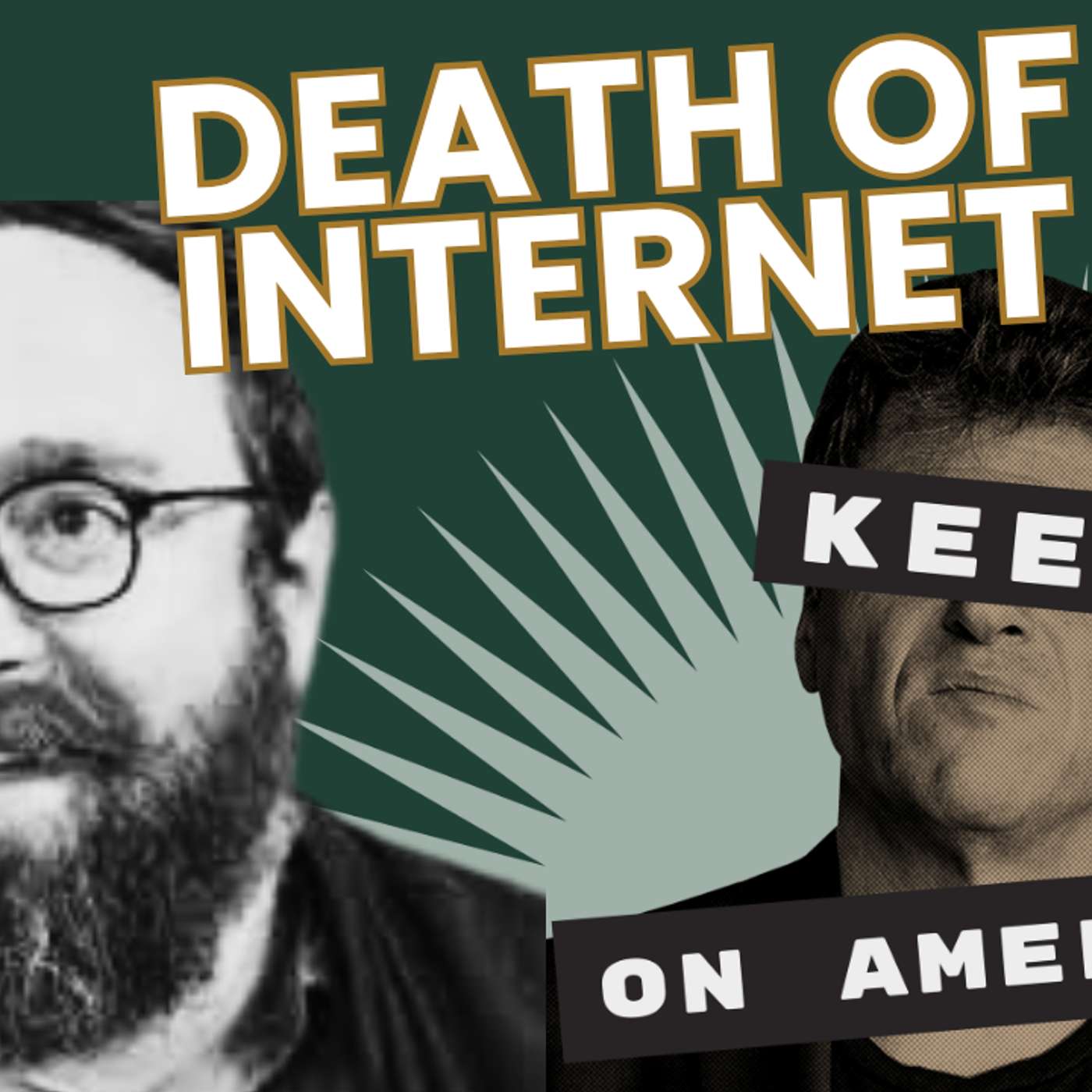


“We have deluded ourselves into thinking that we are as gods, and we are not.” — John West
Back in 2006, at the height of Web 2.0 optimism, Time made YOU person of the year. The user-generated technology of the internet, Time implied, would make all of us into digital gods of memory and forgetting. Twenty years later, the script has been totally flipped. Now we know that the internet is all-too-human. And so are we. This reminder of our mortality is the heart (if that’s the right word) of the new book by John West, the double Pulitzer Prize-winning Wall Street Journal computational journalist.
West’s The Internet Will Die, and So Will You is a kind of digital memento mori. His argument is metaphysical rather than political. Offline, he writes, our lives are marked by constraint. But we mistake the internet’s destruction of physical distance for limitlessness. “We have deluded ourselves into thinking that we are as gods,” he reminds us, “and we are not.” A Christian and a digital deconvert (not an uncommon combination in the technocrati), West wants us to import our mortality online. If we recognize that the internet will decay and finally die, he suggests, we will make it human. (Re)Make it, as us.
I’ve been making a version of this argument since The Cult of the Amateur in 2007. Only West’s version — by contrasting Bach, Ecclesiastes, and Mary Oliver with the infinite scroll — is more poetic and musical. Politer too. Noli timere, as the poet Seamus Heaney texted before he died. Be not afraid. Of life, of death. But beware of YOU. Be afraid. Timere. Very afraid.
Five Takeaways
• We Are Not Gods. The book’s thesis: offline life is marked by constraint — you cannot talk to people farther than you can shout, or hug your child while she’s at school — while online we act at a distance and mistake that “foot-loosening technology” for limitlessness. “We have deluded ourselves into thinking that we are as gods, and we are not” — the AI singularity being the theological version of the same delusion, and “a recipe for disaster, both interpersonally, but also within ourselves.” The fix is not logging off but bringing our mortality online: “this is where we live,” and the Internet’s magic only stays magical when tempered by limits — “in order for it to be magical, we need the flip side, which is that it can’t always be magic.” Andrew’s frame: in 2006, Time made YOU person of the year, promising digital gods of memory and forgetting. Twenty years on, the internet is all-too-human — and so are we.
• The Deconvert’s Meditation. “No one is more strident than the convert or the deconvert.” West’s digital utopianism began in a middle-school computer lab, where an unhappy kid discovered he could find friends and communities online — and it died by monkey’s paw: the same mechanism that found him anime fans now routes lonely kids into pro-anorexia TikTok rabbit holes (his own Journal colleagues’ reporting) and neo-Nazi forums. “That supercharging is something that I wished for.” He concedes the lineage Andrew has worked since The Cult of the Amateur (2007) and The Internet Is Not the Answer (2015) — and goes further: “I actually think largely, Plato and Postman were right.” Culture must metabolize its technological ruptures. Or, per the Freudian slip Andrew gifted back to him for the next book: its raptures. Andrew’s verdict on the lineage: the same argument, more poetic and musical. Politer too.
• A Few Thousand Weeks. On the Luddite summer, West channels past guest Brian Merchant: hatred of technology is usually hatred of lost control. The backlash against AI data centers is about being “completely removed from democratic control over that technology,” and the marketing — a magic box that will take your job — has backfired predictably. His arithmetic of dignity: we get only a few thousand weeks on this earth, and “our dignity demands that we have some say over what we do with our lives.” He cites Freddie deBoer’s Copernican principle — everyone believes they live at history’s hinge — then breaks it honestly: “but I also think this time, it might be right,” the elder millennial awestruck at the rupture he came of age inside.
• Religious, Not Spiritual. West inverts the modern chestnut: “everyone says they’re spiritual and not religious these days. I actually think it’s important to be religious, and spiritual can take it or leave it” — religion being “a powerful technology” for binding people into the civic fabric. His Christianity runs to liberation theology: not storing up treasure for the glorious day, but making this world more just now. Hence Bach cantatas, Ecclesiastes, and Mary Oliver as the book’s unnamed philosophies — and hence his verdict on the billionaires who struggle with finitude: it doesn’t shock him that men who earn millions while sleeping believe themselves gods, since “every dollar is like a little Iago whispering poison into the ears of the Silicon Valley elite.” The advantage belongs to us mere normals, unburdened by the whispering.
• Noli Timere. The Latin on West’s X page — be not afraid — was Seamus Heaney’s last text message, sent by SMS before the surgery he didn’t survive, then carried by the Internet to thousands who found hope in it. That, West argues, is the network at its best: “it is about how you spend your time on the Internet, not what you can do on the Internet.” On memory, his formula is to remember “not more and not less, but rather differently” — choosing what we remember (the Odyssey’s oral re-membering, retold body to body) rather than having it forced on us (the red solo cup photos, the traumas that refuse processing). The great mismatch of the web: “the things that we think should be permanent are often the things that are the most impermanent online, and the things that I really wish would fade away are the ones that refuse to.” Andrew’s send-off inverts Heaney: be not afraid — of life, of death. But beware of YOU, the ultimate human conceit. Timere. Very afraid.
About the Guest
John West is a writer and technologist. He reports the news with code at The Wall Street Journal, where his work has won multiple awards, including two Pulitzer Prizes. The Boston Globe called his first book, Lessons and Carols: A Meditation on Recovery, “lyrical and crystalline.” He holds an MFA from the Bennington Writing Seminars and degrees in philosophy and music performance from Oberlin College, and lives outside Kingston, New York, with his partner, children, and unruly cat. The Internet Will Die, and So Will You (Here Below, September 10, 2026) is his digital memento mori.
References:
• The Internet Will Die, and So Will You: On Learning to Live in Our Digital Age by John West (Here Below, September 10, 2026).
• Lessons and Carols: A Meditati...
00:31 - Introduction: a nation of Luddites?
02:30 - The magic box that takes your job
03:40 - No Internet, no AI: one continuous story
04:30 - Talking to databases: computational journalism
05:09 - A better way to be online
06:19 - Foot-loosening technology and the illusion of no limits
07:52 - “We have deluded ourselves into thinking that we are as gods”
08:45 - Mary Oliver, Bach, Ecclesiastes: a metaphysical book
10:34 - Magic needs limits
11:29 - Plato and Postman were right
12:33 - Rapture or rupture? A Freudian slip
13:05 - deBoer’s Copernican punditry — but this time it might be right
14:30 - The deconvert: from computer lab to monkey’s paw
16:21 - Supercharged: the rabbit holes he wished for
17:54 - The old order’s crack-up
19:25 - Religious, not spiritual
19:56 - Billionaires and finitude: every dollar a little Iago
22:25 - Luddites and lost control: a few thousand weeks
23:47 - Noli timere: Heaney’s last text
26:09 - Liberation theology: heaven here on earth
26:57 - Remember differently: Wikipedia rots, red solo cups remain
29:05 - Moana, not the Odyssey
30:16 - The Internet will forget, and so will you
00:00 -
00:00 -
00:00:31 Andrew Keen: Hello, everybody. As this long, hot summer of 2026 finally comes to an end, it'll probably be remembered by historians as the moment when America became a nation of Luddites, at least according to The Wall Street Journal. It's not just the left that turned against technology. It's the right too. Even January 6 organizers are going against AI. Jill Lepore, perhaps America's most distinguished historian, believes now that the next election, 2026 certainly, 2028, will be fought over AI. Ed Luce, another excellent observer of, America writing in the Financial Times, believes that AI phobia or technophobia is America's new consensus. It's even plunged the book industry into utter chaos, although my sense as an author is that the industry's always been in a bit of chaos. What the industry, though, continues to churn out are books which reflect and perhaps cause our suspicion with technology. John West writes for The Wall Street Journal. He's won two Pulitzer Prizes, and he has a new book out in a few days. It's called The Internet Will Die, and So Will You: On Learning to Live in Our Digital Age. John is joining us digitally, of course, from Kingston, New York, a lovely part of the Hudson Valley. John, congratulations on the upcoming book. You've had a front seat on America's digital revolution, as a digital correspondent, so to speak, of The Wall Street Journal. Why is America, in your view, John, turned so sharply against technology?
00:02:30 John West: Well, first of all, thank you so much for having me on. To answer your question, I, you know, I will say I'm not much of a political pundit, but I can tell you about the kind of digital world. And I do think that, that if you look at the marketing surrounding AI, it's going to take your job. It's super powerful. It's going to hack into every company known to mankind. It's gonna replace us all. I don't think the— I think the marketing has been successful in some ways in terms of getting people to talk about AI, but I think it's also, maybe backfired a little bit in the sense that if you tell people it's— there's a magic box that's gonna take your job and, potentially, lay everyone off, I'm not surprised that people would be upset about that.
00:03:13 Andrew Keen: The subtitle of your book is, learning— on learning to live in our digital age. This so-called AI age, it doesn't seem to me to be dramatically different from the Internet age. The title of your book is The Internet Will Die. I'm assuming that AI will die too. Do you see the AI and the Internet as part of some sort of continuous narrative?
00:03:40 John West: I do. I mean, you know, if you look back at the history of kind of how we got here, there were two components that needed to happen. One was you needed that— one was you needed to have processing power sufficient to create the AI we have today, but you also needed vast amounts of natural language and images and videos all posted somewhere where people could get them. Without the Internet, we would not have the AI boom that we have today. I mean, like, we wouldn't have the vast repositories of natural language and images and videos that we've collectively put online as a human species.
00:04:12 Andrew Keen: So why the book, John? As I said, you won a couple of Pulitzers for The Wall Street Journal. You mostly work from your desk in Upstate New York. You're— what you told me before we went live. I can't remember. What exactly is your title at the Journal? Or what—
00:04:30 John West: Yeah. I'm a computational journalist. I believe I'm actually technically a software engineer is my title at the Wall Street Journal. But, but what I do in my day to day is computational journalism. So I report the news, but instead of talking to people, I talk to databases, and I write code, and I write custom software, to help other reporters kind of comb through large corpora.
00:04:51 Andrew Keen: So is this book a kind of therapy for yourself? I mean, you're a computational journalist. You sit in front of your screen all day, writing about databases. The title of the book, The Internet Will Die, and So Will You, is it a note to yourself?
00:05:09 John West: I mean, definitely. I did write this book as a— therapy might be too strong a word, but I did write this book as kind of a way of understanding for myself, and hopefully, that is illustrated for other people. What is a better way to be online? This is where we live, and I think that when we bring into that world the kind of, hopefully, wise, full, you know, understanding that we are mortal and the things we do are mortal and that so much of the Internet while being, kind of constructed to elide that fact, if we're able to bring that awareness of our own mortalities online, I think we'd have a better experience.
00:05:46 Andrew Keen: So it's a book, a manual, maybe for living better online, living more mortally. Are you suggesting, John, that the kind of person who goes on, I don't know, TikTok, for example, or uses Instagram, Instagram captions, thinks of themself as immortal. What's so— what's so immortal, at least, in the minds of Internet users, about this digital world?
00:06:19 John West: Our lives offline are marked by constraint. I cannot, when I'm not, on my phone, talk to people farther than I can shout. I can't touch people's, you know, touch my partner if she's far away. I can't hug my kid if she's at school. But when we're online, I can get pictures of my kids sent to my phone. When I'm, when I'm online, I can talk to strangers all across the world. And I think that there's this illusion that we have that the— that kind of foot-loosening technology, that ability to act at a distance means that we are without limits. So when we write that Instagram caption that goes out to thousands of people, we're kind of undermining what we've learned in our offline worlds that we have these constraints. And as we're watching hour upon hour of TikTok, we're kind of missing the fact that human creativity plugging directly into our brains, is— isn't something that we can just get all the time. And I think that, like, that is what I mean by living within— living when in the awareness of our mortality. It's also living within the awareness of our constraints and our frailness.
00:07:26 Andrew Keen: So, your previous book that came out in 2023, Lessons and Carols: A Meditation on Recovery, continues in this kind of vein, or perhaps, this new book continued in that vein. Are you reminding us that we're not gods? Is one of the conceits, so to speak, of the Internet that it makes us feel sometimes as if we are gods?
00:07:52 John West: I think that's exactly right. Yeah. I mean, I, you're putting a very fine point on it, which I appreciate. I tried to avoid in this book, I don't know, being too moralistic. But I do think that there's a—
00:08:05 Andrew Keen: We can be moralistic here, John. I encourage you. You're allowed to be moralistic on my show.
00:08:09 John West: Thank you. Yeah. I know. I do think that, like, that, like, we have deluded ourselves into thinking that we are as gods, and we are not. And, you know, whether it's the kind of belief that we have created in AI singularity that will have this kind of, artificial superintelligence or what— you know, whatever the term of art is now, or whether it's, you know, we can, we can interface with the entire world online and without, without kind of constraint or pause. I think that is a recipe for disaster, both interpersonally, but also within ourselves.
00:08:45 Andrew Keen: And has this been, you know, your book is very far-ranging. It's not really a manifesto. It's more, as I said, a meditation goes from everything from, discussion of the great American poet Mary Oliver, Bach cantatas, commentary on Ecclesiastes to commentary on the modern Internet. Is this in a way, a metaphysical book?
00:09:15 John West: I do think that I was eager to engage widely with the philosophies that have shaped me, and I also eager to engage widely with the philosophies that I think should— that stand behind some of the things that we do online, but often are unnamed. So I think that, you know, the lineage of— the biblical lineage that I draw on or the lineage of Western— the Western canon of music that I draw on, all of those things, I think, do shape the world that we live in today, but we often don't remark on them. And I hope that this book is accessible, but also, you know, maybe drawing attention and pointing at some of the humanistic forces that still operate and still could be called upon to offer wisdom as we go forward.
00:10:01 Andrew Keen: So I'm struck with two things, John, you seem to be suggesting going on simultaneously. On the one hand, we have this new technology that gives us the illusion that we're gods, that we can communicate instantly. We can do things which our ancestors would have believed was magic. And on the other hand, the reality of this world is of, increasingly all too human existence. Is the gulf between those two why we're not very lit— why we're not living very well in our digital age?
00:10:34 John West: I think that's exactly right. Yeah. Like, I think it is precisely the degree to which we're able to accept our own limitations and our own mortality, that we're able to craft a world that is actually fit for human consumption and fit for human life. You know, I oftentimes think about— there's this— the magic of the Internet is wonderful, but, also, when it's untempered by our own limitation, when it's kind of, like, just the magic, it actually loses its sheen. And I think in order for it to be magical, we need the flip side, which is that it can't always be magic.
00:11:08 Andrew Keen: But, again, coming back to the fourteen-year-old who uses TikTok or the marketing exec who uses Instagram captions, do they really believe that they're immortal? Aren't they just having fun in the same way as kids in the fifties and sixties watch television?
00:11:29 John West: Yeah. I mean, I think, you know, there are these arguments that go back to say, like, well, we've had television— or, you know, we've had these other large technological upheavals and raptures— ruptures. And with those, like, aren't you just kind of recapitulating these old arguments, about, you know, whether it's Postman arguing that TV is gonna amuse us— we're all gonna amuse ourselves to death or Plato even saying that writing is gonna make us all forgetful and that foot-loosening technology would also have these problems. And I actually think largely, Plato and Postman were right. It's all about having culture be able to metabolize those changes and those ruptures. So I do think that, yes, it is the case that people who are 14 have fun on TikTok, and I think it's the case that marketing executives, I don't know if they're having fun on Instagram, but they're definitely using it. I think that while that is true, it is also true that we need as a society to develop the antibodies that enable us to kind of— maybe antibody is the wrong word. The metabolism to be able to kind of imbibe that stuff without it poisoning us.
00:12:33 Andrew Keen: It's funny, John. You perhaps made a little bit of a Freudian slip. You wanted to say rupture, and you said rapture. I think Neil Postman will be turning in his grave, probably Plato too. Aren't ruptures and raptures really the same thing? Or maybe if you live in a, shall we say, a raptural age, you're, by definition, gonna be raptural too. Is that fair?
00:13:00 John West: I really like that. I—
00:13:03 Andrew Keen: You can have it. You can— for your next book.
00:13:05 John West: Thank you very much. Yeah. I mean, I think, like, the apocalypse, the end of something is also the start of something new. And, you know, I'm wary sometimes of— I don't know. There— there's a critic online, Freddie deBoer, who says that, he wants to bring back the Copernican principle in punditry, and his argument is that everyone thinks that they live in the most important moment in human history. And no one says, you know, no one says, well, this moment's actually not that important or not that big a deal. So every new technology has to be world-changing. Every new political movement has to be—
00:13:39 Andrew Keen: Yeah. Every election, we did a show yesterday on Abraham Lincoln and the election of 1860, which, of course, was one of the most important American elections in history. But every election, including 2024 and 2028, will be considered the most important election in history.
00:13:54 John West: That's right. And I think that, like, I'm wary of that. But I also think, you know, I also think this time, it might be right. You know? I think that these technologies, these digital technologies have completely reshaped human society. And maybe that's true of every, you know, of Gutenberg and television and all the rest, but it's hard to live in this moment and especially as a millennial, kind of an elder millennial who really came of age right at that moment when we started shifting into this new world and not just be a little bit, awestruck at that rapture, that we're all going through.
00:14:30 Andrew Keen: John, I've been warning people also about the dangers of digital. I had a book in 2007 called The Cult of the Amateur, which caused a great deal of upheaval in Silicon Valley. Then, back in 2015, I had a book called The Internet Is Not the Answer, which covers some of the same ground as what you're describing, though it doesn't, of course, address AI. I was writing to digital utopians— or I was writing against digital utopians, and there was an interesting— there's been an interesting conversation over the last twenty years. Were you once a believer? Is there an element of disappointment, almost regret in this book, The Internet Will Die, and So Will You. It may not be therapy, but it's a kind of, meditation on disappointment, on expecting something, perhaps too much of being— being brought down to earth, so to speak.
00:15:27 John West: Yes. I do think that no one is more strident than the convert or the deconvert. So, you know, when I first, became a digital utopian, I think it was in middle school when I was sitting in my computer lab learning how to code and realizing that I could talk to anyone online and make friends online and find communities online, which I did. And I think that, you know, without getting, you know, too into the weeds, I didn't have the happiest middle school experience. I didn't have the happiest high school experience. And the Internet was kind of a way for me to escape and find a different world. And so I really did think, well, this is how we're gonna do it. And then, of course, that faded, as I think that the early promise of the Internet was never really fulfilled, or it was fulfilled, but kind of in a curse of the monkey's paw style. The things that we thought we wanted turns out to be actually not that great for us after all.
00:16:17 Andrew Keen: Could you talk a little bit more about that? What sorts of things?
00:16:21 John West: Sure. So I think, you know, we think to ourselves, well, wouldn't it be great if every lonely kid could find a community online? But then some of those communities are neo-Nazi groups or some of those communities— Some of my colleagues at the Journal. did an amazing bit of reporting about, filter bubbles on TikTok and finding that you were able to get rabbit holes into, for example, pro-anorexia communities on TikTok very easily. Now that is terrifying to me and exactly the kind of thing that— the same mechanism that enabled me to find fans of anime in middle school and high school is the mechanism that enabled people to find pro-anorexia communities on TikTok. It's just been supercharged. And I think that supercharging is something that I wished for. And now that I see the results of it, which isn't just sad lonely kids can find happy communities, but sad lonely kids can find communities that make them angry and malcontent. You know, I think that's something to be worried about.
00:17:17 Andrew Keen: You said earlier that you're not a political writer. I take your point. You mentioned Freddie deBoer earlier as well, who is quite a political writer. Does some of what you're writing about, and warning about in The Internet Will Die, and So Will You, is it a warning about the limit— the limits of liberalism and the way you present it, those early days where everyone could be free and realize themselves and find their own community. Is that not really a technological problem, more a problem of the, as I said, the limits of liberalism and individualism?
00:17:54 John West: I do think that— I think that the old— I think that the old order is under a crack-up. I think that anyone, looking at the world right now would probably pretty much agree with that, whether you're on the left or on the right. That, that the kinds of ideologies that we thought were going to be pretty stable have not been. Now whether or not liberalism, small l liberalism, is having a crack-up or not, I, you know, I don't know if my book was directly attacking that. I do think that my book is in conversation with a lot of thinkers who say that the kinds of schemas that we have operated within the twentieth and early twenty first centuries are no longer applicable. Whether it's someone like Ross Douthat— whose book I [unclear] widely— or someone like Freddie deBoer, for that matter, who I think also would say that liberalism, small l liberalism is, not as, hegemonic as it used to be.
00:18:55 Andrew Keen: You mentioned Ross Douthat, of course, the Roman Catholic columnist at The New York Times— a former columnist. Now he's gone over to 60 Minutes. He wears his religiosity on his sleeve. Is there something religious about this text, John? Absolutely. [ed.: possible guest interjection — verify by ear] The Internet Will Die, and So Will You: On Learning to Live in Our Digital Age? Can we live without religion or without maybe your version of religiosity?
00:19:25 John West: I mean, I'm a Christian, and that comes through, I think, in the book, but I hope that the book remains accessible to people who aren't Christians. I do think that there's a— you know, not to do this whole chestnut again, but, you know, everyone says they're spiritual and not religious these days. I actually think it's important to be religious, and spiritual can take it or leave it. The important thing is about binding yourself into the civic fabric of community making, and religion is a powerful technology to do that.
00:19:56 Andrew Keen: Your book focuses on what you call the illusion of permanence. It's hard to recognize one's own impermanence, isn't it, John? I mean, the Silicon Valley billionaires and trillionaires, the Peter Thiels of the world struggle with it, so we should too.
00:20:18 John West: I mean, I do think that, it's easier for a rich man to pass through the eye of a— or easier for a camel to pass through the eye of a needle than a rich man to get into heaven. I think that might be true. I also think it's possible that, that the more money you have, the more you have that illusion of control in your IRL life, the more that you will think of yourself as a god. It doesn't surprise me that someone who makes, you know, millions of dollars while they sleep believes that they can shape their world. I mean, they can shape their world around them much more than you or I can, and certainly more than, you know, the billions of people on earth who don't make billions of dollars. So I guess, like, I think that the fact that Peter Thiel or whoever else, pick your billionaire struggles with, with their own finitude, doesn't really shock me. And I actually think that we have an opportunity, those of us mere normals, to— maybe to— we don't have that burden of that money, telling us, no. No. No. You can do it. Like, they're all that— all those little— every dollar is like a little Iago whispering poison into the ears of the Silicon Valley elite, I do believe.
00:21:34 Andrew Keen: I take your point, John. Although, on the other hand, of course, we've done many shows on how we're living longer and longer, and people over 60, 70, 80, 90, increasingly a larger part of the population. So that's a reality, isn't it? I mean, we may eventually die, but we're living longer, and we can thank technology for this. Should we be a little careful? I'm not accusing you of this. I mean, you're the computation— you're a computational journalist at the Journal. But is there a danger that all this is gonna turn us into rampant Luddites with just a loathing for technology when, in fact, we know that technology might be on the brink of curing cancer, of sending us up into space, of allowing us to live much longer without awful diseases.
00:22:25 John West: Yeah. I think, you know, Luddite is a word, you know, to paraphrase Brian Merchant's argument from his excellent book—
00:22:34 Andrew Keen: Brian's been on the show a couple of times.
00:22:36 John West: Yeah. I mean, I think he's done, great work in recasting that word. The hatred of technology is oftentimes bound up in, the hatred of a loss of control or a loss of say. I think that one of the reasons why you're seeing this backlash to the AI data centers, to get back to the very first question you asked me, might very well be that people feel completely removed from the process, completely removed from democratic control over that technology. Now I think if it were marketed not quite so aggressively as something that's going to take your job, maybe it would be different. But I also think if we had a real way to shape, you know, shape the technological future that we wanted to live in, I think people might feel that control and that autonomy might be helpful. I mean, like, we have only, what, a few thousand weeks, on this earth whether we are living into our eighties or not. And I think that it— like, people really feel when those weeks are gonna be spent doing things that they would rather not do or not have choice over what they get to do with those weeks. That our dignity demands that we have some say over what we do with our lives.
00:23:47 Andrew Keen: Haven't used the A-word yet, but it seems to, seems to run through your book. The word, of course, is agency. On your X page, you have a Latin phrase, noli timere, which means—
00:24:06 John West: Be not afraid.
00:24:07 Andrew Keen: Be not afraid or do not be afraid. Is that how we get agency, John? Human agency in our age where AI and the Internet seem to be at least challenging it, if not replacing it? It's harder and harder even to distinguish between a bot and a human being. Is human agency about overcoming our fear?
00:24:29 John West: I— you know, that's a fascinating way of looking. I do think that the reason I have that on my X page, it's a quote from— well, it's a quote from many places, including the Bible, but also Seamus Heaney, the acclaimed poet and playwright and translator from Ireland who— his last text message before he went under into the surgery that he would not come out of was noli timere. And that text message was sent via SMS, and it was then sent via the Internet to all these people who found hope in that message, from this great thinker and this amazing artist. And I think that recognition that there are worse things than to have a life be over, that it would be better to— that if you live your life well, having that life come to a close is not something to be scared of. I think that is the message of the Internet that would make our Internet, experience better as well. If we were able to recognize that it is about how you spend your time on the Internet, not what you can do on the Internet, I think that would be a healthier place for us to be at.
00:25:36 Andrew Keen: You said, though, earlier that you are a Christian, although it doesn't necessarily define your work, or the arguments in it in The Internet Will Die, and So Will You. But Christians, and, again, correct me, please, if I'm wrong, I'm not a Christian. Christians believe that this life will be followed by something else. So, in a way, the impermanence of the Internet might be seen as a Christian design, as a way of getting us ready for something more eternal.
00:26:09 John West: I really like that a lot. This— in the strains of Christianity that I'm most obsessed with, in the Catholic circles, would be liberation theology. But the idea basically is that we have an obligation to make this world a more just place, to bring heaven here on earth. I find that deeply moving and deeply affecting that our struggle is not to set up our life for this future thing that— the future, you know, glorious day when we all are risen, but rather to focus on the here and now and to make the world we live in now a better, more just, more happy place, more spiritual place. And I think that calling is— does animate the book, although I don't think— I do really hope that, and I don't wanna stress this. You don't have to be a Christian to read my book. Yeah.
00:26:57 Andrew Keen: And when I saw the title, The Internet Will Die, and So Will You, it occurred to me, and you've written about this, many others have as well, is that the Internet was originally presented to us as a place that would never forget anything. And, of course, in a sense, there's a dystopian quality there because it reminds us of Orwell and cameras everywhere. But I think what you're suggesting is that the Internet is as impermanent as anything. I mean, old websites like America Online and Yahoo seem to be going away. So what's the role of memory in your argument? Should we remember more or less to be human? Does it require us— I mean, what would— I don't know. Mary Oliver, I know you're a big admirer of her work, and you write about her in your book. What would the poets tell us about memory and its centrality in the human experience? Should we remember more or less? And is the Internet, again, a delusion, an illusion, a false hope, a promise, a seduction?
00:28:01 John West: I think it— I think we should remember not more and not less, but rather differently. And what I mean by that is I think we should remember the things that we choose to remember as opposed to remembering the things that are forced upon us. So I think about this in the sense of Homer, right, in the Odyssey. The reason it was an oral tradition that caused us to remember that story again and again, and now it's the retranslations and the reprintings and the making movies that enable us to remember that story. Remembering is a bodily activity in some ways. It's about things that we do together as a species. And I think that, like, on Facebook, I don't know if I want to remember those red solo cup pictures from high school. I don't know if I want to remember, you know, my—
00:28:41 Andrew Keen: You know you don't. I think most of us certainly don't wanna remember those sorts of things.
00:28:45 John West: Yeah. And on the flip side, you know, we're seeing real problems with Wikipedia not being able to keep its web of citations intact. And so the things that we think should be permanent are often the things that are the most impermanent online, and the things that I really wish would fade away are the ones that refuse to. And I think it's that mismatch of, like, we're not remembering what we want to really remember. I think that is the problem.
00:29:05 Andrew Keen: Did you see the Odyssey?
00:29:07 John West: I actually haven't. I used my— I have a six-year-old daughter at home, and I used my, movie ticket to go see the, live action Moana. So that's where I'm at.
00:29:16 Andrew Keen: Yeah. I went to Spider-Man with my [unclear], although she's older than six. The reason I bring it up is because, of course, it's a movie and a book or a poem about refusing to forget.
00:29:29 John West: Yeah. I think that's a— I wish I made that point. Yes. That's a great point. And I also think that, you know, that so much of what we remember is bound up in those questions of agency. Right? Like, if you think about, I don't know, like, even the word remember. Right? To member something, to put it in the body, to do that again and again. I just think that, like, what we remember is oftentimes, the traumas that we— that we suffer are things that we cannot help but remember. I mean, one is PTSD, but the constant recollection of things that we are unable to process and work through. I don't know. I think that there's really something to this idea that remembering and agency go hand in hand in the world that I wanna live in.
00:30:16 Andrew Keen: Well, there you have it. John West, the author of The Internet Will Die, and So Will You. Maybe it could have been renamed, John: The Internet Will Forget, and So Will You. Everything will be forgotten about us, which reminds us of our mortality, an important book, an important, daring argument by the Washington— Wall Street Journal's computational journalist, winner of two Pulitzer Prizes. John, real honor to have you on the show. The book is out in a few days. I'm sure it's gonna be a big hit. Thank you so much.
00:30:44 John West: Thank you.