The Banality of the Deal: Casey Michel on the United States of Oligarchy
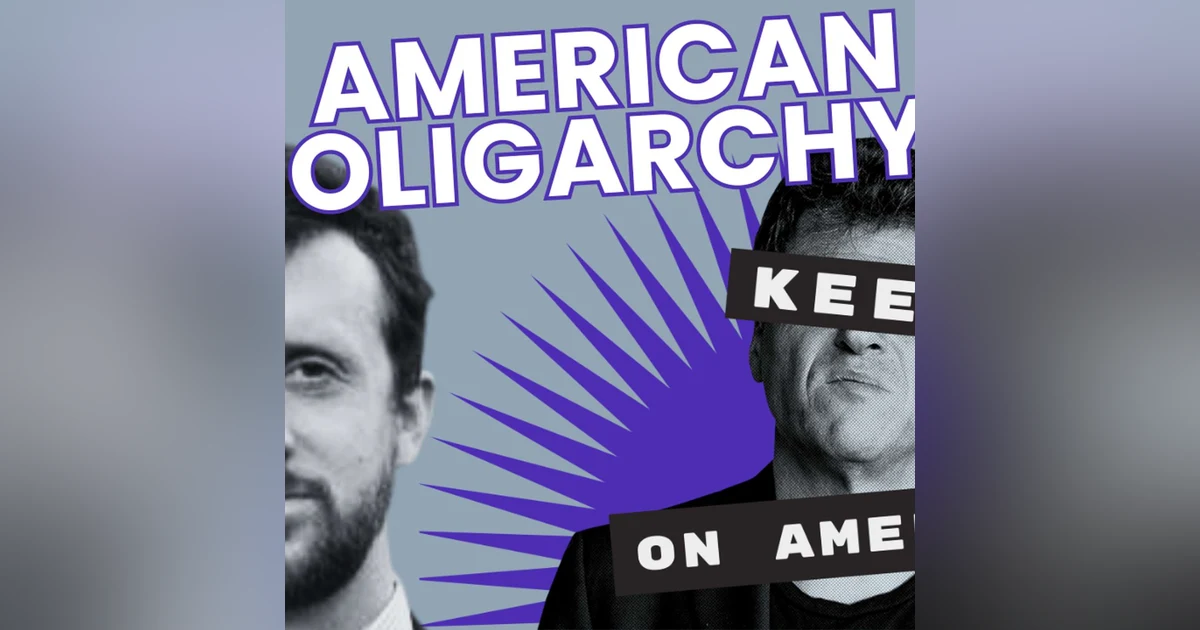


“Jared Kushner is one of the most powerful American diplomats of the twenty-first century — and he has no skill set to speak of that I can see.” — Casey Michel
Four years ago, the muckraking journalist Casey Michel came on this show to discuss how the United States has built the greatest money-laundering scheme in history. That pre-Trump 2.0 America, he says, looks quaint. His new book, United States of Oligarchy: How America’s Wealthiest Ally with Dictators, Weaken the U.S., and Destroy Democracy, describes an American casino where the Trump family has become the dealer with a perennially stacked deck.
The word “oligarchy” comes with 2,500 years of baggage. Aristotle, not averse to aristocracy, nonetheless warned of the rule of the few. Teddy Roosevelt preferred “plutocracy” as a way of describing the baronial rule of the late 19th century American capitalists. And, of course, it took a Roosevelt — the sickly scion of upper-crust New York — to dilute his own oligarchic caste with anti-trust law and inheritance & progressive income taxes.
Exhibit A in this American oligarchy is Jared Kushner, who has leveraged his father-in-law’s rotten casino to ally with dictators and destroy democracy both in America and around the world. Michel says Kushner has “no skill set to speak of” — apart, of course, from an insatiable greed for wealth and power. The banality of the deal.
So what to do? Michel is waiting for a 21st century Teddy Roosevelt — he names Talarico and Ossoff — who will tax and perhaps even prosecute Kushner and his fellow oligarchs. But I fear he is waiting for Godot. Teddy isn’t coming back. Nor is FDR. Don’t expect the banality of the current highly lucrative deal to end anytime soon.
Five Takeaways
• Child’s Play. The anonymous shell companies and mystery donations of American Kleptocracy — dire enough in 2022 — now read as quaint. The scale has exploded (crypto, prediction markets, AI as accelerant), and so has the shamelessness: a Qatari luxury airliner gifted to a sitting president, and a $1.8 billion slush fund that will compensate January 6 rioters while granting Trump’s family, inner circle, and “associates” carte blanche from tax audits, past and future. America has had corrupt administrations — Grant, Harding, Nixon — but nothing, Michel argues, on this magnitude. Trump himself is symptom rather than cause: the culmination of trends decades in the making. “Shameless does not begin to describe it. I have to laugh — otherwise, I’m sure I’d just be crying.”
• From Aristotle to the Trillionaire. Aristotle popularized oligarchy: rule of the few — who must also be the wealthiest. Teddy Roosevelt preferred “plutocracy,” and the Founders fought over “aristocracy”; Michel meets the 2020s where they are. The through line he found in the research: America’s anti-oligarchic champions come from inside the elite — above all TR, the sickly, bloodlet, electroshocked child of upper-crust New York who grew into the singular force against concentrated wealth: inheritance tax, progressive income tax, and a bully pulpit used without apology. Today’s benchmark: Gilded Age fortunes — Rockefeller’s $30 billion in modern terms — are pocket change beside centibillionaires and America’s first, briefly minted trillionaire.
• Exhibit A: Jared Kushner. One of the most powerful American diplomats of the twenty-first century — Israel and Gaza, Russia and Ukraine, the Gulf — with, in Michel’s judgment, no skill set to speak of: a string of failures from 666 Fifth Avenue to the New York Observer, redeemed by the single best thing he ever did, marrying Ivanka Trump. MBS bragged Kushner was “in his pocket”; James Comer told an intermediary to tell him to fuck off — making Kushner, Michel suggests, a genuinely bipartisan target for future investigations. Andrew pushed back — the network of autocrats is real, the Harvard degree is real — and the conversation settled on Arendt: not evil, but indifferent to good and evil. What Kushner cares about: Ivanka and her father, his bottom line, and carrying water for Benjamin Netanyahu.
• The Incentive Machine. Michel’s deeper argument indicts structures, not sinners: virtually none of this is illegal, which is precisely the problem. Corporate secrecy, campaign finance, and offshore taxation build an architecture in which allying with dictators is the rational move — if your competitor will meet MBS or Xi, you must too. Hence the corporate class’s standing ovation for Xi Jinping in San Francisco; Google’s Project Dragonfly censorship engine; Musk’s Tesla leverage in Beijing (and DOGE actions conspicuously in Chinese interest); the NBA’s progressive branding beside its Rwandan and Emirati partnerships; and Ireland, the thriving democracy at the bottom of the tax-haven barrel. Michel is happy to call the CCP one of history’s most monstrous regimes — and to note that no ideology, only rank financial interest, lays American CEOs at its feet.
• Waiting for Teddy. Does oligarchy actually weaken America? Michel points to the Iran war’s aftermath — collapsed interceptor stocks, an intact Tehran regime, Gulf monarchs getting their dirty business done at American expense — plus Greenland threats, wobbling alliances, and the nuclear proliferation he expects among abandoned allies. Andrew pressed the counter-case three times: Wall Street at record highs, half of America holding retirement accounts. Michel’s answer: inequality beyond anything in the national experience — and a political moment, left and right, hungry for anti-oligarchic leadership. The GOP just moved to kill the shell-company database; the remedy is a twenty-first-century TR — a Talarico, an Ossoff — willing to be denounced as a communist agitator. “If Teddy Roosevelt can be, I suppose anyone can.”
About the Guest
Casey Michel is an author, investigative journalist, and director of the Combating Kleptocracy Program at the Human Rights Foundation. He is the author of American Kleptocracy — named by The Economist one of the best books for understanding financial crime — and Foreign Agents, and his writing on offshoring, foreign lobbying, and illicit wealth appears in The New York Times, Financial Times, The Atlantic, and Foreign Affairs, among others. He has testified before the Senate Judiciary Committee on illicit financial networks and national security, holds a master’s from Columbia’s Harriman Institute, and is currently sanctioned by the Russian regime for his work. United States of Oligarchy (St. Martin’s Press, August 4, 2026) is his third book.
References:
• United States of Oligarchy by Casey Michel (St. Martin’s Press, Augu...
00:31 - Introduction: four years after American Kleptocracy
01:42 - Child’s play: what’s changed since 2022
03:59 - What is oligarchy?
06:05 - Oligarchy, plutocracy, aristocracy
04:44 - Aristotle’s word: the few — and the richest
08:29 - A civil war within the elite
09:05 - The sickly child: how TR turned on his caste
11:38 - Exhibit A: Jared Kushner
13:12 - Born on third base — or smart?
16:11 - Indifferent to good and evil
19:27 - “Go tell Kushner to fuck off”
20:30 - The Epstein class and dark bipartisanship
22:37 - How central is Putin now?
25:00 - Is America actually weakened?
26:18 - Interceptors, Greenland, and the coming proliferation
28:27 - Doing the Gulf’s dirty business in Iran
30:47 - Standing ovation: the corporate class and Xi
33:37 - Don’t be evil? Google, Brin, and Project Dragonfly
35:58 - No crimes committed: the incentive machine
41:13 - The Wall Street question
45:29 - Trump: symptom, cause, or distraction?
45:29 - Trump: symptom, cause, or distraction?
47:26 - The slush fund and the Qatari airliner
48:20 - Waiting for Teddy: Talarico, Ossoff, 2028
52:57 - Thanks and goodbye
00:00 -
00:00:31 Andrew Keen: Hello, everybody. Back in January 2022, we did a show with Casey Michel, a muckraking East Coast journalist who had a book out back then called American Kleptocracy: How the U.S. Created the World's Greatest Money Laundering Scheme in History. Four years later, Casey has a new book out with an even more ominous title, United States of Oligarchy: How America's Wealthiest Ally with— how America's Wealthiest Ally with Dictators, Weaken the U.S., and Destroy Democracy. Over the last four years then, much has happened, and I'm thrilled that, Casey is joining us. Casey, what's happened over the last four years? [ed.: apparent false start — Andrew restarts the intro here; possible trim point] Even back in, 2022, at least according to, Casey Michel, the news was pretty miserable. You were reporting on American Kleptocracy. Since then, we've had the second version of Donald Trump. What's happened in America over the last four years?
00:01:42 Casey Michel: Hey, Andrew. Of course, it's great to be joining you today to be talking about some of these topics, including the, new book. There have been a few developments as I'm sure you and listeners are all perfectly familiar with. And it is funny to think about the late twenty tens and early twenty twenties when I wrote that very first book on the US's transformation into the center of international money laundering for as dire and dour as things were in the broader corruption and especially international corruption space at the time and its impact on American policy. It's funny to think that that seems a little bit like child's play at this point. The kind of things we were talking about then, some anonymous funding going to some real estate ventures connected to then president Donald Trump concerns about maybe a certain anonymous shell company being behind a certain donation to whether it was the sitting president or other politicians in the United States of America. And, of course, amidst the kind of broader concerns about campaign finance and who American politics is truly open to. Look. Those concerns were all perfectly valid at the time. I'm happy I wrote the book. I'm happy, of course, to have spoken with you about it then. But here we are in the middle of 2026, and things have changed considerably, not just in terms of the scope and the scale of what we're talking about, but also the kinds of technologies involved, the emergence of things like cryptocurrency, the emergence of things like prediction markets, of course, the emergence of things like AI accelerating so many of these things. But the real concerns about how corruption, both domestic and foreign, impacts and affects American policy, especially in Washington, but not only in Washington DC, that has only grown by magnitudes compared to where we were even just a few years ago. Frankly, it's funny how much can change in just a few years or if it wasn't funny. Maybe there's a different emotion.
00:03:25 Andrew Keen: Yeah. I was gonna call you on that. I don't think it's funny. I mean, some people might be amused, but others might be shocked, horrified, and very upset. Let's just repeat the subtitle of the new book, Casey. I didn't read it perhaps as clearly as I should have first time around. It's How America's Wealthiest Ally with Dictators, Weaken the U.S., and Destroy Democracy. So this is a book, at least according to its subtitle, about, quote, unquote, America's wealthiest. Who are these people?
00:03:59 Casey Michel: So the theme of the book is relatively simple. It's examining oligarchy, and it's examining what oligarchy is, how it operates, of course, how we got here in the United States of America and who we're actually talking about. One of the clear elements of the book that came through on my end in researching it is that there has been, not just for the last few years, not just for the last few decades, but thousands of years of contested elements of the definition of oligarchy itself. Frankly, we have none other than Aristotle to thank for that either.
00:04:29 Andrew Keen: Yeah. And we actually have an upcoming show later this month on, a new edition, a new translation of Aristotle's ethics so we can get into it then. So you're right. So this word oligarchy, of course, I don't think Aristotle invented it, did he? No.
00:04:44 Casey Michel: No. He did not invent it. He first popularized it about three thousand or so years ago, as well. [ed.: Aristotle lived c. 384–322 BCE, roughly 2,350 years ago] No. So he was the first one that it was generally associated with, and he was describing some of the kind of political typologies in addition to monarchy, democracy, and a few others. And, of course, he was commenting on Athens and Sparta at the time. And as he defined it, oligarchy, again, which he did not invent, but he first popularized, as he saw it, yes, it does literally mean the rule of the few, which is, of course, the root of the term itself. But as Aristotle also saw it, and this is where the confusion first set in, the kind of tension inherent to this term first set in was as he saw it, it wasn't just the number of people that you're talking about. They have to be the wealthiest of any given polity or state or nation or empire as well. So, again, Andrew, if you or I and a handful of others are running the United States of America at some point down the line, which who knows, maybe that will happen, that does not necessarily, at least in Aristotle's eyes, in all—
00:05:41 Andrew Keen: So let— yeah. So let's introduce a couple— throw another couple of words in here, maybe to confuse things a bit more. Aristotle, of course, was sympathetic in some ways to aristocracy. And another word that the Greeks invented was plutocracy. So what's the difference between oligarchy, aristocracy, and pluto, plutocracy?
00:06:05 Casey Michel: It's a great question. Plutocracy is one that is perhaps a little bit more accurate as it pertains to what Aristotle was attempting to define at the time. Plutocracy is a term that has seen prominence throughout American history. There's one of the figures that I write about in there, Teddy Roosevelt, as I describe him this kind of anti-oligarchic force, but he didn't use the phrase or the term oligarchy. He preferred to use the term plutocracy. And, of course, that literally means not just rule of the few. That literally means the rule of the rich. If anything, plutocracy might be a little bit more accurate to describe some of the phenomena that I write about in the book. But, look, you know, we have to meet the people where they are. It's the twenty twenties. Folks in the United States of America haven't seen plutocracy come back into vogue. It has been oligarchy that has come back into vogue. That is what we're talking about in the broader political discourse, and certainly that's what I wrote about in this book itself. Aristocracy is an interesting one because as you did just mention, there was an appeal to Aristotle. There's an appeal to many others throughout the broader pantheon of kind of democratic canon, even in the United States of America that have this idea that there is a certain class or caste of well-educated and, yes, generally well off, perhaps not the wealthiest, individuals and networks that should have access to at least the reins of political power, if not in perpetuity, then at least to kind of regular elections. And I think of things like during the founding when there was this, again, tension built in between those who were pro— proposing a House of Representatives and those who are proposing a state-based Senate system. The Senate being as, one of the, I believe it was James Madison described, the saucer that catches the hot water of the teacup that spills over. [ed.: the “senatorial saucer” anecdote is traditionally attributed to George Washington, in a likely apocryphal exchange with Jefferson] Things can cool once it gets to the Senate. And, again, the Senate not being elected by the broader populace, but by those who are already in office. It's kind of additional level of, if you'd like to use the term, excuse me, aristocratic approach. Now I think some of the founders would oppose using that term. We've seen Thomas Jefferson come out, for instance, opposed to the term, aristocracy. And that was in many ways what some of the early efforts against wealth inequality were aimed at. It wasn't aimed at necessarily oligarchy or plutocracy, but as they would describe it, aristocracy. So, yes, there's a lot of blending and melding of these terms. There's a lot of crossover. Of course, the term of art, the popular one of the twenty twenties being oligarchy.
00:08:29 Andrew Keen: It seems to me that the history of America is in part, if not a civil war within the elite. Certainly, conflict between people you mentioned Teddy Roosevelt earlier, then his distant cousin FDR and other members of the American elite. Is there some truth to that, Casey? Is the only way historically that America has been able to control its super rich, its plutocracy, is with the help or the guidance of guys like Teddy Roosevelt who himself, of course, was part of a kind of American aristocracy?
00:09:05 Casey Michel: It is funny, Andrew. There is a through line and, a pattern that you can see emerge throughout American history that it is those who come from sources of great wealth themselves, their families, etcetera, that are the ones that then turn their sights on those who are in the rest of their class or in the rest of their caste. And, again, the Roosevelt family perhaps being first among all of those in describing some of those phenomena. Of course, Teddy Roosevelt is someone that I was not expecting to write as much about in the book itself, but it was very clear that in the late nineteenth, early twentieth century, he emerged as truly one of the singular forces in American history, against wealth inequality. And, of course, he was someone who was from very much upper-crust New York City. His family was as wealthy as some of those others in the city in the mid to late nineteenth century, but Teddy Roosevelt had a, without psychoanalyzing him too much, a quite different upbringing than many of his other comparably wealthy friends. Of course, he was an incredibly sickly child who was subject to frankly horrific treatment, right, bloodletting, electroshock therapy, and the like. And I suspect that may have played a role in his views on what it is like to grow up without any kind of wealth to your name rather than enjoying all of those spoils, all of that lucre, and all of that wealth itself. He was stuck indoors mostly. He wasn't able to go out and play or buy or carouse, whatever it was. And so that gave him a little bit different vantage.
00:10:29 Andrew Keen: And maybe his distant cousin FDR after his terrible experience with polio dramatically changed. We did a show about that a few years ago.
00:10:39 Casey Michel: Yeah. Look. I suspect you're right. Yeah.
00:10:41 Andrew Keen: And I wonder whether maybe the equivalent of the Roosevelts today or at least in the twentieth century might have been the Kennedys. Anyway, let's get into the details. When we think about, how America's wealthiest ally with dictators, the one figure who comes to mind most, certainly for me, and I'm sure for many of our viewers and listeners, is a certain Jared Kushner. You've written about him extensively. You know as much about him as anyone. In fact, maybe you'll write a biography of him at some point. There is his, you've written about how he's making a lot of money out of what you call the mess in Iran. You've also written in Mother Jones about how all the different autocrats, especially in the Middle East, Eastern Europe, Africa go to Jared. Is he Exhibit A in terms of the United States of Oligarchy, Casey?
00:11:38 Casey Michel: Yes. Very much so. He's Exhibit A in a few ways, not only the kind of oligarchy in the United States of America and these, extraordinarily wealthy individuals gaining, certainly in their case, unprecedented power. I mean, Jared Kushner is one of, if not the most powerful American diplomats in the twenty first century. And, of course, almost entirely not due just to his wealth, but, of course, his relationship with his father-in-law, that being Donald Trump. And there is a reason that I selected him as one of the main figures in the forthcoming book. Well, I should say in the book that's out this week. I'm so used to saying forthcoming book. It's now out, United States of— of Oligarchy. Andrew, I don't know that I'll write a full-throated biography of Mr. Kushner. I think I'm ready to take a break from, from Kushner, at least writing about him for the foreseeable future. But he is, someone who embodies the idea that not only can you gain significant wealth through, of course, political connections, but you can also do so without any kind of skill set or expertise whatsoever. Because this was another through line in writing as extensively about Jared Kushner as I did. Look. There are plenty of other figures that are in the book. The Elon Musks, the Mark Zuckerbergs, the Jeff Bezoses, etcetera, etcetera. All of those figures as wealthy as they are, and again, as have some of them cultivated relations with foreign dictators, all of them at least have some subset, some skill set that they can point to, not only as it pertains to their professional success, but also how they began generating their wealth in the first place. Jared Kushner, as far as I can tell, and, again, I've spent far more of my life thinking and reading and writing about him than I ever wish I had, has no skill set to speak of that I can see.
00:13:12 Andrew Keen: I mean, is that if sometimes you get these critiques of guys like Kushner and there'd be many critiques of Trump like that, that they were born on third base. They had all the advantages. I know more of an admirer of Kushner than you are. [ed.: as spoken; likely “I'm more of an admirer”] But I wonder whether, that's, the best way of going about analyzing someone like Kushner. Okay. He hasn't made a fortune like his brother as a VC, but he's behaved with incredible smartness when it comes to making money. He's clearly— has figured out how to manage Trump for better or worse. He and his wife have withdrawn from the public stage in this second version of the Trump presidency. So they went to Harvard. Okay. Maybe his father helped him go there, but he's clearly not a stupid man.
00:14:04 Casey Michel: Well, look. I suppose stupidity is in the eye of the beholder. I mean, who are we to begrudge? Of course. Yes. This man who has made a billion dollars, if not more, and I don't recall who came up with the phrase, something to the effect of, if you're so smart, why aren't you rich? And, of course, that is certainly one way to, to measure that level of intellect. And it's, yes. There is a skill set that is inherent to Jared Kushner. The single best thing he ever did was marry Ivanka Trump, and I suppose that's a certain skill to manage that relationship and a relationship with his now father-in-law as well. But, of course, you can also point to the string of very clear failures throughout his history both as a private sector actor and, of course, now in the public sphere as well, whether it's in New York City as a real estate mogul driving the, the New York Observer into the ground or being responsible for one of the most notorious, and ill-starred, investments in New York City history that is 666 Fifth Avenue. And then, of course, his relationship in opening up the doors to Saudi Arabia, the UAE, Qatar, and many more. And I know, yes, you mentioned just a moment ago, Andrew, that he and his wife, generally speaking, have withdrawn from the public stage. Ivanka certainly, has in Trump's second term. But, of course, Kushner is now the point person for whether it's Israel, Gaza policy, Russia, Ukraine policy, or, I— I—
00:15:21 Andrew Keen: I mean, it's all the worst. I mean, he's got the relationship with MBS in Saudi Arabia. He has a relationship with Netanyahu. He clearly has some sort of relationship in Moscow with Putin. And, again, not to belabor this point, Casey, but I wonder whether if we suggest that he's just a spoiled, rather dumb, rich kid, it might reduce the threat about him that we need to recognize that whether we like him or not and whether we respect him or not, he's clearly a smart guy. I mean, he's certainly in spite of all the failures, some of the business failures you've talked about, he's built up this remarkable network of autocrats. Does he not care? Has he got— I mean, when you look at this guy, I don't know really that much about him any more than anybody else.
00:16:10 Casey Michel: Mhmm.
00:16:11 Andrew Keen: But he looks as if he's someone who just doesn't care about morality, but he's not evil, but just indifferent to good and evil.
00:16:21 Casey Michel: I think that's a great way to phrase it. You know, the phrase, of course, that comes to mind is the banality of evil, and there's a kind of parallel there as far as anyone can tell, certainly as far as I can tell, whether it's pertaining to his public reputation, frankly, whether it pertains to even his successful role as the policy chief for all of the things that we just mentioned a moment ago. As far as I can tell, he doesn't seem necessarily to care one way or the other. You know, there's only a few things, again, that seem to be through lines for things that he cares about. One is his relationship with his wife, Ivanka. And, of course, beyond that, his father-in-law, Donald Trump. Two is his kind of bottom line, his total net worth in and of itself. And three, of course, not necessarily American interest, but generally speaking, and this is without maybe getting a little bit further ahead into the conversation, being willing to carry water for certain Israeli officials, most especially Benjamin Netanyahu, and, of course, extending to things like the Iran war and, of course, ongoing policy in Gaza. This is leaving Russia and Ukraine a little bit to the side, but that has, additionally been kind of a consistent ideological and geopolitical approach that he's taken over the last fifteen, twenty years as well. So reputation doesn't necessarily fit in there, and certainly, we've seen it nosedive, especially in recent months after the Iran war. I suspect that won't be changing anytime soon.
00:17:38 Andrew Keen: You're clearly, Casey, unambiguously and unashamedly a man of the left, but I'm guessing that there will be some people on the right who pick up United States of Oligarchy and actually rather like it and might indeed focus on a man like Jared Kushner, of course, Jewish background, Jewish father, Jewish kids, Donald Trump's Jewish son-in-law. Does that— I'm gonna say it worries you because, I mean, it's certainly not your fault that you're making Jared, so central. But is there a populist reading of this book which might be used by the radical right to justify their own arguments about this international conspiracy of capitalism of guys like, Jared Kushner?
00:18:29 Casey Michel: It's certainly possible. You know, it's funny. I think it's telling that Kushner, especially now, especially after the Iran war has gone so sideways as it has. There really is no camp whatsoever. Not that there was necessarily much, beforehand, but certainly not now in the pro-Kushner orbit. Certainly not any way comparable to what his, father-in-law or even the other Trump children, see. And I, you know, I've written about this elsewhere. I've talked about this elsewhere. I think that Jared makes a wonderfully potentially bipartisan target for potential investigations into how members of the White House have monetized that relationship. There's a quote in the book itself from a Kentucky congressman, a Republican, a gentleman named James Comer, who led the investigations into Hunter Biden, who, of course, I've also written extremely critically about in the past as well, who— I'm not sure if we're allowed to swear on this podcast.
00:19:22 Andrew Keen: No. You're absolutely— especially if we're talking about Jared Kushner. You're encouraged to swear.
00:19:27 Casey Michel: He was talking to an intermediary between him and Kushner. He told the intermediary to go tell Kushner to fuck off. Again, this is indicative of the kind of, I do think whether it's apathy or antipathy or maybe even something worse that even those on the right do generally view Kushner as part of it. Yes. You're absolutely right. There is a pop— I mean, of course, we're in the era of Trump right now. Of course, there's an element of populism on the right that I do and, of course, there are radical elements of it that are as anti-democratic as anything else that we've seen before that, yes, could see the contours of this kind of international cabal of capital flowing around that is not only transnational, but even anti-American. And that is absolutely a threat. Again, this is, a pattern you see emerge in other areas and other moments and other times of staggering wealth inequality of those on both on the left and on the right looking at the same thing and, of course, coming up with radically different solutions. And here we are right now in the twenty first century, and Jared Kushner is right in the middle of it.
00:20:30 Andrew Keen: Who else is right in the middle of it? You've written about the Epstein scandal. You wrote an interesting piece in the New Republic recently about how the Epstein scandal reveals the dark side of bipartisanship in the sense that both parties seem to protect Epstein or at least those people in the parties who were associated with Epstein. Is, Epstein, Jeffrey Epstein, another exhibit in your arguments about the United States of Oligarchy? He, of course, is no longer around to defend himself in contrast to Jared Kushner.
00:21:04 Casey Michel: You know, it's, I mean, the short answer is yes. Of course, you see the term like Epstein class being thrown around. Of course, you and the listeners are all perfectly aware of all the members on both the right and the left, both Republicans and Democrats who'd associated with, Epstein previously. But it's funny because, Andrew, last time you and I spoke, four years ago now, you know, one of the areas that I was primarily focused on at the time was the foreign lobbying sector in, Washington DC. All these Americans who were signing up to act as lobbyists, not on behalf of domestic clients, but foreign clients. Autocratic clients, dictatorial clients, even anti-American, clients or American adversaries around the world. And one of the clear through lines of that, again, this is if you go back even many years before that, this is what I focused my graduate school studies on. I was working on— Russia.
00:21:50 Andrew Keen: The [unclear] of American Kleptocracy. And indeed, you wrote about it also in Foreign Agents, in your last book. Yeah. The book between Kleptocracy and this new book, Oligarchy.
00:22:01 Casey Michel: Yeah. Yeah. And it's funny because looking back at that time, one of the clear through lines again that emerged was that it was both Democrats and Republicans that were signing up these autocratic or authoritarian figures around the world. Sometimes the same exact regimes, including in places like whether it's Ukraine, Russia, or elsewhere, that they were, more than happy to leave whatever kind of partisan disagreements they may have had back home when it came to making money on behalf of some of the truly worst regimes that are out there. And, again, some of whom were, clearly opposed to American interests, American policy, and, of course, American democracy as well.
00:22:37 Andrew Keen: What about the Russian card here? You've written again you know as much about this as most people. You've written about this odd relationship, this symbiosis between Iran and the Ukraine. [ed.: as spoken; context suggests Iran and Russia] You've written extensively on Putin. How central is Putin? He's— he was central to your arguments in American Kleptocracy. How central is he and his thugs to the America— the United States of Oligarchy?
00:23:08 Casey Michel: Well, he was, extraordinarily central for years and years. I suspect over the last year or so, certainly, once the book was put to bed in late twenty twenty five, here we are talking middle of twenty twenty six. I suspect it's a little bit less central if only because his fortunes on the battlefield in Ukraine seem to be turning and, of course, the Russian economy and Russian civil society such as it is. Things seem to be either slowing or fracturing, whatever it may be. Soon— certainly things certainly don't seem to be going Putin's way right now, but for years and, again, Putin himself both cultivated these relationships, helped organize some of these networks, and took full advantage of some of the corporate secrecy, some of the financial flows, and, of course, some of the individuals and organizations on the ground in places like the United States of America who were all too willing, happy to look the other way about whatever crimes Putin may have been committing if it meant that they were getting paid, if it meant that they were either being able to act as lobbyists or have certain investments in Russia. This was, you know, Putin had this idea for years and years, certainly up until the 2022, invasion, the expanded invasion that he could simply buy off whoever he wanted on either side of the political aisle in the United States of America. And because of that, things would simply go his way if he expanded the invasion of Ukraine. The West would roll over. The United States would roll over. And, of course, Ukrainians themselves would then roll over, and he would be on his way to this kind of eternal greatness that he's been thirsting after and that he sees as his, his legacy. And, I mean, look, he was very close to getting his way. If, a few things had gone differently, then we will be having a very different conversation. But, thankfully, the Ukrainians continue to fight on and push back where they can. And, you know, for as much success as Putin had for decades, he has had, of course, a relatively difficult few years and certainly last six months on the ground, in Ukraine.
00:25:00 Andrew Keen: Coming back to Jared, you've noted that he's central to all this. The subtitle of your book suggests that what Jared does and his associates weakens the US. But I'm guessing if Jared came on the show, which he wouldn't, and Witkoff and some of his other associates, they might argue. They might not acknowledge everything that you— they certainly wouldn't acknowledge everything you argue in the book, but they might acknowledge some of your points and say we're actually benefiting the United States. Now we have better relations in the Gulf, better relations with China, better, positions around the world when it comes to AI and, crypto and all the rest of it. So we're not actually weakening America. We're strengthening it. What would you argue? Why is this all weakening the United States? The United States, for all its bad press overseas, seems, if anything, stronger than it's ever been. It invades countries at will like Venezuela, maybe, maybe Cuba. It behaves with incredible stupidity in Iran that seems to be at least this— at this point getting away with it. Where's the evidence that America is weakened by what you call this United States of Oligarchy?
00:26:18 Casey Michel: Well, I think the evidence lies frankly in the last few months and what we've seen out of especially Iran. It does feel like we're going through one of these watershed moments of geopolitical flux that we will certainly look back on as one of those moments. Maybe it's not 1956 and Suez Crisis, kind of end of European hegemony and European imperialism. It's certainly not anything comparable to any of the world wars or maybe even necessarily the Vietnam War right now. But it is clear that American power, both in terms of hard power, export capacity, that is to say the actual usage of American military heft as well as, of course, America's alliances, both Transatlantic and Transpacific. And if you'd like to extend that to the Gulf, you certainly can as well, have weakened across the board. It's not just Iran. Of course, it's the threats against Greenland. It's the lack of any kind of clear clarity for lack of a better term about whether or not the United States would defend the Japans and the South Koreas and the Australias of the world. I mean, look, there's a couple of things that you can point to. One, maybe you saw the news just this week, Andrew, that our interceptor stocks have collapsed. We've used almost everything we've had in store in this Iran war. And, of course, the regime for as much turbulence as it's gone through in Iran over the last six months is not any closer than it was four or five months ago to being overthrown despite what the administration first thought. And, of course, you have the and we haven't seen it yet, but I suspect we will begin to see it soon, nuclear proliferation among both current and even potentially at some point former American allies who realize the American nuclear umbrella is no longer what it once was, and American alliance assurances are no longer what they once were themselves. And whether that's Ukraine or Poland or potentially Germany, whether that's South Korea and Australia, whether that's even places as far afield as Kazakhstan. You know, the list can kind of go on and on. These are things that point to the decline of American hegemony, the decline of American power. And, of course, yes, I suspect Mr. Kushner would say he is doing this all for the benefit of American interest even if it just so happens to align with his own personal interest. I would disagree. I wrote much of this book in disagreement to that, and I would like to think the evidence does, does speak for itself. But it does, again, just so happen to always benefit Mr. Kushner's bottom line.
00:28:27 Andrew Keen: Do you think that the war in Iran has been, if not misunderstood or misrepresented? The understated nature of America is doing the Gulf States dirty business in Iran or Saudi dirty business in Iran, supplying the Saudis potentially with nuclear power. Is that part of what you call the United States of Oligarchy that, I mean, the same case, I guess, could be made for Israel, although it's a slightly different, it's a slightly different, slightly different kind of analysis. But when it comes to allying with dictators, I mean, in the Gulf and Saudi seem, again, very good examples of how America is fighting a war in Iran on their behalf, and it's not entirely clear what Americans are getting back in return.
00:29:20 Casey Michel: Yeah. Andrew, look. I think that's a great point. I don't think the Saudi or Emirati involvement or interest have gotten anywhere nearly the attention they deserve, certainly not compared to the Israeli interests and influence in launching this war and maintaining this war. You know, this, the relationship that has developed between this administration, members of this administration, and those in Saudi Arabia and those in the UAE. Look. This didn't begin last year. This goes all the way back at least ten years, potentially even before that. But certainly ten years ago after Trump's first election, the book goes into more detail about that, about how whether it's figures like MBS in Saudi Arabia, MBZ, figures like that in the United Arab Emirates, and elsewhere, specifically saw both Trump, but especially, again, figures like Kushner as pliable, as gullible, as those who have potential leverage that could be used against them if the right financing mechanisms are found. Right? We have this report of, MBS bragging that he had Jared Kushner, quote, in his pocket. And, you know, I don't wanna give MBS any credit for anything that he's done, but it certainly seems to be the case that he was right there. And, yes, maybe the Saudis and the Emirates are opposed to perhaps how the bombing began or certain strategic, targets that were, identified and certainly attacked in the opening weeks of the war. But by all appearances, they're perfectly happy to have this continue and have, again, their primary geopolitical foe in the region and potentially globally as well in Iran, being decimated, if not, of course, having the regime overthrown as of yet.
00:30:47 Andrew Keen: One of the nastiest dictatorial regimes in the world is China. How does this play in your narrative? Of course, the left historically is certainly less hawkish on China than the American right. But are America's wealthiest, at least in your view in terms of this book, are they allying with the dictators in Beijing or with the dictator in Beijing, Xi Jinping?
00:31:14 Casey Michel: Yeah. Well, look. I'm perfectly happy to go on the record and say the Chinese Communist Party is one of the most monstrous and tyrannical regimes on the planet, both in the twenty first century, but also historically as well. And, of course, part of the book talks about the need for a progressive policy rethink as it pertains to China moving forward and even potentially being ready for formal recognition of things like not only Taiwan, but even Tibet and East Turkestan and potentially Hong Kong down the line as well in terms of independence. But leaving all that to the side for the moment, yes. Absolutely. Part of the book does deal with how members of this oligarchic or even broader corporate class have been, I don't know, laying themselves at the feet of Xi Jinping and Beijing for years and years. And, again, doing this not out of any necessary ideological overlap. There might be some of that there, but purely out of kind of rank financial interest. And this is this goes beyond the Jared Kushners of the world. Again, Elon Musk is one of the primary figures in the book detailed as well, not because of necessarily what Musk has done or was doing in, the United States of America, in certain, you know, what— you know, with SpaceX, etcetera, etcetera, but because of the relationship that he built out with Beijing over the last ten, twelve years regarding Tesla and the leverage of that provided Beijing and then what Beijing may have wanted during Trump's second term. And, of course, the actions that Musk and DOGE took that were conspicuously in Chinese interest. And, of course, we had the report as well of Musk nearly obtaining the innermost American secrets for military preparation and planning for a potential war with China. For some reason, Musk was nearly given those. It's not just Musk. It goes across the board. It's the Tim Cooks. It's the Phil Knights. It's the etcetera, etcetera, etcetera of the American corporate class that in the prologue, you know, you have this opening in 2023 of them— of Xi Jinping visiting, if I remember correctly, San Francisco. And all of them, before he's even said a word, giving him a standing ovation. Again, the man who has authored this ongoing genocide of Uyghurs, the ongoing colonization of Tibet. Of course, nothing like any kind of basic civil rights or freedoms for any Chinese citizens. And here they are giving him a standing ovation, and thanking him for everything he has done for their bottom line and, of course, what kind of doors that may have opened up in the US in the process.
00:33:37 Andrew Keen: Do you credit in the book, Casey, some of America's wealthiest who don't ally with dictators? Yesterday, we did a show, on a former Google employee. It was written a kind of tell-all about experience at Google [as spoken], suggesting that in some ways, it's a rather evil company. But shouldn't we credit somebody like Sergey Brin for actually, historically, at least, pushing Google not to do business in China? I mean, not all of America's wealthiest are allying with dictators. Is that fair?
00:34:13 Casey Michel: Well, I can't speak to Brin in particular, but there is part of one of the chapters in the book looking at how Google, despite its “don't be evil” motto, specifically went to Chinese partners to try to create what was effectively a censorship engine. They called it Project Dragonfly. This is in the late twenty tens that would have prevented any Chinese user not only from accessing information about Tiananmen Square or about Taiwan or about even in kind of the brutality associated with the CCP, but would have specifically transferred users' data to Chinese authorities, including out of Hong Kong. Again, remember at the time, Hong Kong was the most restive region of, of China. So, you know, you can call it evil. You can call it, you know, whatever terminology you'd like. I don't remember what position Brin had at Google at the time, but there were certainly all kinds of—
00:34:59 Andrew Keen: Well, he was one of the cofounders, but he was— I'm not sure how familiar with this. He was very much involved, with Eric Schmidt in challenging and pushing Eric Schmidt not to do business in China and certainly Google. My wife works for Google, so I have to be careful here. But, Google does less business in China certainly than, than Apple and some of its, Silicon Valley competitors. So the more you talk, it sounds to me like, Casey, you're suggesting that all corporations are somehow evil. They're all allying with dictators, whether it's Jared Kushner or Tim Cook at Apple or the Googles and the Musks and the SpaceXs of the world. Are there any examples of companies that are behaving themselves, that are treating, business with foreign countries in a more moral sense? Who are the models here that we should be trying to pursue? The paragons of virtue, if there's something—
00:35:58 Casey Michel: But it's funny because, you know, one of the, again, through lines of the book is this, history of certain legal decisions and certain, policies and loopholes pertaining to whether it is on the one hand, corporate finance in the United States of America or on the other hand, corporate secrecy in the United States of America. And this kind of architecture of incentives, building ever upward and ever outward, for American corporations to look for not only greater mechanisms and means of profit generation abroad, but eventually leading many of them, of course, into the arms of foreign, dictators and foreign regimes, whether it's in China, Russia, Saudi, UAE, Azerbaijan, Rwanda. The list goes on and on. And, again, some of these are organizations that profess to be, you know, progressive, civil rights oriented, you know, like the NBA, right, in the United States of America. Claims to be in search of and support of social progress and yet is allying with the Chinas and the Rwandas and the UAEs of the world. But, again, leaving that a little bit to the side. Yes. Of course. There are— the stark majority of American corporations have never found any means of alliance with any foreign dictatorship whatsoever. Generally speaking, that's because they're too small to participate or build those relationships. And generally speaking, it's because any incentive structure has not led them in that direction as of yet. I think the reality and, again, this is where things parallel the foreign lobbying sector in the United States of America is, you know, for as much as we've been talking about some of these figures and some of these corporations, by and large, they're not committing any crimes. They're not doing anything illegal. Again, barring whatever evidence may come forward in the, in the future, even some of the whistleblowers, whether it's on the Facebook or the Google side as far as I'm aware, aren't necessarily alleging any crimes. And, again, the incentive structure being such that if you're not committing any crimes and if your competitor, whether it's an Apple or a Meta or, you know, OpenAI, whomever it may be, if they may have less moral scruples than you and they may be going to build those bridges with other regimes elsewhere, then the incentive points in the direction of you saying, okay. Maybe I leave my morals to the side for the moment. I'm not happy to be having a meeting with Xi Jinping or MBS or whomever it might be. But if my competitors are gonna be doing that, then I kind of have to follow suit regardless of how I feel, about it. So, again, this is not a— I hope I don't sound like I'm coming across in any kind of soapbox whatsoever. I'm sure if I was in their position, I've been doing many of the same things. There is certainly a place for morality, but when it comes to these kinds of corporate oligarchic relations with foreign actors, this is, you know, it's very much a result of the kind of incentive structure that has built both in terms of corporate financing, campaign finance, corporate secrecy, wealth inequality writ large in this country that is at a certain point not surprising that we got here and how we ended up talking about so many of these figures.
00:38:57 Andrew Keen: Yeah. Your book is also about what you call the destruction of democracy, but it seems ironic that when it comes to tax laundering, for example, many American firms, certainly Silicon Valley firms, have used Europe, Western Europe, which is, a model of democracy, certainly compared with the Gulf or East Asia, China. So one can ally oneself. The oligarchs can ally themselves with democracies in their own interest. How does that come out of your analysis, the behavior of, of tech companies, particularly in Western Europe in terms of, setting up shell companies that, enable them not to pay tax. Ireland particularly comes to mind.
00:39:47 Casey Michel: Yeah. Yeah. Yeah. Ireland, I— which, surprisingly, has not seen nearly the kind of tax haven [unclear] reputation in the broader public discourse that a Cayman Islands or Switzerland or Malta or Cyprus may have despite being, in many ways kind of at the bottom of the barrel in terms of providing all of the, taxation, benefits to multinational corporations. Yes. I mean, you're absolutely right. These countries are still classified and qualified as, democracies. Irish democracy is thriving. Swiss democracy is thriving. And yet, again, those companies, or those countries, I should say, are opening their doors for, the— again, all this kind of race to the bottom in terms of, in terms of taxation. You know, I think, again, the thing that emerges is that these oligarchic corporate C-suite leadership classes are willing to look to whomever it might be to drive their costs down to minimize any taxation, including, in places like the United States of America and leaving the United States of America and Americans. The ones holding the bag and saying, wait a minute. Why are you doing this? How are you doing this? What does that mean for us if we are not filling our— in this case, federal coffers with all of that money that has been simply offshore? And again, as far as I'm aware, no crimes being committed. This is all perfectly legal. This is all perfectly above board. And how are we to get out of this mess if this remains legal in the first place?
00:41:13 Andrew Keen: Some people might listen to this, Casey, and think— this guy is just a sort of disguised socialist. He's against business. He's against corporations. America has actually done rather well out of this strengthening of American companies around the world, whether it's in Middle East or East Asia or certainly in Europe. Wall Street is at its height, and it's not just American— America's wealthiest who benefit from Wall Street. Many, many Americans, I think it's 50%, more than 50% have, retirement accounts. So could one argue that this United States of Oligarchy is actually United States of democracy when it comes to the benefits of strengthening the US economy and these relations with rather distasteful regimes overseas.
00:42:03 Casey Michel: You're certainly welcome to make that argument. Of course, as we have seen throughout history and whether it's back in the nineteen eighties, similar relationships being built with, far-right governments in places like Central or South America. If you go back to the nineteen twenties and the nineteen thirties, similar arrangements being built with, on the one hand, far-right regimes in Europe, but also far-left regimes in places like the Soviet Union. And, of course, most especially over the last ten, fifteen, twenty years, the kind of relationships and investments built with China. These are all at specific moments in time, things that appear to be beneficial to the United States of America or to American interest. But just a few years go by and suddenly you're looking at the emergence of the most anti-American regimes, whether it's in the European context in the nineteen thirties and early nineteen forties or, of course, in the twenty first century with the emergence of this Chinese colossus that is standing, again, antithetical to American interest, not only in the Western Pacific, but globally as well.
00:43:02 Andrew Keen: These people— But you're not answering the question on the benefits to many, many Americans who are directly or indirectly investing in Wall Street and actually benefiting from current American economic strength.
00:43:16 Casey Michel: Sure. Right. Look. I don't have the statistics in front of me, but, of course, United States of America in the twenty twenties now has more wealth inequality than we've ever seen in American history, far more than we even saw during the Gilded Age. You know, figures like Rockefeller, the Carnegies, the Vanderbilts, they died with billions, maybe tens of billions. In Rockefeller's case, $30 billion, modern equivalent of when they, were no longer, alive, which is pocket change compared to what we see with the, centibillionaires, and now we're in a trillionaire, at least recently trillionaire, Elon Musk. And, look. I think, what would they say? The proof is in the pudding. I think there is a reason that it is this kind of search for both affordability and the kind of anti-oligarchic messaging, anti-corruption messaging that we see now having so much cachet in the United States of America on the left, but also increasingly on the right as well. Again, a kind of marriage of strange bedfellows or unexpected bedfellows.
00:44:10 Andrew Keen: But you're still Casey, you're dodging the question. I mean, there are a lot of Americans who are doing very well at the moment. I mean, not all, of course, and you're not— I'm not disagreeing you about inequality, but many Americans who have retirement funds, Wall Street is at record levels. I mean, some people might believe it's on the verge of some collapse or some crisis, but that's another question. Aren't some Americans or many Americans actually benefiting from the strong American economy at the moment, especially compared to Western Europe, which is becoming, poorer and poorer compared to the United States?
00:44:44 Casey Michel: Certainly, some are. Of course, the higher you get toward the end of the wealth spectrum, the better you're doing overall. Look. I— Andrew, I don't have the statistics in front of me in the book, and I didn't write about this in the book necessarily. But, you know, again, what I can talk about that was from the book is we've never seen this level of wealth inequality in the country. We've never seen the kind of wealth pooling ever upward, and, of course, we've never seen the impact on American policies and politics themselves. I— you probably have a better idea of how many individuals in the United States of America have a 401(k) or have a Roth IRA and whatnot and are benefiting from the increase in the—
00:45:19 Andrew Keen: I'm sure you do, and you're not part of the wealthiest elite, are you?
00:45:23 Casey Michel: No. Not as of yet. No. I don't have those statistics in front of me. So, unfortunately, I can't comment on, on that.
00:45:29 Andrew Keen: Let's talk briefly about— I don't wanna endlessly talk about Trump because he's very boring. But, of course, this is a week in which his $1.8 billion slush fund has, become again news. Barely— rarely out of the news. How does Trump play in all this? Is he the symbol, an epiphenomenon, or is he just a kind of distraction as he always seems to be in every aspect of American policy?
00:45:56 Casey Michel: Well, as the phrase goes, why not both? He can be all of that. He is, as I've certainly said elsewhere, a symptom rather than a cause of so much of what we have seen either as it pertains to the rise of this oligarchic class or of course, the kind of corruption that we have frankly never seen throughout American history. Yes. We have had corrupt administrations in the past. Yes. Frankly, every administration has had corruption concerns. You have Richard Nixon, Warren G. Harding, Ulysses S. Grant. There have been spectacular corruption scandals in American history, but nothing on the magnitude of the scope of what we have seen here under the second Trump, administration. Again, this goes back to what we were talking about earlier. Andrew, this makes Trump's first term again look a little bit like, like child's play. And, yes, I mean, how many? Is it possible to say anything original about Donald Trump at this point? Is it possible to say anything new about Donald Trump at this point? I suspect not, but, he is the culmination or the epiphenomenon of so many of these trends that we have seen emergent over the last fifteen, twenty, thirty, even longer, years in the United States of— of America. And the beauty and the curse, I suppose, of Trump is that he puts it all front and center, makes it all—
00:47:04 Andrew Keen: Yeah. I mean, he's shameless as, as a recent best-selling book about him. I mean, there's— it's the shamelessness of him. He's not even trying to disguise it, especially with this slush fund and this new IRS stuff, which makes him legally, legally beyond the law when it comes to paying or not paying taxes.
00:47:26 Casey Michel: It is, look. I— few things surprise me these days given as much work as I do in this space. There's been a couple things over the last year and a half that have truly shocked me. One, the fact that the Qataris were able to give one of their luxury airliners to a sitting American president. That still shocked me. Two, the creation of this fund in and of itself, which will presumably go toward the January 6 rioters, but also, allows Donald Trump and his family and his inner circle and even as it says associates, we don't quite know what that means, carte blanche from any tax audits both previous and as I understand it future as well. And this is something that could potentially torpedo the appointment of Todd Blanche as attorney general. We have some Republican opposition to this. It's just— shameless does not begin to describe the kind of behavior. It has been absolutely remarkable. And, look, I have to laugh. Otherwise, I'm sure I'd just be crying.
00:48:20 Andrew Keen: Yeah. You've written extensively about current legislation on dismantling what you call the United States of Oligarchy, a Republican attempt to— to deal— to reject a bill, on shell company databases, which you see are important. You've also written about some, upcoming politicians. I know you rather like, Talarico in Texas. You have a regular column in the Houston Chronicle. Is— and you, of course, began our conversation, Casey, by talking about Teddy Roosevelt. Is there any way to address this politically? Is it gonna come, if not from a Talarico, but a new version of Teddy Roosevelt?
00:49:07 Casey Michel: I would love to see a new version of Teddy Roosevelt. I don't know who that would be. I don't know what that would look like in the twenty first century. Again, one of the surprising elements that came together through writing this book is how much Roosevelt himself, Teddy Roosevelt, emerged as this singular force both in terms of, proposing, as he would describe it, anti-plutocratic, mechanisms, things, like the inheritance tax, things like a progressive income tax. But, again, using the power of the presidency to cajole legislators to push those policies themselves and then continuing to rhetorically put this front and center. It's funny. There's, one of the comments you made just a moment ago, Andrew, talking about how I maybe sound a little bit like a dyed-in-the-wool socialist. And maybe I do, but it's— I'm reminded of a speech that, Roosevelt gave after he left office where he was talking about, again, as he described it, the tyranny of the wealthiest and the tyranny of plutocracy being worse than any tyranny, and him having this comment saying he will be denounced as a communist agitator. And as analysis after the— after the fact said, yes. Teddy Roosevelt was denounced as a communist agitator. And, look, if Teddy Roosevelt can be denounced as a communist agitator, I suppose anyone can. But I would love to see his leadership style and his willingness to use that bully pulpit as he did in another administration moving forward and to kind of, restore that legacy that he once had and has since kind of fallen out. Whatever that may look like, whether it's centering, again, the kind of all anti-oligarchic rhetoric, anti-corruption rhetoric, you know, the field is wide open for, in this case, presumably, Democrats. Of course, it could be a potential Republican down the line as well. Teddy Roosevelt was certainly a Republican himself. And the opportunity is there. The model is there. And certainly, the momentum is there. And whether it's a Talarico, a Jon Ossoff, or some other potential candidate for 2028, the moment is there. It's just incumbent upon them to take it.
00:51:08 Andrew Keen: So in this current debate, if that's the right word to use to describe it within the Democratic Party between the left and the right, are you suggesting that there needs to be a populist move forwards to recognize what you call the United States of Oligarchy? Teddy Roosevelt never was shy to express himself. Do we need a politician, maybe an— or a Talarico equally, equally able to make this argument?
00:51:44 Casey Michel: It's funny. I don't know the history of both Teddy Roosevelt and the phenomenon of populism. That's something I actually haven't considered the intersection of because at the time, there was this other thing called the Populist Party that, of course, Teddy Roosevelt was not necessarily a part of. You know, I think look. We're talking here in 2026. Populism in the United States of America, at least going back to Trump's first election, has been the kind of key to political success across the country in many ways across both sides of the political aisle. I don't know if Ossoff or Talarico would necessarily consider themselves populist per se, but it has been a benefit and I suspect will be moving forward for those who want to, again, tackle these different policy elements, whether it's campaign finance reform, wealth inequality writ large, or, of course, things like corporate secrecy, offshoring, and all these tools that kleptocrats around the world are more than happy to use in the United States of America. And it has to be the kind of whole-of-government approach to this out of both the executive and the legislative branches. And, yeah, I mean, if populism is there and is a potential means to an end, then sure, they can use that as an electoral strategy. But the policies do remain the same. The policy solutions remain the same regardless of who ends up in office.
00:52:57 Andrew Keen: We will see over the next couple of years. But this week, it's out. Yeah. Casey Michel's new book, United States of Oligarchy, and it's very much in his tradition, muckraking tradition. Congratulations, Casey. And we will see over the next couple of years whether a Talarico or an Ossoff or someone else within, ideally, the Democratic Party picks up your book and begins to figure out how they can replicate Teddy Roosevelt in the twenty first century. Thank you so much. And, as always, an honor, to talk to you. Really interesting.
00:53:36 Casey Michel: Thanks so much, Andrew.