Ordinary People, Extraordinary Times: Skye Perryman's Guide to Reclaiming Power in Trump's America
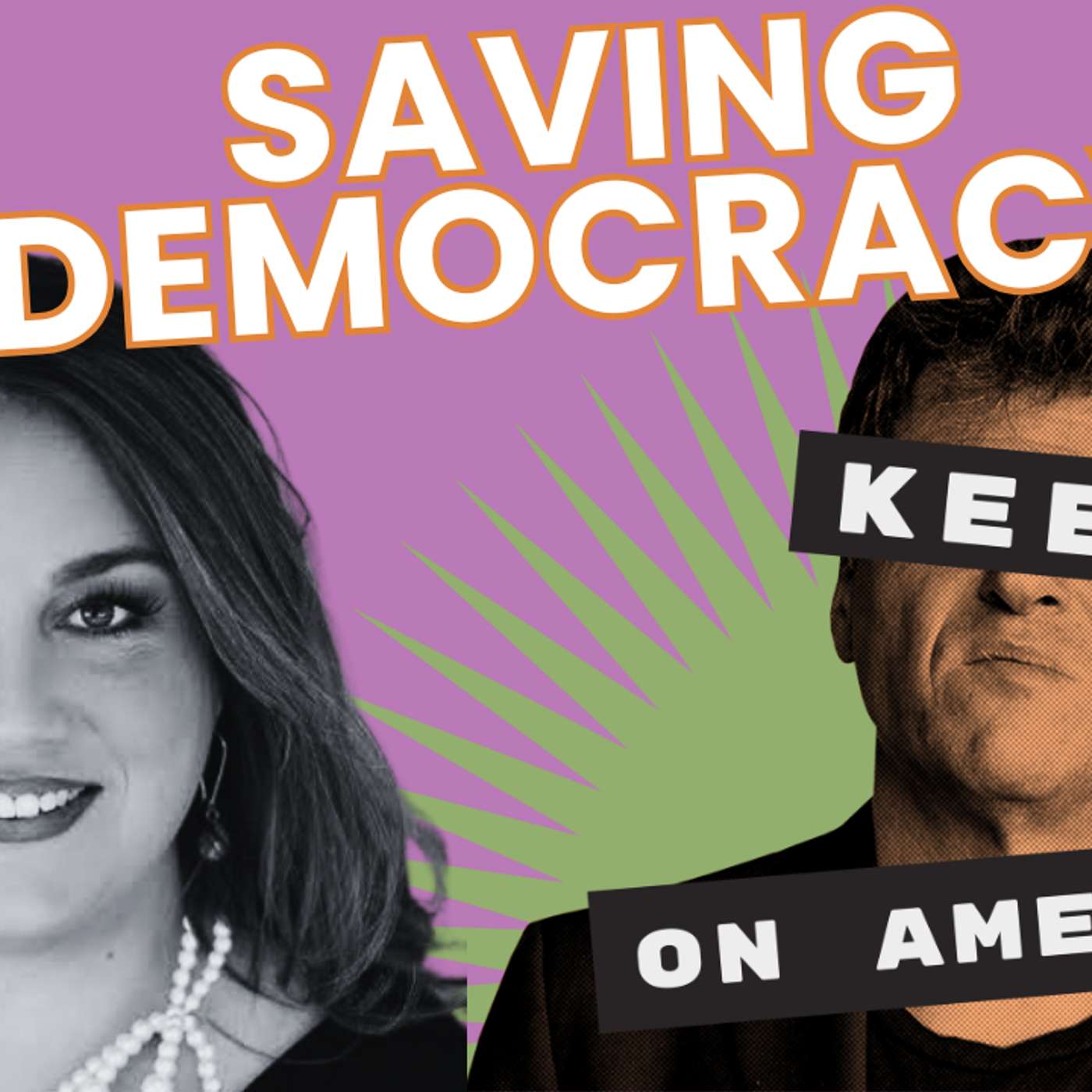


“The number one tool that autocratic actors have is not voter suppression or gerrymandering. It’s making you feel alone and isolated.” — Skye Perryman
Three years ago, the president and CEO of Democracy Forward Skye Perryman came on the show to wonder what our kids will one day ask us about what we did to confront authoritarianism in America. Now she returns with an answer in the form of her New York Times bestselling Ordinary People, Extraordinary Times about how Americans can reclaim their power, fight for freedom, and reimagine democracy.
Her diagnosis is pretty dark. Reminding us that America joined the list of backsliding democracies in 2021, Perryman warns that this descent into authoritarianism is rapidly accelerating. But her central argument inverts the gloom. Hopelessness is a feature, she reminds us, not a bug of our extraordinary times. So, rather than voter suppression or gerrymandering, the number one tool that autocratic actors have is making us feel alone and isolated.
Thus her call to agency. She prescribes seven actions including what she calls “information sobriety.” We don’t all have to do everything, she says, but everyone needs to do something. She ends where we began three years ago — with the kids. Skye Perryman dedicates the new book to her son as a way, I suspect, of telling him what she has been doing to confront authoritarianism in America. Ordinary people in extraordinary times, indeed.
Five Takeaways
• A Generational Threat. Three years of Democracy Forward’s work, summarized from the courtroom: challenging executive overreach by the Trump-Vance administration, fighting book bans, and managing the fallout of Dobbs. America, Perryman notes, has never been immune to anti-democratic movements — they’ve been here since the founding — but this moment is “unprecedented in many ways”: the question is no longer just whether the country can move toward a democracy that works for everyone, but whether it can hold hard-earned gains like equal rights and voting rights at all. The receipts: the United States was added to the global list of backsliding democracies in 2021 — she and Andrew discussed it then — has stayed on it every year since, and the slide is accelerating, driven in part by a Supreme Court that more often reverses rights than protects them: the fruit, she argues, of a multi-decade far-right project against the civil rights movement’s gains. Even thirteen presidential libraries — Republican ones included — have sounded the alarm.
• Neither Adjunct Nor Partisan. Andrew’s needle — blurbs from Hillary Clinton, JB Pritzker, the late Gloria Steinem, and Stacey Abrams: is Democracy Forward an adjunct of the Democratic Party? — drew her counter-blurb: Michael Steele, former chair of the Republican National Committee, endorsed the book too. The standard, she insists, is conduct, not letters after names: “we will oppose anyone” who strips constitutional rights, threatens journalists, or sends masked ICE agents into communities — and the administration’s agenda harms Republican voters in red towns like her native Waco as surely as anyone. As for the that’s-just-democracy argument — Trump won, deal with it — she calls it “quite an un-American argument” twice over: nonvoters outnumbered the supporters of either candidate in 2024, and America is not a plebiscite but a democratic republic with a constitution. It doesn’t matter how large the majority: “he can’t jail journalists for what they report. He can’t kill Americans in the middle of the street.”
• Is It Evil? Andrew previewed later this week’s guest — the philosopher Susan Neiman, whose new book calls the Trump-MAGA movement evil — and put the word to Perryman directly. Her answer, from a onetime philosophy major: judged by deeds — stripping families apart, terrorizing communities with masked agents, calling whole groups of people garbage — “if you wanna use the word evil… I’m with you there.” But she draws a practiced line between labeling acts and movements, which she will, and labeling every individual, which she won’t: most Americans of good faith across difference deserve bridges, while much of the president’s movement has operated in bad faith that forfeits them. The same discipline shapes her answer to Andrew’s question about national reconciliation, via the title of Omar El Akkad’s Gaza book (One Day Everyone Will Have Always Been Against This): no backsliding democracy anywhere, she notes, has managed a U-turn “without some measure of truth and accountability.” That reckoning is tomorrow’s work; today’s is holding the administration accountable in the present tense.
• Hopelessness Is a Feature, Not a Bug. The book’s central reframe, previewed in her Rolling Stone essay: the despair so many Americans feel is not a byproduct of the assault on democracy — it is the strategy. “The number one tool that autocratic actors have is not voter suppression or gerrymandering. It’s making you feel alone and isolated” — deprived of hope and agency alike. Hence action one of seven: stop spiraling and pick up a shovel. Doomscrolling, she argues, is the trap perfected — it feels like civic attention while it exhausts you into paralysis; “they want you doomscrolling.” The exit is communal: show up — even alone — to a No Kings march, discover the crowd feels as you do, and let community produce the conditions for courage, and courage for hope. We can’t control what the administration does each morning; we can control how we respond. The goal is a conversion: from spectators of democratic decline to agents of change, in small and repeatable ways.
• Everyone Needs to Do Something. The practical core. Action two, information sobriety: audit your media diet, learn the difference between news and commentary and between independent and merely accurate journalism, get curious across the spectrum, and keep a healthy intake of the genuinely independent — the AP, ProPublica, NPR — whoever owns the rest. (Andrew’s Murdoch question got the even-handed version: know what’s influencing whatever you read, Breitbart or the Times.) The book meets readers where they are — the exhausted, the seasoned, the unplugged — because its creed is proportion, not purity: “we don’t all have to do everything, but everyone needs to do something.” And it ends at the beginning: dedicated to her son, with a kids’ corner and a chapter called Begin at Your Front Door — democracy lives there, not in Washington, and the young, whose future-visioning she finds more inspiring than their elders’ present fights, deserve to be heard on AI, climate, and the country they’ll inherit. Andrew’s verdict: an optimistic book in what many people insist are our dark times — a way, he suspects, of telling her son what she has been doing to confront authoritarianism in America. Ordinary people in extraordinary times, indeed.
About the Guest
Skye Perryman is president and CEO of Democracy Forward, a TIME 100 honoree, and a nationally recognized attorney; under her leadership, De...
00:30 - Introduction: three years later, extraordinary times
02:02 - What’s extraordinary? A generational threat
03:17 - The blurber question: partisan or principled?
05:16 - The backsliding list: accelerating since 2021
07:36 - “That’s just democracy”: the MAGA argument answered
10:13 - Is the Trump movement evil? Previewing Susan Neiman
12:31 - Hopelessness: a feature, not a bug
14:49 - Action one: stop spiraling, pick up a shovel
15:59 - Action two: achieve information sobriety
17:46 - News versus commentary: where disinformation begins
20:05 - One day everyone will have always been against this
21:47 - What does “fight” mean for people with lives?
23:28 - The kids’ corner: democracy begins at your front door
25:18 - An optimistic book for dark times
00:00 -
00:00:30 Andrew Keen: Hello, everybody. It's Wednesday, 09/09/2026. Three years ago, we did a show with Skye Perryman. She's an influential figure, political figure. She's the president and CEO of Democracy Forward. And back then, three years ago, it seems a long time, she asked what our kids will ask us about what we did. This was, of course, before the second, Trump administration. She has a new book out. It's already a New York Times bestseller, Ordinary People, Extraordinary Times, and she's joining us from San Francisco just down the road. She's on book tour, Skye. Congratulations on the success of the book. So what have you been doing in the last three years that, you'll be able to tell your kids about?
00:01:22 Skye Perryman: Look. I mean, we have the privilege at Democracy Forward of working with so many communities across the country that are really, they're committed to their rights. They're committed to their communities. They're committed to this democracy. So the last year and a half, we've been in court a lot having to challenge, executive overreach by the Trump-Vance administration. And of course, you know, even before that, as you know, because we talked about it three years ago, we were in communities across the country doing everything from helping challenge book bans to helping communities find the resources they needed for important life-saving programs to dealing with the fallout of decisions like Dobbs at the US Supreme Court.
00:02:02 Andrew Keen: What's so extraordinary about our times? America, of course, has had, for better or worse, an extraordinary history. Is there something extraordinary about what's happened over the last couple of years, especially in this second Trump administration?
00:02:16 Skye Perryman: Sure. I mean, this is a country that has had so many extraordinary moments and pivotal moments and times, but we are definitely living amidst one right now. The attacks on United States democracy, the attacks on the progress that so many people made generations before us, are right now at a very, very high point and are unprecedented in many ways. This is not a country that is immune from threats to democracy from movements that seek to undermine people's rights or the ability of people to thrive in this country. That's always been here since our founding, of course. But we are in a moment now where the question isn't just are we going to be able to move forward to truly achieve that democracy that works for all people. It's also about whether we're going to be able to hold on to some of the hard-earned gains like equal rights, like voting rights, in the midst of what is a generational threat to people, communities, our constitution, and our democracy.
00:03:17 Andrew Keen: Your book comes with some very illustrious blurbers, including Hillary Clinton, the Illinois governor JB Pritzker, Gloria Steinem, who unfortunately isn't around anymore, Stacey Abrams, the very successful, prominent, Georgian activist. They're all Democrats, of course. Are you an adjunct part of the Democratic Party? Are you just against what the Republicans are doing? Do you have people in the Republican party who are supporting what you're doing?
00:03:51 Skye Perryman: Yeah. I appreciate you highlighting those blurbers very much, but, you neglected to highlight people like Michael Steele who ran the Republican National Committee, and convention for many years who also blurbed the book and said it's a book, and this is work regardless of your politics. And that's really what my work has always been about, and that is what the work of Democracy Forward is about. We are open to anybody that wants to be part of the work in this time to promote freedom to enable communities to thrive. We are going to oppose anyone regardless of what letter they may have behind their name. If they do things like strip people of their constitutional and due process rights, if they do things like threaten journalists or have masked ICE agents killing American citizens in the street, we will hold them accountable regardless of what political party they're in. Of course, in this moment, just the facts are that the president is leading, the Republican Party. And, in many instances, that party is aligning with him behind an agenda that is deeply harmful to the vast majority of Americans, including, by the way, Americans that may vote Republican Americans that may live in red areas, like my home state of Waco, Texas [as spoken]. And so that's kind of where the bidding is [as spoken] [as spoken] right now. But I assure you, in the same way we fight for everyone, we will oppose anyone that seeks to violate the American people's rights.
00:05:16 Andrew Keen: You had an interesting update in the Times last week about our democracy being at stake. There are people, of course, on the right who will say, yeah, that's true, but it's coming from the left. It's coming from the woke community. Would you accept any of that, or is the crisis of democracy really one coming purely from the right from particularly from, the MAGA right and Donald Trump?
00:05:41 Skye Perryman: I mean, that's the crisis that we find ourselves in. In 2021, the United States was added to a list of global backsliding democracies. You and I talked about this three years ago because we were on that list three years ago. We remained on that list every year since, including now where the backslide is really accelerating. And the reasons for that backslide are things like a Supreme Court that is more often than not, reversing people's rights as opposed to protecting them. That Supreme Court is a result of a multi-decade far-right effort to undermine the progress of the civil rights movement and to call into question basic guarantees in our constitution that people fought and died for like equal protection under the law. The Trump administration has alarmed, you know, 13 presidential libraries, including many Republican ones with the way in which rights have been violated. And so I would just say I think the threat, of course, is very, very based in this very far-right movement. Now that said, that doesn't mean that everyone in the country that's not part of that far-right movement is really doing what they should be doing to protect democracy in this time. And we would call everyone to account and, ask everyone to do more than they could be doing. I know there's a lot of messaging and talking points about, you know, the woke left. We have to understand what that really means. If you're talking about people who want to defend the rights of all people in this country, that's something that the vast majority of Americans agree with, and that's not any type of special interest agenda. That's an American agenda, and it's agenda that is consistent with the progress of this nation, but it's very much under attack. If you're talking about people who would, you know, seek to undermine the freedoms of those around them, I mean, that's— that might be a different story, but I don't think that's what we've really seen here.
00:07:36 Andrew Keen: What about the argument from the right, especially from the MAGA right, that the twenty twenty-four election was won? Clearly, very few people debate the legitimacy of that election even on the left, and that Trump was shameless in his agenda [as spoken] and what he wants to do with the country. And that's what American democracy is, for better or worse. You and I and many of our listeners and viewers, I'm guessing, don't like or agree with what he's saying, but that's the nature of democracy.
00:08:06 Skye Perryman: Yeah. So that argument really misses the point and is quite an un-American argument, I have to say. I mean, first of all, we need to remember what happened in the twenty twenty-four election, which is if you look at that election, President Trump decisively got more votes than Vice President Harris. But do you know which position got more votes than either one of them? People who didn't vote and people who did not participate in our civic system because perhaps they believed that our system was not particularly delivering for them or that their vote didn't matter. That's why I've written this book, Ordinary People, Extraordinary Times, which is about helping people who might feel disengaged plug in. So that's one problem with that argument, is it ignores that so many people in this country did not actually endorse what President Trump, was seeking to sell to the American people even if they opted out of the system. The second thing that ignores is it ignores something that is so beautiful about American democracy, which is that we're not just any type of democracy. We're a democratic republic with a constitution. And in this country, it doesn't matter if the majority of people vote to silence you. You still have a First Amendment right. You still have the right to due process. Our country is a country that balances the needs of the majority and the will of the majority against the foundational rights that people, even if they're not popular at the moment, have, those inalienable rights or rights that are then later codified in our constitution. So that's really one problem with this talking point for MAGA is it essentially tries to erase the United States constitution. It doesn't matter how much support the president has. He can't jail journalists for what they report. He can't kill Americans in the middle of the street because he disagrees with what they're saying. And the book, my book, Ordinary People, Extraordinary Times that you mentioned, this book actually has some analysis in there and actually has tips for understanding the current moment, but also for how to communicate and respond to some of these things that, the president and his allies are trying to insert into the public discourse that are so wholly un-American, and, anti-democratic and unconstitutional, that's pretty unbelievable.
00:10:13 Andrew Keen: Later this week, we have a show with Susan Neiman, a very prominent philosopher. She has a new book out suggesting that the current Trump MAGA movement is evil. Do you believe that?
00:10:29 Skye Perryman: The current Trump movement is evil? Yes. Look. I believe that, goodness and badness and goodness and evil are things that— that are about what you do in the world and the impact that it has. And so when you were talking about stripping families away from each other, killing people in the street because you don't agree with what they're doing, sending masked agents into communities to terrorize whole generations of people, including, by the way, people who have done everything right, and children in those communities. If you wanna use the word evil for it, if you wanna use the word wrong for it, if you wanna use the word morally bankrupt for it, I'm with you there. But I do think that in our current environment, we also have to understand that there's a lot of highly polarized rhetoric that is seeking to make, and divide our country even further. And in my book, Ordinary People, Extraordinary Times, I encourage people to really focus on those that are around them that may not see the world the same way that you do. They may not have the same political views that you do, but you know that they are operating with good faith and that we can have conversations across difference. That is not everyone. And I dare say that is not everybody, and it's certainly not a lot of people in the president's movement who we have seen operate in such bad faith and seek to undermine our very humanity. So that's my answer. I think a lot of the things that are happening are wrong or morally bankrupt. If you wanna use the term evil, I'm happy for you to use those terms. But I think that we need to be careful in how we label people and in how we label individual people, and really, you know, be quite nuanced about that and try to build bridges across differences, but also hold the line in those areas where really humanity is at stake, which I think you see now. I look forward to reading her book. Maybe I'll have a better answer.
00:12:22 Andrew Keen: Yeah.
00:12:22 Skye Perryman: I mean, I think I was a philosophy major and really adore so much of the work, that's out there in the new philosophy that's being published, so really look forward to reading that.
00:12:31 Andrew Keen: Yeah. I think you and she probably agree mostly on everything. The book is written for ordinary people, quote-unquote, and that's the title of the book. You suggest, in the book that ordinary people are experiencing what you call in an excellent piece in Rolling Stone, which is borrowed from the book, hopelessness. What does that hopelessness look and feel like, Skye?
00:12:59 Skye Perryman: Well, it looks like so many things, and I wanna say at the outset that the hopelessness that so many people are feeling by the way, that's a feature, not a bug of an anti-democratic movement. The number one tool that autocratic actors have is not voter suppression or gerrymandering. It's making you feel alone and isolated. It's trying to deprive people of their hope. It's trying to deprive people of their agency. And so the fact that you have so many people walking around right now that are having trouble finding hope, that's actually part of this entire governing strategy that Trump and his far-right movement are seeking to impose on the country. And so what we have to do is we have to control how we respond to that. We can't control in all cases how this administration seeks to govern. We can make our voices heard. We can take them to court, but we can't control everything Trump wakes up and tweets or does. But what we can control is how we respond. And what we have found is that when people come together and build community, when they focus on what they have in common, when they focus on how to solve common problems together, when they build bonds of community, when they show up to things like a No Kings march, maybe they show up by themselves, and they see that there are so many people who are feeling the same way that they are, that community, and those bonds can help people find the conditions to then embrace courage, to embrace being true to their values at a time where this administration and far-right and powerful movements want to take away your values. They wanna create cost to your values. And as you do that, you find hope. Taking action, working with each other, being in community with each other, those lead to the conditions that lead to hope. And hope is really important to fuel the work that we have to do in this moment to reimagine and achieve or reimagine democracy for all people.
00:14:49 Andrew Keen: The book, has seven core actions that anybody can take. The first is, stop spiraling and pick up a shovel. What does pick up a shovel mean, Skye?
00:15:03 Skye Perryman: Take action. So it's— instead of focusing on the outrage of the day, focus on what you can do about it. That is gonna be different for different people, for different circumstances, for different threat levels that people are living under, but we have to switch our mindset. This president, his administration, this far-right movement, they want you doomscrolling. They want you paying attention to the outrage by outrage updates of the day, because then you confuse yourself that kind of doomscrolling is actually taking action when in fact, it's exhausting you. It's depriving you of your hope, and it's making you feel that there's nothing that you can do. And so that first step is all about how we can shift our mindset from being spectators, onlookers watching the decline of American democracy from cable news or from our phones to being agents of change, people that are actually in small and repeatable ways, taking action that can, inspire and empower a better future.
00:15:59 Andrew Keen: The second deliverable, so to speak, and I'm quoting, and it's a nice phrase, but I'm intrigued with it is achieve information sobriety. Some people might say, well, that's all very well. But then why would you read a book like Ordinary People? What exactly does information sobriety mean, Skye?
00:16:22 Skye Perryman: It's about being mindful of the media that we are consuming and the media environments that we're living in. That chapter goes through a lot of explanation about what's happening to the free press in the United States. The fact that with the consolidation of media outlets and tech platforms, fewer and fewer entities are controlling more and more information today. It's about understanding that as people, we are privileged and that we have access to more information than any humans have ever had access to. But with that also comes the fact that we're being inundated by so much on a day-to-day basis that, can really bring people down. There's a proliferation of misinformation and disinformation. It's important that we be mindful of where we're getting our facts. So information sobriety are the steps that we as individuals need to take, I would say we should take, in order to, be mindful of our media environment, maybe shift some things around if we find that we're looking at or paying attention to sources that have inaccurate information or information that isn't really, helpful in the moment. And then there are steps in there about how we can support pro-democracy media environments like, conversations like this one and so many others, that are really investigative journalists that are still doing this work to actually investigate facts even as support for investigative journalism and funding for investigative journalism has declined.
00:17:46 Andrew Keen: So would that include— I mean, I'm assuming— you're very kind to mention my show. I'm guessing it would include reading The New York Times, The Washington Post. What about—
00:17:57 Skye Perryman: Yeah. Go ahead.
00:17:58 Andrew Keen: [Fox] News or Wall Street Journal, both part of the Murdoch empire. Where does disinformation begin when it comes to the conservatives?
00:18:11 Skye Perryman: Yeah. Well, you're really raising two things. One is, you know, how you deal with media outlets that might be influenced by outside forces. Of course, there's so many of them that are, not just outlets on the left, certainly also, I mean, on the right, certainly also outlets on the left. And so the book actually encourages people to take a look at your media diet. And if the commentary that you are listening to is all from one kinda side of the political spectrum, we encourage people to actually get a little curious and look at commentary from other perspectives as well just to understand what's out there. So that's one piece. The chapter also breaks down the difference between news and commentary. The difference between independent journalism and investigative journalism and, other journalistic sources that are not independent even if they're very accurate, but they're not independent and things with respect to local journalism as well. And so to your question, I think what we want people to do is to be mindful of the information they're consuming, to know when they're reading an outlet, when they're reading news from an outlet, whether that's The New York Times, The Wall Street Journal, or Breitbart or whatever you're reading, that you understand what is influencing, what you are reading. And then we have, information and resources about how you can be your own fact checker at times. We recommend that people have a really healthy diet of what we call independent media. So that's gonna be everything from the Associated Press to groups like ProPublica, media outlets like ProPublica that still invest in investigative journalism to NPR. So there's a lot of resources in there about the outlets that, you know, are more likely to give you accurate information that still take those standards of journalism seriously as well as understanding that some things you listen to maybe just because you like to listen to them, but they might not be real investigative or independent news.
00:20:05 Andrew Keen: There's a book— I actually haven't got the guy on my show. I'd like to. He's a Palestinian [ed.: Omar El Akkad is Egyptian-born Canadian, not Palestinian] and written about Gaza. The book is called One Day Everyone Will Have Always Been Against This, which implies that at some point, what the Israelis are doing in Gaza is self-evidently wrong. Do you think that there may be a need at the end of this episode, this chapter of Trump and MAGA for some sort of national reconciliation that in America as well, one day, everyone will have always been against what Donald Trump is up to.
00:20:41 Skye Perryman: Yeah. I mean, what I can say about that is that there's not a single democracy across the world that when it was backsliding was able to achieve a U-turn out of that backslide without some measure of truth and accountability. What that looks like and how it needs to be instituted is going to be the subject, I think, of a lot of work in the days ahead. But, when a society fails to truly hold accountable, people who are stripping individuals of their rights, who are denying our constitution, who, by the way, don't even wanna follow federal court orders, who would seek to deny the humanity of people, to call individual groups of people garbage based on where they are born. I mean, these are just examples of things that have happened in the last few months. That society can be in a lot of trouble in seeking to U-turn. And so, I think that will be a lot of the work moving forward. Right now at Democracy Forward, of course, we are very focused on holding the administration accountable as they violate the law in the present tense, and protecting people in communities' well-being and their rights the best we can with the tools we have in courts and in communities.
00:21:47 Andrew Keen: You also— one of the other actions is remember the past, fight for the future. But what does fight mean? Does that— for ordinary people, does that involve doing it on a daily basis? Can they just sometimes show up to No Kings rallies? Or when ICE gets particularly out of control, should they be showing up? What does it mean in terms of people's daily lives? Because you know better than I do, ordinary people have lives and jobs and families. Many of them have more than one job and more than one family. It's very hard to— we're not talking about formal dissidents here. We're talking about real people's lives. What does that actually involve?
00:22:28 Skye Perryman: Yeah. So the book is actually titled a guide for all of us [as spoken], and that's because there is something in this book that can meet you where you are. If you were someone that is exhausted from all the outrage and you need a little inspiration, you're gonna find that in this book. If you were somebody that is a seasoned advocate and you're just trying to figure out ways you can make your work for social justice more effective, you're gonna find that in this book. And if you're somebody that's been unplugged, either because of the busyness of life or because you don't believe that our system has a lot to deliver for you, there's things in this book for you. So it really does seek to meet people where they are. And part of the themes of the book that go and weave history and our present day and examples throughout time is that there's no one way to engage in this work to achieve a reimagined democracy for all people, but that we all have something to contribute to it. We don't all have to do everything, but everyone needs to do something. And there are things in this book for all of us.
00:23:28 Andrew Keen: I know you gotta run. So let's end where we began with our kids. When we talked three years ago, you asked what our kids will ask us about what we did in these unusual extraordinary times. But in this new book, you have a kids' corner too. What can kids do? Kids are not just innocents here as well. I mean, obviously, they can't vote, although there's an increasing debate about whether or not the voting age should be lowered. What do you think kids can do in our extraordinary times?
00:24:00 Skye Perryman: Yeah. So I dedicated this book to my son and to all of our children who are going to inherit the country that we leave them. This is a multigenerational work right now, and so the book actually encourages— one of the chapters is begin at your front door. That's where democracy is. It's at your front door. It's not just in Washington or in the Supreme Court or at the White House. It's things that are happening in your community, and there's never— you're never too young to start getting involved in your community, to start building bonds, to start practicing acts of kindness towards people. And so the book encourages those types of things, but it also encourages us to listen to young people. Because one of the things we have to do in this moment is we also have to keep our eyes focused on the future, not just on the present fights. And when you talk to young people about what they want to see in their country, about the future they want to see built, it's much more inspiring than when you talk to older people often. And so, we encourage, people of all ages, but of course, young people to also get involved in actually visioning the type of future that they want. This generation's gonna have to deal with, you know, AI, climate change, so many threats, to their well-being as well as these threats to our democracy. And so I think there's something for everyone, and we've really tried to make it that way for all ages.
00:25:18 Andrew Keen: Well, there you have it. The book is a New York Times bestseller already, Ordinary People, Extraordinary Times, How to Reclaim Your Power, Fight for Freedom, and Reimagine Democracy. An optimistic book in what many people see as our dark times. Skye Perryman, lovely to see you again. I hope it was three years before you come back [as spoken] on the show, and have fun in California, in Santa Rosa.
00:25:43 Skye Perryman: Thank you so much. Always happy to see you.