Opening the Book of Genocides: Graphic Artist Dana Mashoian Walrath Draws Humanity’s Worst Crime
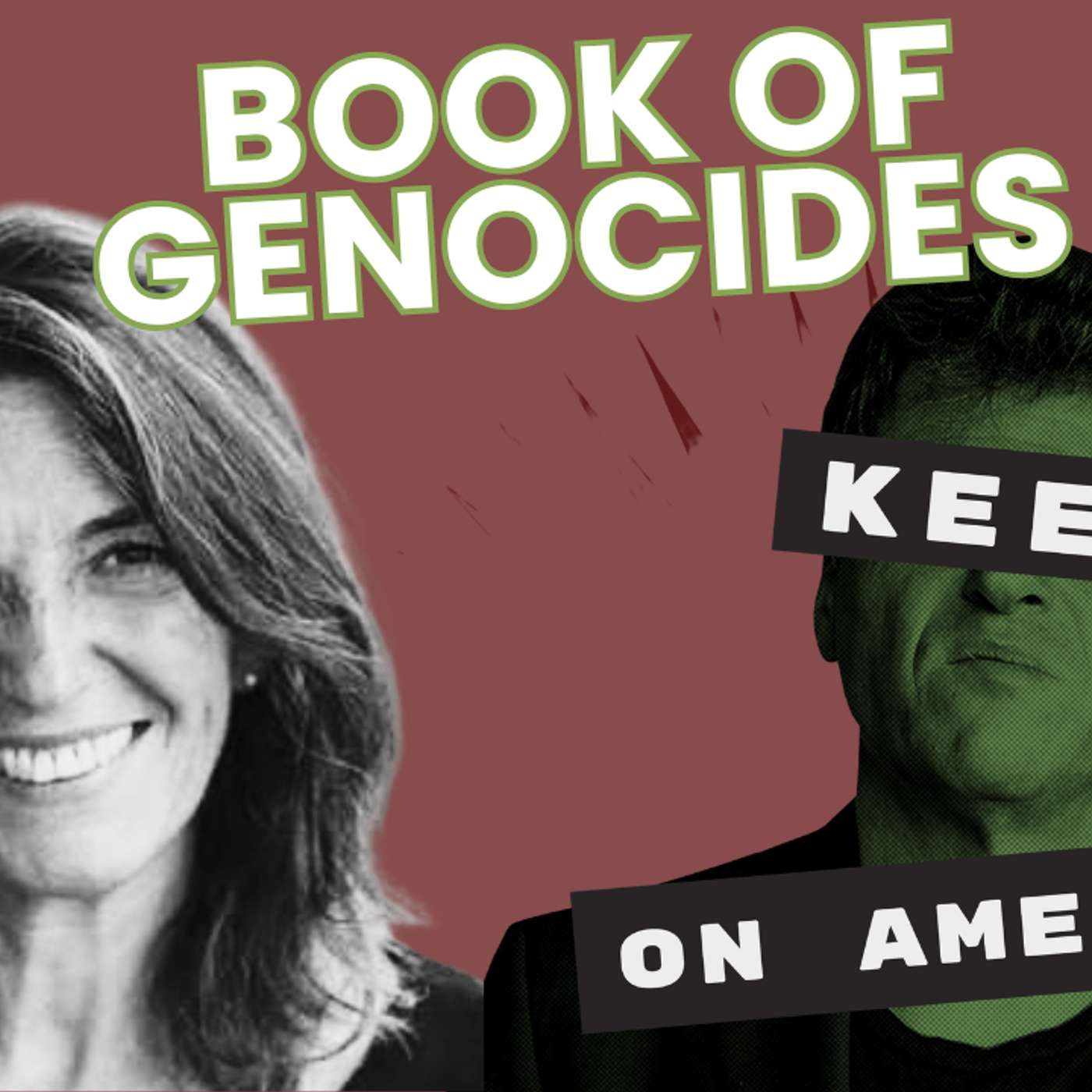


“We’re hardwired for love. We are taught to do violence, and to hate.” — Dana Mashoian Walrath
A couple of months ago in Warsaw, the Polish writer and Jewish activist Konstanty Gebert argued that Gaza wasn’t a genocide. Today’s guest disagrees. In The Book of Genocides, graphic artist and anthropologist Dana Mashoian Walrath draws ten genocides including what she sees as the crimes against humanity committed by the Israeli army in Gaza.
So what, exactly, is a “genocide”? Walrath’s definition borrows from the Polish lawyer Raphael Lemkin, who coined the term during the Second World War. Lemkin meant the word to mean the destruction of peoples that had been deemed sub-human. Thus Walrath includes crimes against the First Peoples of the Americas and Black Americans alongside 20th-century mass killings in Cambodia, Rwanda, Bosnia and Armenia, where her ancestors were persecuted.
Some will quibble over this list. Although quibbling over the top (or bottom) ten genocides isn’t exactly good taste. Besides, The Book of Genocides is a poignant work of graphic art in the tradition of Art Spiegelman’s Maus. And its author, for all her anthropological insights into why people commit crimes against humanity, isn’t shy with her genocide jokes. Springtime for Hitler, anyone?
Five Takeaways
• Always a Land Grab. Ten genocides across five centuries — the First Peoples of the Americas, Black Americans, Aboriginal Australians, Armenia, the Holocaust, Cambodia, Rwanda, Bosnia, the Rohingya, and Gaza — chosen not to rank horrors but to expose “the repetitive patterns and the processes that underlie genocide.” Walrath’s definition is Raphael Lemkin’s original, processual one, before politics narrowed the convention: the purpose is always a land grab, the apparatus always dehumanization, and precise academic definitions are often deployed “to keep some stories and histories out.” The book began as an interactive art installation with nine genocides and a tenth chapter on “the borders of genocide” — Afghanistan, Vietnam, Congo, Ukraine, Palestine — until the violence in Gaza persuaded her to make the case outright, while insisting the aim is not to demonize her Jewish friends, Judaism, or Israel, but to show the system. Her hope: that a globally framed comic might open dialogue between Jews and Palestinians “trapped in enmity right now.”
• Lemkin’s Last Train. The man who coined the word is the book’s tragic through-line. As a Polish law student, Lemkin followed the Berlin trial of a young Armenian who had shot one of the architects of the Armenian genocide — and found it ludicrous that the assassin faced justice for one murder while his victim had answered for none of his millions. His family farm had been seized in the First World War; his brother Samuel died in the forest. He escaped Warsaw on a train that was bombed, ran by night to reach his family, and failed to persuade them to leave (“they do this to us all the time”). Via Sweden, Russia, Japan, and Duke, he spent the war in Washington trying to make Americans see. His convention passed — then waited years for the US, UK, and China to ratify — and he died in 1959 penniless and friendless, UN officials fleeing him in the corridors. Walrath’s speculation: his great regret, looking down, may be refusing to support We Charge Genocide, the 1951 petition by Black Americans — “we can’t talk about something America has done” in the Cold War. Had America owned and repaired that crime then, “we’d be in a very different world.”
• Can You Have Half a Genocide? Andrew’s pushback — if politicians can be “verging on genocidal,” does every Karen yelling at her kids get accused of it? — drew the hour’s most honest concession: “that’s the absolute spot-on critique of the approach I’ve taken.” Her defense is preventive: half a genocide is “too quantitative”; better to name things “on their way to massacre” and stop them, or repair them, than to litigate the label afterward. Genocide, she argues, predates modernity and Arendt’s industrial reading — it arrives with the first hierarchical, extracting, wealth-inheriting “so-called civilizations,” Sparta and Thucydides included. Slavery qualifies because the operational word is systemic: the transatlantic trade ran on thinking of humans as lesser. But she draws one line firmly: asked about factory farms as future genocides, “I would hate to see genocide get used over there. It is something that humans do to one another” — and, she insists, don’t have to: the literature on aversion to killing shows soldiers must be socialized into it. We’re hardwired for love and taught to hate.
• Stanton’s Stages in MAGA America. Is there something genocidal in MAGA’s language about undocumented immigrants? “Absolutely.” Walrath applies the ten stages of genocide — the classroom heuristic Gregory Stanton first presented to the State Department in 1996 — and finds the United States “doing a heck of a lot of them”: polarization; dehumanization (people called vermin, “not worthy of life”); discrimination in the restriction of voting rights. “We’re on very, very shaky ground.” Homelessness, in the same frame, is the product of structures that disenfranchise some and privilege others — “we’ve got enough to go around; we just revere wealth.” Her model for how ordinary people let it happen is Ursula Hegi’s Stones from the River: the fearful, the wounded, the disenfranchised, vulnerable to takeover — with parallels in MAGA voters spurned by the neoliberal machine and unable to see who is pulling the levers. Hence her claim for the book: it is resistance, but resistance that builds a coalition across horrors rather than policing which horror counts.
• Springtime for Hitler. She didn’t read Maus until 2009 — “that’s when I found my medium and just went wild” — and pays it explicit homage in the book. Comics, she argues, let readers “come into” a history and think for themselves, and laughter is respite: an angry messenger gets no listeners. Her earlier Aliceheimer’s let people laugh about her mother’s dementia (not at it, she corrected sharply); telling audiences she’s working on her genocide jokes makes them relax enough to hear the rest. Andrew’s challenge — “do you really want to make it safe?” — produced the useful distinction: safe to enter, not whitewashed; hand-lettered so readers can bring the content in, every truth intact. The closing exchange landed on The Producers and Springtime for Hitler as a brilliant portrayal of the legacies of catastrophe. Her last word: knowledge must cross boundaries, “and the boundaries are all human made, so let’s unmake them.” Andrew’s: most will disagree with her list — and it may be a classic.
About the Guest
Dana Mashoian Walrath is a writer, artist, and anthropologist. Her award-winning works include Aliceheimer’s, a graphic memoir about her mother’s dementia, and Like Water on Stone, a verse novel about the Armenian genocide. She holds a doctorate in anthropology from the University of Pennsylvania; her comics, art, essays, and poetry have appeared in The Nation, The Lancet, Slate, and on NPR. The Book of Genocide...
00:00:31 Andrew Keen: Hello, everybody. Couple of months ago, I was in Warsaw in Poland. I sat down, with a man called Konstanty Gebert, who's, a Polish Jew, an authority on experiencing the suffering of Polish Jews. And we talked about many things, including whether or not what the Israelis were getting up to in Gaza was a genocide. He wasn't sure. He had a very specific definition of genocide, which not everyone will agree with. And we're talking about the G word today, genocide, an international crime against humanity, with my guest who has a new book out. It's called The Book of Genocides. She's an artist, a wonderful artist, a graphic artist, and I think this book is gonna be thought of in the same way now as we think of Art Spiegelman and Maus. Her name is Dana Mashoian Walrath, and I think I've— I haven't mangled your name, Dana, have I?
00:01:36 Dana Mashoian Walrath: No. You've done very well. Thank you, Andrew.
00:01:39 Andrew Keen: We joked before we went live that I wouldn't make any genocide jokes, but, I haven't, I haven't committed genocide on your name. We have to be serious about this, Dana, of course. But at the same time, you've maintained your humanity, it would seem to me, in this book, which is a very ambitious book and no doubt in some ways controversial. It's coming out, published by Harvard University Press, next week, the week after this goes live, on September 9 or September 8. Do we have to keep, Dana, when we think of genocide? Do we have to maintain, what, humor, distance, irony? How would you or how have you gone about this book?
00:02:30 Dana Mashoian Walrath: Oh, what a good question. I think that the act of genocide depends upon us, alienating ourselves from our feelings and our hearts and even from what we're hardwired to know is right and wrong. So that what kept me going throughout the process of working on this was the fact that I was doing something to counter genocide, that I was, elevating stories, some known, some unknown, and that I was, trying to give people the body of knowledge that they needed in order to be able to see that this is not inevitable, that we have ways to not behave like this. And I think, where everyone is at the end of their rope is the fact that we feel so helpless. And I'm lucky to be a writer and an artist and, and an anthropologist as well so that I have the toolkit that I could do something constructive with this, body of knowledge as well as the street cred to do it because I'm a descendant of genocide, survivors.
00:03:42 Andrew Keen: Dana, this book traces the history of 10 genocides. And I think one reason why this is gonna be controversial is because of the genocides you have and haven't included. Mhmm. You've included the Palestinian genocide in contrast with Konstanty Gebert. You've included the genocide of the First Peoples of the Americas, the genocide of black Americans. Do you think it's helpful? I mean, if you're gonna write a book of genocide, you gotta define what it means, and you've gotta probably exclude some and include others. Does it make any sense to argue about whether these crimes against humanity are examples of genocide or of something else?
00:04:35 Dana Mashoian Walrath: I think that oftentimes when people are arguing about the precise definitions, they're doing so to, to, keep some stories and histories out. And I understand the benefits of that and within academia to really have your terminology absolutely precise. But that is, also something that can be used by powerful forces in order to, encourage one view of history. So when I chose the 10 that I chose, I was actively trying to make a case for the repetitive patterns and the processes that underlie genocide. And, originally, the book when I was, it started as an interactive art installation. It had nine genocides, and, the tenth chapter was going to be called The Borders of Genocide, and I was going to, talk about Afghanistan and Vietnam and Congo and Ukraine and Palestine, all these places, whether we had to decide or whether the UN got to decide or politicians got to decide whether it was genocide or not. But the violence, that's going on right now, made me think that I had to really explain why I see what's happening in Palestine, Israel as genocide. But I do it in a way not to demonize, any of my dear Jewish friends or the Jewish religion or even the state of Israel. I do it because the purpose of the book is to show patterns and systems and processes that underlie genocide. And so as a writer and an artist, instead of the academician, I use a much more processual definition of genocide. And, it actually aligns with the original, definition of genocide that Raphael Lemkin used when he first started writing about it and what he was trying to have embedded in the genocide convention. But then politics took over, and it had it became, less broad. But the advantage of keeping it broad is we can see the patterns and then have more ways to stop things before it gets to massacres.
00:07:13 Andrew Keen: Well, let's go back to Raphael Lemkin, the man who coined the term genocide. Where does the word come from? And tell me a little bit about this Lemkin character. He died in 1959. He was a Polish Jewish lawyer, and very much involved in coming to terms with the Jewish, with the German crimes, against the Jewish people in Poland.
00:07:42 Dana Mashoian Walrath: Yeah. He, is a fascinating and tragic character. He started he really first became conscientized to the notion that there was a crime for which there were no legal methods to prosecute. When a young Armenian man, took the law into his own hands and shot in the streets of Berlin one of the leaders of the genocide against the Armenians. And Raphael Lemkin thought, when he was following this trial, he was in law school at the time, he thought this is ludicrous for holding this man responsible for a single murder, whereas the person he killed was responsible for the murder of millions. And so he was following this for throughout the course of his life. And he even, probably was thinking about it as a little kid. You know, he watched the injustices as a Polish person, when German troops came through, his family farm was taken over during World War Two — One, rather — and they had to flee into the forest. His younger brother, Samuel, died there. So he really had a deep attachment to figuring out how we can stop these injustices. So he developed the convention. He managed to get out on the last train from Warsaw, into, ultimately, he first went to his— find his family to try and convince them to leave, and he his train was bombed. Everyone in the middle died, but at the beginning and the end of the train, people escaped, and he ran, at night and hid during the day till he reached his family, tried to convince them to leave. They said no. No. They do this to us all the time. We're gonna just stay and wait this one out. And he ultimately made his way to Sweden and then across Russia, to Japan, to the US, and then, to Duke University, and then, spent the rest of the war in Washington trying to make people aware of what really was going on in, Nazi Germany. And, so, ultimately, though, his convention was successful. It got established. It took forever for it to be ratified. And by the time he died in 1959, he, was penniless and friendless, and people at the UN would run away from him because they didn't want to ratify the convention, which is shocking. Many of the big players like the United States, the United Kingdom, China were very late to ratify the convention.
00:10:55 Andrew Keen: Dana, all the genocides in this book, and please correct me if I'm wrong, are all modern. They're all they all happened in the last three or four hundred years. I guess the earliest one would be the genocide of the First Peoples of the Americas. Yeah. Hannah Arendt, of course, one of the great philosophers, I guess, or moral philosophers of, of the Holocaust. She experienced it firsthand, of course, as a German Jew.
00:11:27 Dana Mashoian Walrath: Yeah.
00:11:28 Andrew Keen: Saw the Holocaust and particularly in her book, The Origins of Totalitarianism, as a feature of modernity. Now you're not a philosopher. You're a graphic artist. But would you agree with Arendt? Is genocide a modern thing?
00:11:48 Dana Mashoian Walrath: I would push it back a little bit further than it being modern and tied to the industrial revolution. You know, I'm a doctorate in anthropology [as spoken], and we always think in terms of vast time scales. And I would say that it came about with, the first so called civilizations. Once we started having groups dominating one another and extracting, hierarchical societies and, and inherited wealth. And those things began to bring about this tendency to hurt one another. So if you look, at the various, academic tomes about the origins of genocide, they will talk about, yes, it happened in Sparta and so on and so forth.
00:12:41 Andrew Keen: Yeah. I mean, Thucydides describes—
00:12:44 Dana Mashoian Walrath: Yep.
00:12:45 Andrew Keen: And if— whether we would wanna call it genocide, but, certainly, the torture and murder of thousands of people during the Peloponnesian war.
00:12:53 Dana Mashoian Walrath: Yeah. Yeah. It, this is why I like going back to thinking about it in terms of processes because, that is different from the just, a war. This is really describing a group of people and taking away their humanity and taking away their land and all these other things and perpetrating the violence because of a notion that they're really subhuman somehow or another, much like, what, we hear politicians say today when they're perpetrating genocides.
00:13:35 Andrew Keen: As I said, you include the genocide of black Americans.
00:13:39 Dana Mashoian Walrath: Yeah.
00:13:40 Andrew Keen: Slavery, of course, is a tragically, a perpetual feature of history, sometimes racialized, sometimes not. Yeah. Aren't— isn't in the way you're defining it, isn't slavery by definition, whether it's of the ancient Egyptians finding slaves to build their pyramids or many other civilizations, or maybe we shouldn't be calling them civilizations, aren't they all examples of genocide?
00:14:04 Dana Mashoian Walrath: I know that gen— some genocide scholars would object to black Americans being in there. For me, the operational word is whether it's systemic. And what and so the Transatlantic slave trade was, and had many moving parts, and it was absolutely dependent upon a mindset of thinking of these humans as lesser. So that for me is that dehumanization is a fundamental quality that makes it genocide.
00:14:40 Andrew Keen: Dana, we joked earlier that your background is Armenian. The Mashoian in the middle of your middle name is Armenian, but you half joked earlier that no one can be half Armenian, either you're fully Armenian or not. And extending that, can you have half Holocaust? Can you have half genocide?
00:15:06 Dana Mashoian Walrath: The way I would think of it is you have things that are, on their way to massacre. And so let's recognize them for what they are, so we can prevent the massacres ahead of time, or we can repair the damages that were done. And so, saying half of something, it's too quantitative. I think it's much better to stay in a realm of process and the quality and intentions of the actions.
00:15:48 Andrew Keen: But in terms of this quality and intentions of the actions, you suggested that some people, some politicians, for example, might be verging on being genocidal in what they do or don't say about other people. Mhmm. We can probably guess some of the people you're mentioning. Okay. Does that, though, in all seriousness, does that sort of lower the bar so much that we can all have genocidal moments? So when Karen screams at their kid to go to bed or eat properly or behave themselves, kids are gonna start accusing their parents of being genocidal in their attitudes. In other words, is there a danger of making this word so generic—
00:16:34 Dana Mashoian Walrath: Mhmm.
00:16:35 Andrew Keen: Of lowering the bar so much that it, in a way, trivializes the whole debate?
00:16:40 Dana Mashoian Walrath: That's the absolute spot-on critique, of the approach that I've taken, and I know that there are scholars who are defending the term in very good ways. But what I wanted to do in this book was give people a series of histories that, would let them start discerning from themselves whether they thought this was genocide or not. And so I say upfront, I'm using Raphael Lemkin's definition, and I think by his definition, many places would, end up being called genocide that, because they're part of the definition. And I, wonder, if there's another realm where he's looking down, I wonder if one of the big regrets of his life is that he didn't support the petition that black Americans brought to the United Nations, accusing the United States of genocide against the Negro people. That's the title of the book, We Charge Genocide. And Raphael Lemkin at that point, he said because of this time of cold war, we can't talk about something that America has done. But I wonder what the world would have been like if the US at that moment had owned systemically and structurally and, what it had done to black Americans and then repaired it. We'd be in a very different world. So the point of the book is not to, tell people you have to think this way or that. The point of the book is to, help people think critically about the issues and to give them the information so that they can start having conversations with one another. And to circle back to where, you know, you started with, asking about people being upset that I have Palestine in there. My biggest hope is that this can contribute to good dialogue, between, Jews and Palestinians who are trapped in enmity right now. You know, not there are many incredible peacemakers out there doing amazing work, but there has to be new ways to kind of bring people in who are accepting dominant narratives. And I think comics really helps people do that, getting access to history through drawings and words and then to have it also globally, framed, I think, might contribute in that regard.
00:19:42 Andrew Keen: It might. Although, on the other hand, I'm guessing that there'll be many Jews who, perhaps like, my friend Yeah. Konstanty Gebert, who, on the one hand, are no great fan, certainly, of the current government or the behavior of the Israeli government in Gaza, but at the same time, wouldn't define what the Israelis are doing in Gaza as a, a genocide. But, anyway, you're an artist rather than an academic as you know. Is this book, art or education? Is it pedagogical? What are you trying to do in the book? I mean, it comes out. It's published by Harvard University Press. Yeah. Which may surprise some people because Harvard University Press is a fairly mainstream, very credible academic press. Yeah. Whereas, Spiegelman, for example, I— who published Maus originally? I can't remember.
00:20:42 Dana Mashoian Walrath: Pantheon. I'm—
00:20:43 Andrew Keen: So it was more of a mainstream commercial press. I mean, what are you trying to do in this book? Who do you wanna pick— who do you wanna reach? Is it kids? Is it scholars? Is it undergraduates?
00:20:56 Dana Mashoian Walrath: I think that I want to reach the broadest audience possible, but I do think that getting it into, educational settings will be fantastic. High school, university, graduate level. It could be a very good foundational text, but it's not just pedagogical. It's meant to be, in university settings. It's meant to spark dialogue. It's meant to, so I hope book groups. I hope adults. I hope, globally, it really gets read. And my, every day as I got up and worked on genocide again, I was thinking I'm doing something to help get rid of, the violence that so many people believe is inevitable. And I really think we're hardwired to take care of each other. And, Rebecca Solnit's written about this beautifully in terms of how our true natures come out during disasters, and we support one another. And we can see with children that we're hardwired, for love and that we are taught to do, violence, and to hate. And so, because of that kind of broad goal, and I know it can sound, you know, so broad that it's absurd, but I think it is absolutely backed up by facts. And, you know, I am earning my living as a writer and an artist at this point, but I've got, you know, a doctorate from Penn in anthropology. I've written academic papers, and this book was incredibly well researched. And we actually had interest from some of the trade presses, as well, the, you know, the comics presses. And, this was the perfect home for it, because of the fact that I was working on a project that, took in the entire world. So when I went to Bosnia or to Cambodia to research, I could say the book is coming out with Harvard and doors would open. Whereas, not everybody in Cambodia has heard of Pantheon, you know, but they will know Harvard. And so it felt like that layer of academic credibility was really vital.
00:23:34 Andrew Keen: How were the conversations with your editor or editors at Harvard University Press? They bought the book.
00:23:45 Dana Mashoian Walrath: Yeah.
00:23:46 Andrew Keen: Did you have conversations about the criteria you use, why you might include some versus others, why you might include, for example, the Bosnian genocide, which certainly is debatable? I mean, Serbs, of course, or certainly Bosnian Serbs would object, but that goes without saying. Right. What was the editorial position? Did they treat it as a graphic comic—
00:24:11 Dana Mashoian Walrath: Yeah.
00:24:12 Andrew Keen: piece of education, moralism, and so they were perhaps less stringent editorially than they would have been if it was a straight textual book?
00:24:23 Dana Mashoian Walrath: I would say that, my book proposal really laid out all of the criteria by which I made those choices. And, and when I submitted the book, it was submitted with, very long academic essays that showed this woman knows what she's talking about. And I worked with scholars as well as community members for every single chapter. You know? So I read the scholarly literature. I and then went to the places. And, so the editorial commentary back and forth, once I established that I was a scholar, then it was about how to make this the most powerful comic it could possibly be. And so instead of 8,000-word essays giving every detail of the Armenian genocide — or any one of the genocides — it's distilled down to about a thousand words, a little more in the case of the Holocaust because Raphael Lemkin's story is more woven in through there. But, the editorial process was one of, establishing deep credibility on many fronts and then just making the book as good as it could possibly be.
00:25:48 Andrew Keen: You and, again, please correct me if I'm wrong, but you suggested earlier that all these genocides had one thing in common, some sort of controlling element that encouraged people to hate and kill one another. Is that fair? Is that the thing linking all these genocides that the people who committed them—
00:26:13 Dana Mashoian Walrath: Yeah.
00:26:14 Andrew Keen: From Armenia to Palestine to Cambodia to Rwanda to Bosnia, that they were all somehow taught to hate and kill?
00:26:25 Dana Mashoian Walrath: I think that is a thread that carries through that absolutely, that, we all and here, I'm an anthropologist. We all learn the dominant beliefs of our culture. We— they are internalized. We learn how to think and how to be in this world, so that we can be valuable, functional members of our societies. And, and, I mean, I grew up, for example, you know, learning about the pilgrims and the Indians and thinking that they— it was, that, that beautiful Thanksgiving myth. And, but I also watched a lot of, I'm old enough that I remember the assassination of Martin Luther King, and I, I remember as a kid just putting it together and thinking something's really wrong here. This is this, this isn't how we're meant to behave, that this isn't, what any of the systems that are trying to teach us about how to be good, they don't say go out and kill people and hate people, that it's much more subtle. So it wasn't until I got the doctorate in anthropology that I had the vocabulary to be able to, really push back on those dominant narratives that I perceived and was uncomfortable with as a younger person.
00:28:08 Andrew Keen: Do you think, Dana, that there is something potentially genocidal about the MAGA language and attitude towards undocumented immigrants in the United States.
00:28:23 Dana Mashoian Walrath: Absolutely. I think that we, we are really living in a time of incredible danger, and we are so far along in sort of the various processes that lead to massive, murder, murder on that scale that, it's time to truly pay attention. And I know, I'm ready to be a spokesperson against that because I've processed my own grief about my family's situation, and I feel like my responsibility moving forward is to try and make sure this doesn't happen to anyone ever. So there's a really, an interesting heuristic model that gets used in the classroom sometimes called the stages of genocide. And, I've used it in op-eds that I've written on, and, it's 10 different stages. It was first, presented to the State Department in 1996 by Gregory Stanton, an anthropologist. And then, an Armenian Canadian scholar, added two more stages. So there's 10 stages now. And when you look at what each of the stages of genocide are, the United States at this current moment is doing a heck of a lot of them. I mean, the polarization is one of the stages. The dehumanization is another stage, and we hear that in the rhetoric regularly. We hear about, people being, you know, not worthy of life and things like that, and they're called vermin and so forth. So, we see discrimination, another stage, in terms of how, voting rights are being restricted right now. So we're on very, very shaky ground now, and, I'm grateful that I've got at least something to contribute to helping us get back into really being, a great country, one that repairs its mistakes.
00:30:54 Andrew Keen: What about the socioeconomic element? You talked about dehumanization. You mentioned the dehumanization of, of undocumented people in this country. I live in San Francisco. We talked about San Francisco earlier. I know you're familiar with it too. I know you're gonna be doing some talks in September on your book there, or here. Is homelessness an example of, again, the genocidal tendencies perhaps of, I don't know what you would wanna call it, American capitalism, American the American free market system.
00:31:34 Dana Mashoian Walrath: Yeah. I would say it's a product of systems and structures that selectively disenfranchise some people and privilege others. It's very simple. So the homeless person, has been, systematically throughout their lifetime, but has been dealing with all sorts of layers of discrimination and bigotry and so forth. And we're not, figuring out a way to support them. And I know I, it sounds like, you know, a bleeding heart liberal, but, it's not— my notion is not just to keep on pouring money at problems, but to really rethink our systems and structures because they're producing incredible poverty. They're producing disenfranchisement. We've got enough to go around in the world. We just, as a society, revere wealth, revere the people who have mega wealth. And if we, convince them all to give it away and to be a little more like minded, in caring about other people and figuring they deserved it, we could actually build up a pretty incredible world for everyone.
00:32:53 Andrew Keen: So maybe billionaires and trillionaires are, by definition, genocidal. What about the species or speciesist element here? Some people might be reading this book and saying, what about chickens or dogs or pigs? At what point in a hundred or two hundred years might people be writing books entitled The Book of Genocides and be describing factory chicken farms, for example.
00:33:21 Dana Mashoian Walrath: Yeah. You know, the it's, I would like it not to go there, though I really also, feel like part of what got us into trouble, is this notion that humans are separate from nature. And that, because we're separate from nature, then we're out of balance, and we have these tendencies towards violence. And as I said earlier, I think we're hardwired not to be violent to one another. There's a good literature on aversion to killing another human, and we know that soldiers have to be socialized in order to kill. I mean, there are very rare, exceptions, you know, people with pathologies who are murderers, but the vast majority of us do not kill. We know not to do it. And so, instead of sort of keeping the systems and saying, now let's talk about factory farming, which is something I think is a bad idea for many, many, many reasons. I would hate to see genocide get used over there. It is something that humans do to one another, but they— we don't have to. We can stop this.
00:34:43 Andrew Keen: Dana, you're talking to me from Burlington, Vermont. We joked or you joked before we went live that it's near the Canadian border. If you need to leave the country, maybe you'll go on some bad— you'll go on the, the blacklist, so to speak, of the MAGA regime for this book. But in all seriousness, is this a book of resistance? I mean, there have been so many books, so many questions about why people living in Nazi Germany allowed the genocide against the Jews, or why, if you believe that there's a current genocide in Gaza, which is debatable as we've said, but why liberal, peace loving Israelis put up with it. What's the narrative in this book, The Book of Genocides, about people living under genocidal regimes, whether it's the Turkish regime or the Bosnian regime or the Nazi regime, or for that matter, white southerners in what you call the, the genocide, the genocide of black Americans.
00:36:04 Dana Mashoian Walrath: Yeah. No. Great, great question. Absolutely. This is a book of resistance. But what sets it, in a slightly different category is that it bridges across various, horrors so that it's resistance, while building a coalition. I know there are others that do that, but I think in the world of, some genocides, there's a real particularity [unclear]. Only these things are genocide, and this other thing might not be. And what I'm trying to do is deal with systems and structures. And, your other part of your question was, oh, help me. Help me. Your other your the latter part of the question besides it being resistance, it's, please—
00:37:03 Andrew Keen: Well, it's a question of how you should and shouldn't behave in— if you're living
00:37:11 Dana Mashoian Walrath: Yes.
00:37:11 Andrew Keen: in a genocidal under a genocidal regime, but you're not yourself targeted.
00:37:16 Dana Mashoian Walrath: Yeah. Thank you. Thank you. I went off thinking about Ursula Hegi's beautiful novel, Stones from the River, which really gets inside the mindset of the, the German people in the nineteen thirties that allowed for the rise of Hitler. I think that the way that it happens again and again is people are fearful, variety of ways. They can, I mean, people can be protected by, you know, the comfort of their daily living, the comfort of their money? But if they're in the state that people were in Nazi Germany, they're starving and feeling very wounded and disenfranchised themselves. So they were vulnerable to that kind of a takeover. And I think there are parallels within the MAGA movement, people who felt disenfranchised, by, sort of the neoliberal democratic political machine, found a populist candidate very appealing. So there are parallels, there without necessarily seeing the bigger picture of who is pulling, the levers. And I think we are living in a time. I know you had a recent show on oligarchs. I mean, we've got the
00:39:00 Andrew Keen: Yeah. We've had many too many shows on oligarchs. Yes. I— too many oligarchs as well. We have too many shows on it. Hmm. Dana, in the introduction, I mentioned Art Spiegelman, of course, is one of the founding figures, I guess, in your kind of art. He was a very troubled man.
00:39:20 Dana Mashoian Walrath: Yeah.
00:39:21 Andrew Keen: Very complicated background. Yeah. You do similar work. Yeah. You're— you wrote, Aliceheimer's, sort of a graphic, novel or a graphic book about Alzheimer's. You also contributed to a comic treatment called Menopause. It won, it won a series of awards.
00:39:47 Dana Mashoian Walrath: Yeah.
00:39:47 Andrew Keen: Does it require you to be troubled, or does it take somebody with a degree of lightness to be able to make fun, a kind of fun, I guess, not just of genocide, but of Alzheimer's and—
00:40:05 Dana Mashoian Walrath: Yeah.
00:40:07 Andrew Keen: Sexism and every other kind of ism.
00:40:10 Dana Mashoian Walrath: I really believe that laughter is respite. It gives us new ideas and that if I come into this filled with anger and filled with angst, who's gonna listen to me? So I think, I mean, I, we all listen to Art Spiegelman because Maus is absolutely brilliant, and I even, on page, what page is it? I paid homage to Maus with that drawing there. And I think my life might have, been different if I had read it when it first came out. I didn't read it till 2009, and that's when I found my medium and just went wild, after that. And I've, you know, made a career on good genocide jokes, thanks to my mother. And not good genocide jokes, good dementia jokes. And I am working on, how to make sure and present this in both a respectful way, but with hope and with a place for, us to not make fun of it, but to laugh at human foibles and laugh at ourselves so we won't be so afraid of facing the real dangers because we're in very dangerous times right now. And so as I presented everything in the book, I just wanted to make it safe. I handwrote it so you could—
00:41:49 Andrew Keen: Do you really wanna make it safe? That's a— [ed.: Walrath, overlapping: "to read"] That's one of the words that some critics of wokeism suggest is rather dangerous. Can one write a safe book, Dana, about genocide? Won't that make it pointless as well?
00:42:04 Dana Mashoian Walrath: Great question. I wanted to make it safe for the person to read it so they would bring in the content. I think what happens right now is we've got scholars working and activists working, and your average person can pretend it's not going on. And so I wanted to have a way for someone to engage with the topic, kind of to bring them into it. And, your point is really well taken to be careful about safe. This is not whitewashed. It tells all of the truth about what happened, but it also lets people come into it and think about it themselves. And I think that's a strength of the comics medium.
00:42:55 Andrew Keen: It certainly is. Maybe the book should come with, if not a warning, an encouragement that this is not safe. Finally, you mentioned jokes, and that your book, Aliceheimer's, made fun of dementia. Can we end with a good, or a bad genocide joke? Do you know any?
00:43:18 Dana Mashoian Walrath: It didn't end— it didn't make fun of dementia. It let us laugh about dementia.
00:43:24 Andrew Keen: I didn't mean that in a critical court [as spoken].
00:43:26 Dana Mashoian Walrath: Good. Good. No. I wanna make sure because, I mean, that's even more serious. At the first [unclear].
00:43:32 Andrew Keen: And I'm not suggesting your book makes—
00:43:34 Dana Mashoian Walrath: fun. [unclear]
00:43:35 Andrew Keen: I mean, that would be outrageous. But, I mean, let's talk about getting the kind of distance where we can at least laugh when we think of [unclear].
00:43:45 Dana Mashoian Walrath: Yeah. I mean, I when— before we— you started taping, I mean, we were remembering The Producers. That was a brilliant—
00:43:54 Andrew Keen: Springtime for Hitler.
00:43:55 Dana Mashoian Walrath: Springtime for Hitler, a brilliant portrayal of the legacies and consequences and what it's like to then arrive in the US and then try and make a life somehow or another. So I think that, I mean, really, often just saying I'm working on my genocide jokes, that'll make the company— the people I'm speaking to— relax because they know that I'm not gonna be an angry, person who's trying to tell them that they're all messed up and doing everything wrong and thinking wrong. I mean, because that won't get us anywhere. What we have to do is help, knowledge and understanding get transferred across boundaries. And the boundaries are all human made, so let's unmake them.
00:44:52 Andrew Keen: Well, it's an important new book. Not everyone will disagree. In fact, I think most people will disagree with your list. Maybe some people will want some additions. Some won't agree with all the 10 you include, but it's an important new book, may indeed be a classic. The Book of Genocides, Dana Mashoian Walrath, herself of Armenian descent. So has some very personal experience of genocide. Dana, I'm not sure whether to congratulate you on the book, but I think it's an important contribution, and I appreciate you coming on the show. Best of luck with the book.
00:45:28 Dana Mashoian Walrath: Thank you so much for having me.