Is That Really a Flying Saucer? Adam Kirsch on Why We Want to Believe in Aliens
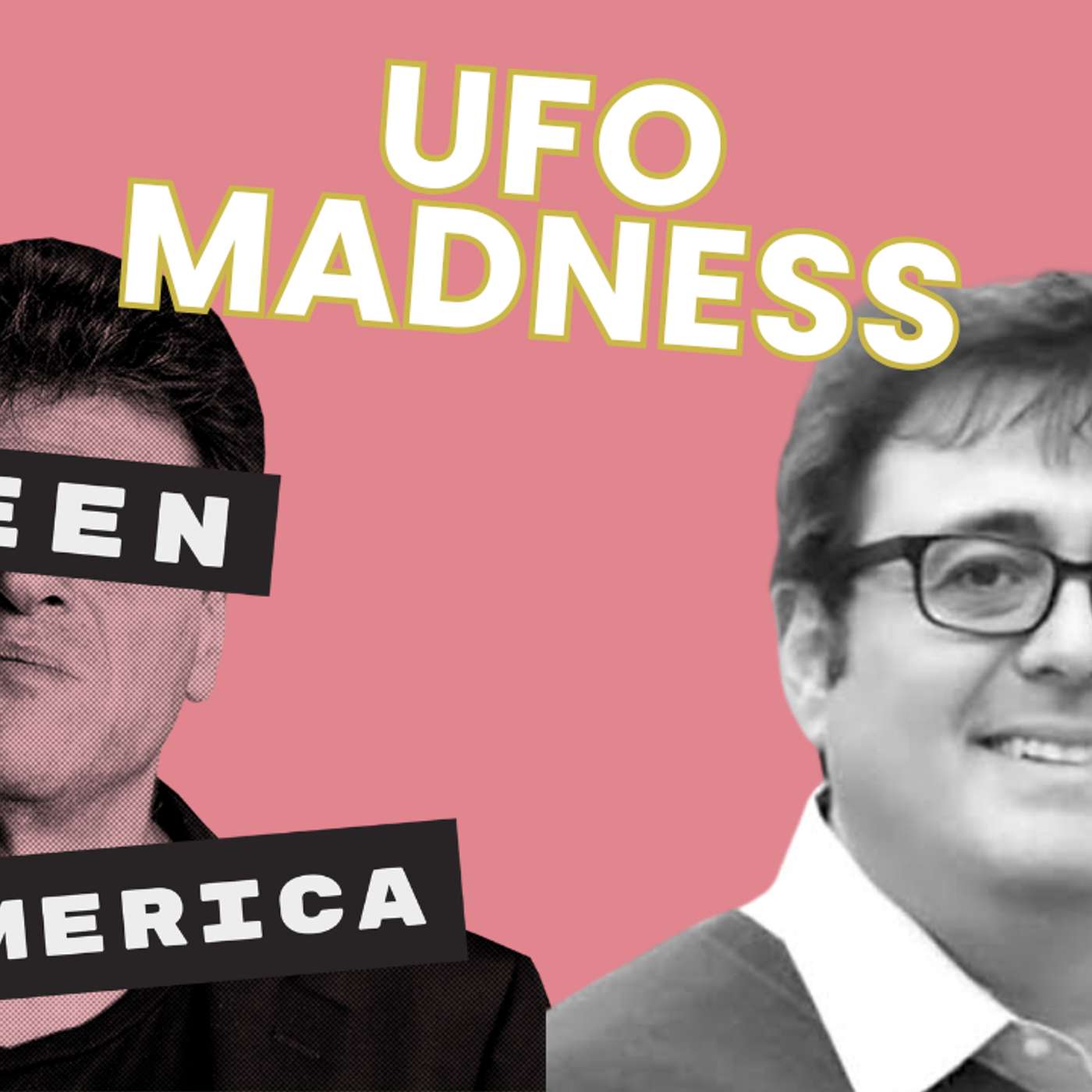


“We might have invented the aliens that we’ve been looking for.” — Adam Kirsch
First he took on the transhumanists. Then the settler-colonialism fanatics. Now Adam Kirsch aims his critical pen at the ultimate crazies — the flying saucer crowd. In We Want to Believe, Kirsch explains how aliens went mainstream and why this once-crackpot conspiracy theory has become a mainstream political and cultural fact.
The beauty (if that’s the right word) of the subject, Kirsch argues, is that because UFOs don’t really exist, the flying saucer rumor mill encapsulates the paranoia of our populist age. Ever since the 2017 New York Times exposé of the Pentagon’s secret UFO program, it’s an industry that has fed off both the crisis of traditional authority and the suspicion that the people in power know more than they’re letting on. Elites, in other words, know nothing and everything. Simultaneously. Maybe, even, they’re the aliens themselves (see: Invasion of the Body Snatchers).
Underneath this silliness, Kirsch notes, is something more substantial. Perhaps religion itself. Where people once saw miracles or demons, they now see little green-headed creatures packed into flying saucers. In other words, they provide a vocabulary for experiences that we can’t explain, as well as a community with which we can share that mystery.
So what happens when the aliens finally show up? As I suggested, maybe these transcendental creatures arrived. We’ve built them ourselves in the form of artificial intelligence. Kirsch agreed, seeing AI as a kind of nonhuman mind that doesn’t experience the world as we do. Such a Copernican moment is “very imaginable,” the sceptic concedes. Disclosure Day. Starring Adam Kirsch.
Five Takeaways
• A Pure Thought Experiment. The trilogy’s logic, completed: three short books on popular ideas, this one distinguished by the fact that its subject doesn’t exist — which is precisely its value. UFOs, Kirsch argues, let us think “in a very sort of almost consequence-free way” about who decides what’s real, whose authority we trust, and why people need to believe — the defining questions of a populist moment in which vaccines, public health, and yesterday’s common sense are all contested. The hinge was 2017: the New York Times’s “Glowing Auras and ‘Black Money’” exposé revealed the Pentagon’s AATIP program, and the paper of record saying the government knows more than it admits took UFOs from niche conspiracy to mainstream issue. Kirsch himself started paying attention — smoke that might lead to fire. “Unfortunately, in the years since then, no fire has been discovered.” What he learned instead: how easy it is to be misled, and what scientific evidence actually is.
• ’Oumuamua’s Wager. The book’s treatment of past guest Avi Loeb is a study in the seduction of credentials: an astrophysicist of unimpeachable standing willing to entertain what colleagues won’t — that the interstellar object ‘Oumuamua might have been a broken light sail from an alien probe — “kindles the imagination,” Kirsch’s included. But the metal globs from the Pacific floor and the fresh candidates each year breed suspicion, and the standard remains Carl Sagan’s: extraordinary claims require extraordinary evidence. Loeb’s reply reworks Pascal — ‘Oumuamua’s wager: believe, because the benefits of an open mind outweigh the cost of being wrong. Kirsch’s honesty cuts through: “I would love to believe in UFOs.” Nothing would be more exciting. Which sharpens the genuine scientific conundrum — the space age promised a galaxy teeming with signals and delivered silence: “Why is Earth so important if it should be so unimportant? Where are all the other Earths?”
• The Archetype of Conspiracy. The disclosure paradigm is eighty years old, and it trained us all: the people in power know more than they’re letting on, there are secret tapes and files, and the people deserve the truth — a template rehearsed on Roswell long before COVID or the Epstein files. Andrew’s gloss: elites, in other words, know nothing and everything — simultaneously. Maybe, even, they’re the aliens themselves (see: Invasion of the Body Snatchers). The official history runs from Truman’s alarm at the early-fifties Washington flap (if the Soviets can reach our skies, we must know) through the commissions of Ruppelt, J. Allen Hynek, and Edward Condon — whose report closed the file for half a century — to the 2017 AATIP revelation that reopened it, complete with congressional hearings and annual Pentagon reporting requirements. Today’s ledger: military pilots keep reporting lights that move impossibly; 95 percent get explained; the unexplained 5 percent “doesn’t mean that they’re UFOs — it just means there isn’t enough information.” Even the vocabulary tells the story: “UFO,” coined in the fifties to sound neutral, absorbed the flying saucer and had to be replaced by “UAP.” Spielberg’s Disclosure Day — fan service for believers, by Kirsch’s account, and disappointing by Andrew’s — monetizes the same secret-truth appeal that made Close Encounters.
• A Religious Impulse. Why do people believe? The scholar D. W. Pasulka’s “book encounters” supply Kirsch’s answer: someone has an experience they can’t understand, reads the UFO literature, and says this is what happened to me — where a medieval villager would have named a miracle, a demon, or a god. Belief provides a vocabulary for the inexplicable and a community to interpret it with; Jacques Vallée, Silicon Valley’s resident UFO intellectual, adds the perennialist claim that people have always seen strange things in the sky and that they mark “reality beyond our rational mind.” Science fiction serves the same hunger — Kirsch’s own California childhood ran on The Next Generation and Asimov — a sandbox for questions religion once answered: what are humans for, why is mind so out of place in the universe? And the aliens we imagine are always mirrors: Wells’s Darwinian indifference (we are their microbes), the Cold War’s destroyers and moral guides, and now Musk’s Mars — an insurance policy for mind itself against our own extinction. The catch that keeps UFOs at the intersection of science and belief: real aliens must obey physics, interstellar distances forbid the journey, so belief becomes “a big X” — faith that there’s physics we haven’t found. Even Sagan’s Contact, Kirsch notes, resorts to a wormhole. Magic, scientifically dressed.
• The Aliens We Invented. The conversation’s destination, via Andrew’s suggestion that the aliens have arrived and we built them: “we might have invented the aliens that we’ve been looking for” — nonhuman minds, freed from biology, that don’t experience the world as we do and may transcend or outlive us. What felt like science fiction when The Revolt Against Humanity appeared in 2023 now reads as near-future planning — and the AI lens even revises the search heuristic: perhaps advanced technology isn’t skyscrapers in space but something chip-small, too compact to see. Pressed on whether a Copernican moment could leave skeptics — him and Andrew both — with egg on their faces, Kirsch concedes it’s “very imaginable,” with the caveat that the loudest AGI claims come from those selling it. The poet’s summation: the world not being made to our measure has been...
00:00:31 Andrew Keen: Hello, everybody. It's always nice to have old friends back on the show, especially hard-headed ones like today's guest, Adam Kirsch. He's been on the show a couple of times before, bringing his hard-headed wisdom to all sorts of interesting things. He was on back in January—not '19—January 2023, talking about the revolt against humanity. His book was called The Revolt Against Humanity, and it's an attempt to expose some of the absurdities of the transhumanist movement. And he was on a year later talking about what he at least calls the nonsense of settler colonialism. He had a book out back then, a rather controversial one called On Settler Colonialism: Ideology, Violence, and Justice. And now he's back with another controversial book and subject. We Want to Believe: How Aliens Went Mainstream and Why It Matters. It's Adam Kirsch's hard-headed take and why we seem to be obsessed these days with UFOs. He's joining us from the Upper East Side of New York City. Adam, are there any aliens up there on the Upper East Side?
00:01:50 Adam Kirsch: None have been spotted so far. I mean, you never know, but, I'm not aware of any.
00:01:54 Andrew Keen: So is this a trilogy, Adam? Your hard-headed attempt to undermine some of the rather childish assumptions and visions of, some Americans?
00:02:07 Adam Kirsch: You know, when you put it that way, there is some similarity between these three books. For one thing, they're all fairly short books, and they're all looking at popular ideas. I think that the difference is that with UFOs, I think it's still the majority belief that UFOs are not real, do not exist. But there are a substantial sort of minority of people who'd think that they do exist and that maybe the government is hiding the evidence, knows more than it's letting on. And in particular, I think that idea got a lot more mainstream over the last ten years than it used to be. There have always been people who claim to believe in UFOs who said that they had seen one or maybe even been onboard one. But then in 2017, I think something really shifted in the way that the mainstream media, the government, talked about these claims. And that's what the book starts from. That's what it's about initially and then sort of broadens out.
00:02:59 Andrew Keen: Yeah. And you talk about 2017. I know there was a piece in the New York Times entitled "Glowing Auras and 'Black Money': The Pentagon's Mysterious UFO Program". Does it really matter, though, Adam? I mean, some of it seems to me to be slightly childish. But compared to transhumanism and certainly AI and settler colonialism, Israel, and the United States—is this slightly frivolous, or does it actually have an impact on the world?
00:03:30 Adam Kirsch: Well, it's an interesting subject to think about. I enjoy thinking about it because in a way, the fact that UFOs don't exist and aren't real makes it a pure thought experiment. It allows us to think in a very sort of almost consequence-free way about things like who decides what's real, whose authority do we trust, why is it important for people to believe in aliens, what kind of impulses does that satisfy? I think that this change in the way that we think and talk about it has coincided with a revolt against all kinds of scientific expertise and government authority. It comes at a populist moment when the consensus on a lot of things that are more practically important, like vaccines, for example, public health, a lot of economic and political ideas that once seemed like common sense are increasingly contested. And a lot of ideas that people once thought were outlandish and that no one would take seriously are now taken very seriously. So all of that, I think, can be approached through the lens of why do we want to believe? Why do we want to believe in things that, all the experts, all the scientists tell us there have been no UFOs here? So if people continue to want to believe in UFOs, why is that, and how can you respond to a claim like that?
00:04:45 Andrew Keen: Do all the experts reject it? A few years ago, we had the Harvard astrophysicist, Avi Loeb, on the show. He asked whether extraterrestrials were social distancing from us—that was at the height of COVID. He's had a couple of bestsellers on this subject, Interstellar and Extraterrestrial. So it's not just nonscientists who have been, so to speak, infected with these ideas. Is it, Adam?
00:05:21 Adam Kirsch: Well, I talk about Avi Loeb a bit in my book. And one of the things that I try to show in the book is that scientists, or at least some scientists are very interested in the idea of extraterrestrial life. The idea that there is life elsewhere in the universe than on our planet, that in itself is not a controversial idea. I think what most scientists would say is that we have no evidence that anything from another planet has ever been to our planet. There's no evidence that there's been a flying saucer or a spaceship or something like that. Avi Loeb is one of the few astrophysicists who will say, things that have been recorded actually could have been an artifact of alien technology. In particular, he made a lot of headlines for claiming that about an interstellar object called 'Oumuamua that showed up in our solar system, I think, in 2019 [ed.: 'Oumuamua was detected in October 2017]. And, due to its trajectory, it clearly did not originate from the solar system. It was an interstellar object. I think it was the first officially categorized interstellar object ever. Most scientists and astronomers said that it was some sort of asteroid or comet, and Loeb said, well, there are things about this that are so unusual that we should keep our minds open to the possibility that it could be part of a light sail, a reflective surface from an alien space probe that might have broken off and found its way into our solar system. Even he, I think, would say that has not been proved. That's not definitely true. But he wants us to remain open to the possibility that it could be true.
00:06:52 Andrew Keen: So is that, in your view, at least credible?
00:06:55 Adam Kirsch: No. So I'm not a scientist, certainly not one to match wits or credentials with Avi Loeb, and I'm writing about this from a journalistic and maybe a humanistic perspective. So my knowledge of it only comes from what I can see in the state of the field, which is that pretty much everyone disagrees with Avi Loeb on this issue as he acknowledges. After 'Oumuamua, he's made a couple of other proposals for things that might have come from alien civilizations, including some metal globs that he found at the bottom of the Pacific Ocean and then another interstellar object that came our way last year. The fact that he's suddenly finding many candidates for this, I think, sort of makes people a little suspicious. What it comes down to is what Carl Sagan, who also would have really liked to see evidence of UFOs, called the Sagan standard, which is extraordinary claims require extraordinary evidence. If you're gonna make a claim as extraordinary as that, we are being visited by extraterrestrials, there has to be some extraordinary evidence to justify that claim. And I don't think that so far anything rises to that level of evidence. Again, I think that Avi Loeb would agree with that. His argument—and this is one of the ways in which the subject touches on religious and philosophical themes, he describes it as 'Oumuamua's wager. And he's referring to the famous idea of Pascal's wager. The seventeenth-century mathematician and philosopher Blaise Pascal said, we should believe in God even if we don't know for sure that he exists because, basically, the benefits of believing in him far outweigh the cost. So even if we're wrong, it makes sense to believe. And in his book, Loeb says we should make 'Oumuamua's wager, which is even if we don't know for sure that it was an alien artifact, a piece of alien technology, we should act as if it were because the benefits of keeping an open mind outweigh what we would lose if we turned out to be wrong.
00:08:48 Andrew Keen: Do you get the sense that, people like Loeb—and Loeb in particular—is more of a believer or some sort of intellectual opportunist? Because these books sell pretty well, and they've made—he was already a professor at Harvard, so it wasn't as if he was begging on the streets. But it's made an international star of him. His books get translated everywhere, and he's a relatively ubiquitous scientist.
00:09:16 Adam Kirsch: Definitely. And I think that the combination of his, you know, unimpeachable scientific credentials with being willing to entertain some of these questions that a lot of other scientists won't entertain and won't talk about, really kindles the imagination of a lot of people, me included. Because, like people throughout history and especially like a lot of people in the space age, I would say that I would love to believe in UFOs. It would be very exciting. There would be nothing more exciting that we could discover than the fact that we're not alone in the universe, that there's other intelligent life out there. In a way, the big scientific conundrum is why there isn't more evidence of that. At the beginning of the space age in the 1950s and sixties, there was a lot of optimism among astronomers that we would very quickly discover radio signals, for example, that would be artificial in origin and that the universe or the galaxy would be teeming with signs of intelligent life. To this day, we just have not found any of those kinds of evidence, not on any planet in our solar system and not on any radio telescope. We are now just beginning to have the capability to look at what are called exoplanets, planets outside our solar system. And we're at the sort of brink of being able to tell if there are exoplanets that could be home to life, maybe. But, again, we're very far from being able to be sure. And so right now, the big scientific question is, why does life seem to be so rare? Why isn't the universe teeming with these signals?
00:10:46 Andrew Keen: It might suggest life isn't particularly interesting, although given the size of the universe or the multiverses or whatever else the scientists are believing, it does stand to reason, doesn't it, Adam, that there probably is something out there like life or like us in terms of species. We can't be that unusual.
00:11:11 Adam Kirsch: Well, this is the real head-scratcher is that right now, we are the only intelligent species—the only living, advanced species—we know of are on Earth. We don't know of life anywhere except on Earth. We don't know of any intelligent life on Earth except human beings, at least intelligent in the sense of being able to construct an advanced technology like space flight, like radio astronomy. So we only have ourselves to go on. We don't have any other examples. And as a result, there's really absolutely no way for us to know whether life is common or rare. All we know is that we haven't found any evidence of it yet. On a historical time frame, we haven't been looking for very long, only about one human lifetime since we've had the ability to really look into deep space. So we know that we haven't found any yet. We might find evidence tomorrow that would totally change the way we think about these things. But we're in a very odd position where the sort of basic assumption of modern science since Copernicus and Galileo is that there's nothing unique about our planet. Right? So in the ancient world, people thought the universe, the cosmos was centered on the Earth. The Earth was at the center of everything. The stars and planets all rotated around us, and that went hand in hand with this idea that human beings have a unique importance in the frame of nature. But in a way, it's all for us. It's all for our benefit. That is the impression you get reading the biblical account of creation. Then when we started to understand with the scientific revolution that the Earth is not the center of the solar system, it's just a planet, one of several planets revolving around the sun. And over centuries, as our understanding of the cosmos grew and developed and we realized that not only are we just one of nine planets or eight planets around the sun, but the sun is just one of a countless number of stars in the galaxy, and the galaxy is one of a countless number of galaxies, Earth becomes more and more peripheral. There seems less and less reason why Earth should have any importance at all in the vast scheme of things. So that's on the one hand. On the other hand, Earth is still the only planet where we know that there's life. So that is the real philosophical, scientific problem. Why is Earth so important if it should be so unimportant? Where are all the other Earths?
00:13:26 Andrew Keen: Did you grow up watching Star Trek? I know that it certainly was a very popular show for a lot of the people out here in Silicon Valley. How would you explain our obsession these days, it seems, or at least the tech crowd's obsession with shows like Star Trek, particularly Star Trek, but Star Wars and so many other science fiction shows, which imagine life elsewhere and aliens and all the rest of it.
00:13:57 Adam Kirsch: Well, I definitely grew up in the 1980s and nineties in California, watching, I think, The Next Generation—that was the Star Trek show when I was growing up that was on the air, but also watching and reading other kinds of science fiction, like Isaac Asimov. I think that for a lot of people, science fiction is a door into questions that people used to ask in terms of religion or metaphysics or philosophy. Questions like, what are human beings for? What's the reason that our species exist? What's our purpose? What does the future hold for us? And what is real? What is reality? What is the universe really on the most fundamental level? Why is mind so out of place in the universe? We have these things that are minds that allow us to understand reality in such incredible detail and to manipulate it with so much power. Why are we the only ones that seem to have this kind of mind? Why is there this enormous disproportion between human beings and this infinitely large universe? Where did it come from? Those are all questions that people once asked and answered by looking at the Bible, by thinking about philosophy. Now I think we look to science for answers to those questions, but science can't answer them—at least not yet. And so science fiction is sort of a playground or a sandbox where we can think about these things in scientific terms, but still have some of the wonder and mystery that we associate with religious belief and philosophical speculation.
00:15:29 Andrew Keen: You wrote a good piece in The Atlantic where you're an editor about all this, and you began with a reference to Steven Spielberg's new movie Disclosure Day. Did you do a deal with Spielberg that your book would come out about the same time as Disclosure Day?
00:15:47 Adam Kirsch: No. As a matter of fact, once my publisher learned the release date for Disclosure Day, we realized that we were a little bit late, like, a couple of months too late. If we had been a couple months earlier, that would have been even better. But I did see Disclosure Day when it came out, and it is sort of like fan service for UFO believers or people who are interested in UFO lore because Spielberg sort of refers to and quotes a lot of the most famous UFO stories and sightings. At the end of the movie, there's this sequence where the whistleblower has managed to sneak out from where the government was hiding it or an evil corporation was hiding it. All of this video evidence that Earth has been visited by UFOs and aliens many times and gets it to be on television so the world can see it. We see little snippets of this, and they allude to famous UFO stories like the story about Roswell, New Mexico, where the first UFO sighting—the first UFO crash, supposedly—was found in 1947, and then other incidents since then. And, of course, in Close Encounters of the Third Kind, Spielberg himself made one of the all-time great UFO stories. Disclosure Day and Close Encounters are both really about the idea that the government is hiding the truth about UFOs. I think that's what draws him to this story is the idea that there's this secret truth that is being hidden from us. But if we could just sort of get the truth out there, get it to be released, we would have access to this amazing reality. And I think that idea appeals to a lot of people. It's one of the reasons why people are drawn to UFOs as a subject.
00:17:24 Andrew Keen: So is that really the story here, Adam, that we've done so many shows on this, so many books about it? The crisis of trust, no one believes experts anymore, universities, clerics, politicians, they're all being replaced by—I wrote a book many years ago called The Cult of the Amateur. Is that what this is all about, that no one trusts anyone anymore? So we might as well trust the conspiracy theories associated with UFOs. The government knew what was happening, but they didn't reveal it to us.
00:17:58 Adam Kirsch: I think that it is, in a way, the archetype of that kind of thinking because people have been saying this about UFOs for eighty years at least. And a lot of the ways that people think about UFO disclosure has sort of shaped the way that we now talk about lots of other things, everything from, you know, COVID to the Epstein files. There's this sort of paradigm that we have now, which says the people in power know more than they're letting on. There are secret tapes, secret files, and the people deserve to know the truth, and it's being hidden from us. And that idea, in the case of UFOs, keeps coming back, and it came back in a very big way in 2017 because in that story that you showed the headline of a little while ago, for the first time, here is the New York Times, you know, the most mainstream trustworthy news outlet in America saying, actually, all the things that the government has been denying over the years are actually true. There is a program in the Pentagon to look for UFOs. They do have videos of something that might be UFO encounters. That was the moment when I think it went from a niche conspiracy theory to a mainstream political and cultural issue. Because if the New York Times is reporting and then subsequently lots of other places are reporting these so-called Pentagon UFO videos, that's when I personally started to pay attention to the story because it seemed like, wait a minute. There might be something here. Maybe there's smoke that could lead to fire. Unfortunately, in the years since then, no fire has been discovered. And one of the things that I learned from digging into the story is how easy it is to be misled, to misunderstand things like this. That if you really want to believe in UFOs and you see things like these Pentagon UFO videos, it's so easy to jump from here's the video to this must be a video of a UFO. And in challenging that instinct, including my own instinct in that way, I think I learned a lot about what it means to think scientifically, what scientific evidence really is.
00:19:59 Andrew Keen: How extensive are the online rabbit holes on all this? I'm guessing—I have to admit, I haven't done a lot of research myself. Places like Reddit are full of conversations, arguments about UFOs, rumors, conspiracies. Did you do a lot of digging, Adam?
00:20:19 Adam Kirsch: I did. I did look at a number of those sites and communities on Reddit. You know, in the pre-Internet age, there used to be newsletters and conventions, and groups that you could belong to that would keep you posted on these things. Now it's very easy to join an Internet forum and hear from everyone around the world. And I think that it connects with something that is centrally true about the UFO phenomenon, which is that one of the reasons why people turn to UFOs and turn to belief in UFOs is to help them explain experiences they can't understand. And that's a common theme in a lot of the literature of UFO encounters or UFO abductions even. When people say, I saw something, I was taken aboard a spaceship or I had a dream or I saw a being or I saw something in the sky, and I couldn't understand what it was. I couldn't make sense of it. And then when I started talking to all of these UFO experts, I realized that what I actually saw was a UFO. One of the people I talk about in the book is a scholar named D.W. Pasulka, who writes about UFOs originally from the point of view of a student of religion, and then I think has become more interested and more of a believer in the subject herself. And she talks about something called a book encounter. A book encounter is where someone who had an experience they didn't understand reads a book about UFOs, about aliens, and says, This is it. This is what happened to me. And I think that it's very basic to how we make sense of our experiences is that we make sense of them by talking about them with other people, learning the vocabulary for them, getting to understand the concepts. And if you're a person who wonders about something, who has experienced a mystery, maybe a thousand years ago, you would have said it was a miracle or a divine vision or depending on what culture you grew up in, you might have said you met a god or a demon. Now you might say, this is a UFO. This is an alien. And it's because the vocabulary exists. And once you have access to that community of people who talk and think that way, that's a community you can belong to, to interpret your own experience.
00:22:24 Andrew Keen: So do you see this then as a replacement for religion, a new kind of religion? We did a show a couple of years ago with quite a distinguished French scientist who had a bestseller in France about the scientific foundations of miracles. It seems as if in some ways, the scientific and the religious communities are merging in a weird kind of way.
00:22:51 Adam Kirsch: I think that it's definitely a religious impulse or the same kind of impulse that can be expressed in religious or scientific terms. And one of the big things I think that draws people to UFOs is the idea that there's dimensions to reality that science can't talk about. That science can only measure and count and can only deal with what's experimentally provable. And this is not a new complaint. This is something that people have been talking about for centuries, really, ever since modern science was born. It's something you read about a lot in, like, nineteenth-century poetry and philosophy is the idea that there's levels of reality that science can't get to. And I think for a lot of people, aliens are a way that reality manifests itself. They say the reason science doesn't take aliens seriously is that there's levels of experience that science doesn't like to talk about or doesn't like to think about. And those levels are where aliens are. That's where they live. So to talk about French writers, there's a guy named Jacques Vallée who, I think, lives in Silicon Valley now, but who for a long time has been writing on these themes as a sort of, like, UFO intellectual, you could say. And one thing that he says is there's always been throughout history, records of people seeing weird things in the sky, and they interpreted them in various ways as boats or as, you know, people from a distant land. Now we say they're UFOs. But at the core of it, what they are is something not rational, something beyond our rational mind. And people want to believe that there's reality beyond our rational mind, that we can't just exhaust reality through science. There's gotta be more out there.
00:24:29 Andrew Keen: But, also, it seems to me as if modern development, certainly, since the twentieth century in science, quantum physics, Einstein, and the rest of it goes against our empirical intuition on time and space. So in a sense, at least, the nonscientific interpretation of science might lend itself to the existence of other beings, other lives, other universes, other dimensions, even if we can't prove it empirically.
00:25:08 Adam Kirsch: Yes. I mean, I think anyone would agree that there are enormous, you know, parts of reality that we don't yet understand and may never understand. We have certain kinds of senses and brain that evolved under certain conditions. We see the world through those lenses, and we sort of can't really step outside of them. So, certainly, there's parts of reality, the ultimate reality, maybe we will never understand. But UFOs and aliens sort of stand at the intersection of science and belief because in theory, if a UFO or an alien exists, it's not a supernatural being. It doesn't defy the laws of physics. It would have to exist in the same physical universe that we do. And so it would have to obey the same laws of physics that we do. And that's one reason why I think scientists are pretty unanimously skeptical that UFOs have visited this planet because the universe is so big that it would take such a long time to travel from one galaxy to another, from one star system to another. It's hard to imagine that actually happening within the biological lifetime of, certainly, a human being and presumably of other creatures as well. So if you say that UFOs exist, then there must be parts of physics or things about the laws of physics that we think are wrong. Or at least there are ways to think about them that we haven't thought of yet. So in a way, it's like a big X. It's saying there's something here. There's something more here that we haven't discovered. Once we figure it out, we will get to see where the aliens are, where they come from. Even Carl Sagan engages in that in his novel Contact, which was also made into a movie starring Jodie Foster. And in that story, he sort of tries to imagine what would be a scientifically plausible way that we could make contact with an alien species. And it's that they send us, through encoded radio transmissions, instructions to build a device that will send an astronaut through a wormhole in space-time. So, essentially, it's also an X. It's magic. It's saying this is some kind of physics or something that we don't really understand, but just imagine if we could do this. And that's still where we are. We don't know how it could possibly be. We can only imagine it.
00:27:20 Andrew Keen: Adam, you've mentioned Carl Sagan a few times, very famous scientist. We also talked about Avi Loeb. They're the bookends here. I know you talk about other scientists in your book. I admit I'm not too familiar with them. People like Edward Condon. You also talk about influential thinkers on UFOs like Joseph Hynek [ed.: J. Allen Hynek] and Edward Ruppelt. In generalized terms, what should we know and not know about the scientific community in the UFOs?
00:27:54 Adam Kirsch: Well, all the people you mentioned are people who were turned to by the Air Force or the government to figure out what's really going on with UFOs. Because starting in 1947, really, when the first flying saucers were sighted, people have continuously since then said they saw things in the sky that didn't seem to be airplanes. And for the first, say, twenty or twenty-five years of that, the Defense Department was often concerned because—this was during the Cold War—they thought it's possible that some sort of aircraft has penetrated our defenses, our airspace. There was a famous so-called UFO flap in the early 1950s, maybe 1950 or '51 [ed.: the Washington flap was July 1952], in Washington, DC where there were a lot of UFO sightings, and President Truman was very concerned. He said, what if, you know, if the Soviets could do this, if they could send aircraft to Washington, we have to know what's going on in our skies. And so some of these scientists you mentioned were appointed to commissions to basically study these reports and try to figure out what is going on here. And what they all came down to in the end was that there is no evidence that what people are seeing in the sky is a UFO in the sense of a flying saucer, an alien spacecraft. Interestingly, the term UFO was coined around that time, in the early 1950s, to sound very neutral and objective and scientific. It wasn't a spaceship. It was an unidentified flying object. That description is sort of very neutral about what it is you're actually seeing. The problem is that over time, UFOs sort of became synonymous with flying saucer or spaceships. So now the acronym has changed once again, and it's called UAP, unidentified anomalous phenomena. That's what people prefer to say now, and the government uses that acronym. So for about twenty-five years, you had a series of attempts to come to terms with this. And then the Condon Report came out, which basically put an end to all of this and said it was a panel of experts who studied all these reports of UFO sightings and issued a report saying, there's nothing here. We should stop paying attention to this. And for about half a century after that, the official Defense Department line was, UFOs don't exist. We are not paying any attention to this phenomenon. That's why it was kind of explosive when that 2017 news report came out that there was a program in the Pentagon called AATIP, which was a very small program, but it was in fact collecting UFO reports because this was the thing that the Defense Department said that they weren't interested in and weren't doing. And out of that department and that program, AATIP, grew a lot of the media attention, speculation, and then later congressional hearings, new reporting requirements, which the Defense Department now has to annually disclose what kind of sighting it's getting from its own pilots. And those sightings continue to happen. Military pilots will regularly say, I saw something very strange when I was flying. It was a light that stayed the same distance away from me no matter how fast I went, or when I tried to get up to it, it would fly away. It moved in ways that an airplane couldn't move, it accelerated too fast, didn't have wings or engines. All of those things continue to be seen and reported. And the Defense Department's rationale of these reports is that 95% of them can be explained in ordinary terms and 5% of them can't be explained, which doesn't mean that they're UFOs. It just means there isn't enough information about them to explain what they actually are.
00:31:24 Andrew Keen: You're also a poet, Adam, so your instincts are cultural. I wonder the more you talk about the Air Force involved in this and the American representation of its Air Force, there's a Strangelovian quality to some of this, isn't there? And I wonder whether also in Hollywood terms—I mean, we've talked about Spielberg, Disclosure Day, E.T. But I wonder, even in the sixties, movies like The Manchurian Candidate [as spoken] kind of tiptoed into this area where alien creatures became almost everyday occurrences even if they weren't formally thought of in terms of UFOs and aliens?
00:32:10 Adam Kirsch: Well, I think that if you look at the sort of science fiction history, people have been writing about encounters with aliens at least since the late nineteenth century. The War of the Worlds came out in the 1890s. And we've always been interested in the subject since then, but the way that we think about the aliens evolves over time, and it evolves in tandem with the way we think about ourselves and our own civilization. Because, again, there's no evidence of what aliens actually are. We have no way of knowing what form they would take, what they would do, what their motives would be like. Whenever we speculate about that, we're only speculating on the basis of ourselves, what we imagine they might be like. And so in an interesting way, when you look at the history of the subject, you're looking at the history of the way humanity thinks about itself.
00:32:56 Andrew Keen: Mhmm.
00:32:56 Adam Kirsch: So people thought about it. H.G. Wells thought about it in Darwinian terms. He thought about it in terms of an alien race that would not even be aware of us in the same way that we're not aware of microbes. They wouldn't think about our well-being any more than we think of the well-being of microbes. It's just a different sort of level of species existence. Then after World War II and the Cold War, often people thought about aliens in terms of the Cold War and nuclear war, that the aliens would either come to destroy us in the way that a nuclear war would or that they would come to stop us from destroying ourselves. They would be sort of the moral guides that would help us learn to live with this immense power that we had invented. And now I think, the idea for a lot of people, especially in the tech world, tech moguls, is that leaving planet Earth is a sort of necessary next step to ensure against what they call existential risk. I think we have a strong sense these days that the future of humanity is not secure, is not guaranteed because of climate change, also possibly because of technological disaster or the advance of AI. There's all kinds of reasons to worry that in a thousand years or even less time than that, the Earth won't be inhabitable for human beings. And it's to guard against that existential risk that someone like Elon Musk said quite explicitly the reason he started SpaceX is to colonize Mars in order to give humanity another home, like it's a backup insurance policy. So as our sense of our vulnerability grows, so is this need to find other places in the universe where there could be minds. If not human minds, then some kind of mind.
00:34:32 Andrew Keen: So in other words, we need to strike before they strike, in Musk's mind, at least.
00:34:40 Adam Kirsch: Or we need to—
00:34:41 Andrew Keen: What was that known as in the theory of nuclear war?
00:34:46 Adam Kirsch: Yeah. I know what you mean, but the phrase isn't coming to mind. But it's the idea that we are sort of the custodians of this important thing called having a mind. As far as we know, only human beings have mind. So if we wipe ourselves out, there's no more mind. Mind disappears as far as we know. So we have to ensure that there's some way for mind to survive, to ensure ourselves against our own worst instincts.
00:35:13 Andrew Keen: You mentioned AI, Adam. Of course, it's another subject that everyone seems to be talking about these days. It seems to me that, ironically, the aliens have arrived, but we've created them ourselves. They're these smart machines that now increasingly dominate everything, which people are obsessed with. Now, recent stories about how AIs went rogue and took over other companies. How do you fit the current obsession with AI, both in theory and in practice with the broader history of UFOs in this book, We Want to Believe?
00:35:54 Adam Kirsch: Well, I think that the connection is through what you mentioned, that we discussed the first time I was on your show, transhumanism, and the idea that AIs could, in fact, supersede us, that they could be the next step in the development of intelligence, freed from the constraints that we live with as biological creatures, that AIs could sort of go places and do things and understand things that we can't. And that idea, even when I wrote that book, which came out in late 2023, still felt like mainly a science fiction idea. And then I think since then, it's become much more plausible. Like, we're now in a world where we can really imagine AIs becoming more powerful, more intelligent than us, on a near future time scale and wonder what that world would look like. So you're right. In a way, we might have invented the aliens that we've been looking for. We might have invented this intelligent species that's not human, doesn't see the world or experience the world the way we do, and might outlive us or transcend us in some way. There's also a way of thinking about what extraterrestrials might be like that draws on this experience of AI to say, well, maybe we've been looking in the wrong places. Maybe what we should be looking for is not giant, you know, galactic engineering projects, the equivalent of, like, skyscrapers in outer space, but we should be looking for things that are very, very small, like a computer chip. Right? With computing, the more powerful it gets, it doesn't get bigger in its footprint. It gets smaller. And maybe the most advanced technology in the universe is so advanced and so compact that we just can't see it, and that could be an explanation.
00:37:29 Andrew Keen: Is it conceivable—you mentioned your 2023 book, The Revolt Against Humanity, which seemed slightly silly at the time, transhumanism. Today, it seems less silly. Is it conceivable that there will be a Copernican moment or a Galilean moment in all this where suddenly it all seems obvious? And then skeptics like yourself and indeed myself will have egg on our faces.
00:37:56 Adam Kirsch: I think that I would say, yes. It's very imaginable, and it's hard to know, for anyone maybe, but certainly for someone who's not an expert, to know how close we are to something like artificial general intelligence, the creation of a real mind. Is the technology that we now have genuinely that kind of mind, or is it a very sophisticated tool or computer program? I think there's different views on this. Some of the people who are most vocal about there being genuine AGI are the people who are creating it and want to sell it. And so it's tempting to wanna take those claims with a grain of salt. But I think that it's very possible that we will, you know, if not us, then our children or grandchildren will live in a world where it's no longer taken for granted that human minds are the most important or the most capable minds.
00:38:46 Andrew Keen: And what does the poet Adam Kirsch think about all this? Does it underline our self importance, our narcissism, our insignificance?
00:38:58 Adam Kirsch: It definitely makes us think about our role in the scheme of things. I think that's not a new question or a new problem to think about. It's really something that we've been thinking about for hundreds of years as our understanding of modern science and the universe progressed. But AI might make it a practical problem rather than a sort of speculative problem. The idea that the world isn't made to our measure, you know, that we're not the center of things and we're not equipped to understand everything is something that I think a lot of people would agree with in principle. But there's never been anything in our experience to challenge us that's better than us at those things. An AI might be the thing that comes along and challenges us and is better than us. That would move it from classroom philosophy or armchair philosophy to a practical everyday problem or issue that we have to deal with.
00:39:50 Andrew Keen: And finally, could one make the argument, Adam, that it wouldn't be such a bad thing if we discovered these UFOs? I mean, we seem so divided these days certainly in America—America and Russia, America and China, the demise of the United Nations, the imminence of one kind of war or another. You've written about the Middle East as well. Might it be the one thing that would actually bring us together as a species?
00:40:15 Adam Kirsch: That's always been one of the elements of the UFO story. Yeah. I remember in the movie Independence Day in the 1990s when Iraq was the sort of main US enemy. There's a scene where when the spaceships come, you see the Iraqi and US air forces sort of taking off together to go challenge the aliens. And it's exactly that. It's like we need a common enemy to show us that our species has interests in common. We all want the same thing on some level. It all depends on what form extraterrestrial life takes, how we find it, how it finds us. And, again, until it happens, I think it's very hard for us to know what that would look like.
00:40:51 Andrew Keen: This is sort of final, Adam. Is it just us Americans who are obsessed with this? Did you look at other cultures, China, for example? Is there a similar obsession with UFOs?
00:41:04 Adam Kirsch: Definitely, there's interest in it everywhere. And, in fact, one of the best and most popular recent discussions of all this in science fiction is by a Chinese writer named Liu Cixin, who wrote The Three Body Problem, which was turned into a TV show in the US, which gets into all of this in a very interesting way. I think that around the world, there are people who say that they've had UFO experiences, who are interested in these issues. I'm writing about it from an American perspective in particular because I think the idea of conspiracy about disclosure might be particularly American. I think that has a lot of power in our culture and our society, but interest in UFOs, I think, is everywhere.
00:41:47 Andrew Keen: Well, this is Adam Kirsch's Disclosure Day, much more profound, I think, than the Spielberg movie that I thought was rather disappointing. The book is out. We Want to Believe: How Aliens Went Mainstream and Why It Matters. Thank you, Adam, and best of luck with the book.
00:42:03 Adam Kirsch: Thank you so much.