How We Got the Thirties Wrong: William Hitchcock on FDR, Fascism & America’s World War II
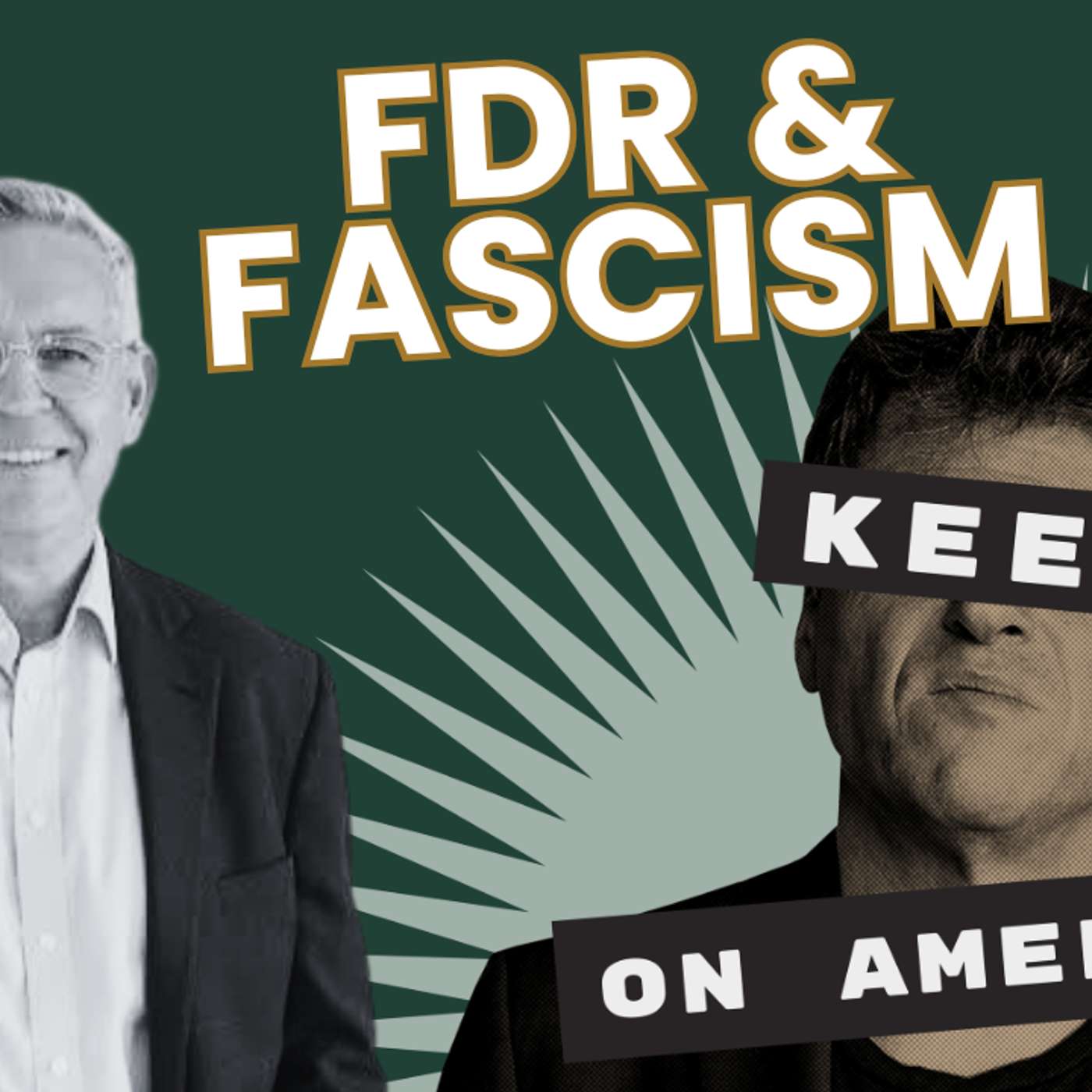


“We’ve taken our democratic functioning for granted, and we’ve forgotten what it looks like to actually have to fight for it.” — William Hitchcock
Today is the twenty-fifth anniversary of 9/11, and there’s a lot of sombre talk about the forever wars triggered by the attack. But sometimes, fighting evil might be necessary. So argues William Hitchcock, whose A Shadow Over the World is a major new history of Franklin D. Roosevelt, the rise of fascism, and the making of American involvement in World War II.
We got the thirties wrong, Hitchcock says. The conventional view is that an interventionist FDR was hamstrung by an isolationist American public. Thus the US’s tardy entry into the war. The truth, Hitchcock argues, is the opposite. Judging from the period’s magazines, radio, films, and plays, he finds that most Americans hated fascism and wanted to act, while Roosevelt wanted nothing to do with Europe until after Munich. Having become an interventionist, FDR managed the propaganda war with such trademark sophistication that “isolationist” and “appeasement” became the nastiest insults in Washington DC. So insulting, in fact, that American policy makers still deploy them today, with every adversary a new Hitler, every negotiation a new Munich.
Because the isolationists ended up as history’s villains, Hitchcock says, we’ve back-projected a narrative in which the 1930s public had its head in the sand and FDR was the lone farsighted interventionist. So the real thirties — featuring a vibrant public conversation about America’s role in the world, with the public actually more anti-fascist than the president — has gotten buried under FDR’s own accomplished myth-making.
And then there’s the F word. Are we back in fascist times? Is the 2020s a repeat of the 1930s? The UVA professor lives in Charlottesville, so it’s a particularly timely question for him. Hitchcock sees fascist behavior, he confesses, but not a fascist country. In the face of authoritarianism, he notes, America remains a vibrant democracy. Maybe that’s what the 2020s, with its public resistance to authoritarianism, has in common with the 1930s. History doesn’t repeat itself, as the line attributed to Mr America himself, Mark Twain, has it — but it rhymes.
Five Takeaways
• We Got the Thirties Wrong. The book’s revisionist core, against libraries of Roosevelt biography: the standard story — an interventionist FDR hamstrung by an isolationist public — is backwards. From fresh research in the periodicals, radio speeches, films, and plays of 1930s political culture, Hitchcock finds an American public that hated fascism and wanted to do something, while Roosevelt wanted nothing to do with Europe or Asia from 1933 all the way to Munich in September 1938. His gift, once converted, was finding ways to act short of war — and then vilifying the isolationists so thoroughly that appeasement became the great sin — insults American policy makers still deploy today, with every adversary a new Hitler and every negotiation a new Munich. The thirties Americans were more sophisticated than the caricature: they struggled to fight fascism while avoiding war. The decade, Hitchcock insists, was not a cautionary tale of heads in the sand but “a time much like our own,” when Americans argued about the right role for their country in the world.
• Coughlin, Not Lindbergh. The corrective to Philip Roth: The Plot Against America is a wonderful novel that overstates its villain. Lindbergh came late — speaking out only in 1940, joining America First in spring 1941, by which time “the table was set” and Roosevelt had won the war of ideas; polling showed two-thirds of Americans against Lindbergh’s views. The German American Bund, swastikas in Madison Square Garden notwithstanding, was small. Far more dangerous was Father Coughlin, the radio priest with millions of listeners undermining Roosevelt at every turn. The deeper discomfort: fascism was popular in America later than we like to admit — elites welcomed Mussolini in 1922, dictatorship carried no stigma, and Studebaker sold a sedan called the Dictator until 1937. (“Roth missed the trick,” Andrew noted. It should have been a Ford.) As for the New-Deal-as-fascism charge, leveled then and since: Roosevelt’s own answer — he was saving capitalism by making it fairer — holds, because fascism is not an economic program but war on enemies at home and abroad.
• The Sheriff and the Same Tree. The South’s paradoxes, which deserve a book of their own. In Congress, southern Democrats — including Carter Glass of Virginia, among the most racist senators of a racist era — were ardent interventionists, not least because rearmament dollars flowed to southern military bases. Meanwhile African Americans were the first to recognize fascism, because they already lived under it: “he’s right here in our courthouse… He’s the sheriff. He’s the mayor” — Jim Crow and fascism, branches of the same tree, as the Black press argued years before Pearl Harbor. Hence A. Philip Randolph’s high-stakes poker in 1941: threatening a million-man march he might not have mustered, he extracted the executive order barring segregation in federally funded defense plants — the first federal lever of the modern civil rights era. The enduring puzzle Hitchcock presses on his disbelieving students: America fought and won the great war for democracy with a segregated army. And civil rights remains, in his verdict, one of the biggest stains on FDR’s reputation — Eleanor’s Black Cabinet notwithstanding.
• The Making of a World Power. The trail of tears first: Abyssinia invaded, and America wouldn’t even embargo oil; Spain’s elected government denied weapons while the fascists poured in guns; the Anschluss, the Sudetenland, Munich — nothing. The switch, Hitchcock argues, came at Munich: Roosevelt grasped that American military weakness was itself the problem — nothing could deter Hitler’s testing — and by early 1939 the Neutrality Act was being unwound, billions were flowing into a new Navy (even isolationists loved a picket fence around the hemisphere), and 1940 brought peacetime conscription. The supporting cast makes the chapter: Martha Gellhorn’s letters from Spain — “a dress rehearsal of the coming conflict” — reaching FDR through Eleanor; the loathed Chamberlain (“there’s one thing Roosevelt couldn’t stand — condescending Europeans”); the Stalin gamble that made him look a fool at the pact and a prophet at Lend-Lease; and Dorothy Thompson, the Republican journalist expelled by the Gestapo, whose Herald Tribune columns FDR’s speechwriters lifted by the page. And then Hollywood’s convergence: Casablanca — written after its playwright visited Vichy France to rescue his wife’s Jewish family — with Rick as Roosevelt, hesitating in a cafe called White House until he joins the fight, in theaters just as GIs landed in North Africa.
• Not at Midnight Yet. The 2026 lessons, delivered from Charlottesville — Exhibit A, where 2017’s riot was “the kind of thing you could have seen in Weimar Germany.” First: normalization is the danger — the salami tactics of fascists mean “if they can get away with a little slice, they’ll keep slicing,” and the thirties’ sin was depicting Mussolini as harmless. Second: the demonizing instinct should be resisted — pressed on Susan Neiman’s forthcoming Ca...
00:31 - Introduction: 25 years after 9/11, when is war necessary?
02:00 - A just war — reluctantly
03:41 - The public hated fascism; FDR wanted out
05:09 - “We got the thirties wrong”
05:16 - How appeasement became the great sin
06:39 - Roth, Lindbergh, and The Plot Against America
07:33 - When America welcomed Mussolini
08:10 - The Studebaker Dictator
08:35 - Coughlin, not Lindbergh, was the danger
10:24 - Was the New Deal fascist?
14:42 - Dead armadillos: the brain trust’s contradictions
18:50 - The South’s paradox: Carter Glass and the same tree
21:45 - Randolph’s high-stakes poker
24:44 - A segregated army won the war for democracy
25:43 - FDR, Stalin, and the pact that made him look a fool
31:47 - The switch: Munich and the making of a world power
35:11 - Martha Gellhorn’s letters from Spain
39:48 - Loathing Chamberlain, watching Churchill
43:31 - Dorothy Thompson: the conveyor belt
45:24 - Casablanca: Rick is Roosevelt
48:10 - The lessons of 2026: salami tactics and normalization
52:36 - Is “evil” useful? The Neiman preview
53:29 - Charlottesville: fascist behavior, not a fascist country
54:49 - Not at midnight yet — Darkness at Noon
55:46 - What Democrats can learn from FDR’s supermajority
58:13 - My favorite Hitchcock
00:00:31 Andrew Keen: Hello, everybody. It is Friday, September 11, 2026, the twenty-fifth anniversary of 9/11. Lots of chatter in the media about ending the post-9/11 forever wars. In fact, yesterday, we did a show imagining the American war in Iran, as America's new forever war. Wars are, of course, extremely unpleasant. And my guest today is all too familiar with that, William Hitchcock's The Bitter Road to Freedom: The Human Cost of Allied Victory in World War II was a 2009 Pulitzer Prize-winning— finalist. But sometimes wars are necessary. And Hitchcock's new book, A Shadow Over the World: Franklin Roosevelt, the Rise of Fascism, and the Making of America's World War II is out next Tuesday. William Hitchcock, Bill [as spoken: Will], is joining us from Charlottesville where he teaches history at UVA. Bill [as spoken: Will], congratulations on the new book. Sometimes then war is necessary. Is that a simple condensation of this new book, A Shadow Over the World?
00:02:00 William Hitchcock: Well, there's a long process that you have to go through to get to the point where there are no alternatives. So I would like to stress that this is not some claim that war is the answer to our problems. But in 1940, 1941, the American public and Roosevelt finally converged on an argument that stopping fascism was not only important or morally right, it was the only way American democracy itself could survive. So, yes, in this case, it was a just war, one that Americans reluctantly committed themselves to. But I want to stress that I'm not suggesting that somehow war is always the answer and quite the opposite as we've known since the post-1945 world, war has brought untold suffering and has often been unnecessary. But 1940, 1941 is a different period.
00:02:51 Andrew Keen: So the conventional view, Will, as I know you take on in the book, is that Roosevelt was, an uncomfortable isolationist or at least forced into isolationism by the general fear of war in the United States, having experienced the First World War, and that he did everything he could to stay out of the war until the bombing of Pearl Harbor, in December 1941, which made war inevitable. You take on this argument in the book. Is that fair that he was never much of an isolationist and was tiptoeing, so to speak, into recognizing the inevitability of war even before Pearl Harbor?
00:03:41 William Hitchcock: Look. There's libraries of Roosevelt biographies that basically converge around the idea that Roosevelt was hamstrung. He was constrained by an isolationist American public. And that because the public was so isolationist and wanted to have nothing to do with Europe or Asia, Roosevelt's hands were tied. But personally, he deeply opposed fascism, and personally, he wanted to act. And personally, he was looking for ways to assist the European democracies. The reality is exactly the opposite. Roosevelt did not want to have anything to do with European and Asian affairs in 1933 all the way up really to the Munich Conference in September 1938. But the American public was far more engaged with what was going on in Europe. And I have done an enormous amount of what I think is fresh research into the periodicals, the publications, the radio speeches, the films, the plays of American political culture in the 1930s. Americans hated fascism. And it's not that they wanted to pick a fight with Hitler or the Japanese, but they wanted to do something. And it was Roosevelt's gift to find a way to do something short of war before, Pearl Harbor. So I want to emphasize that I think we have the thirties wrong. The thirties is a cautionary tale. Like, let's not go back to that terrible time when Americans buried their head in the sand. Actually, it's a time much like our own when we were having an argument about what's the right role for America in the world.
00:05:09 Andrew Keen: I've got the title for the show. We got the thirties wrong. Why?
00:05:16 William Hitchcock: That's a good question. And there are two explanations. One is that Roosevelt, once he became committed to a policy of aiding the democracies, sending millions of dollars of weapons and aid to Britain, to Russia, and to China even before Pearl Harbor, he began to vilify the isolationists, and he turned them into a kind of toxic political brand. Appeasement became the great sin. And this was then doubled down on in the early Cold War. In the early Cold War, the worst thing you could ever call anybody was an appeaser. Nobody wanted to be Neville Chamberlain, et cetera, et cetera. So it became, a kind of absolute ironclad rule of international relations that appeasement, conciliation, negotiation, those were bad things. The world was black and white. You were either with us or you were against us. And as a matter of fact, diplomacy is much more complicated than that and people are more complicated than that. But, isolationism was turned into this sort of horrific, naive, foolish game that only a few crazy people would ever play. And I don't think that's right at all. The thirties Americans are far more sophisticated than that. They were looking for ways to fight fascism, but avoid war. That's a difficult balance to strike, and they talked and struggled through that problem in the 1930s.
00:06:39 Andrew Keen: Many of the viewers and listeners, I think, for this show will have read, Philip Roth on this period, who, of course, wrote a remarkable novel about Lindbergh. Is Roth's version of the thirties fictional? Is it true? Was there a substantial body of Americans who loved Lindy, and could be compared and contrasted very directly with FDR? And how did it I mean, you mentioned Americans recognized fascism, but how did it break down in terms of ethnicity? I mean, it wasn't just, of course, the Germans who were fascists, the Italians too. And America was made up of considerable numbers of German and Italian immigrants. So— yeah. Did that play a muddying role too?
00:07:33 William Hitchcock: Yes. I mean, one of the things that I talk about at some length in the book is when fascism first came on the scene in 1922 with Mussolini's, March on Rome, many American elites welcomed him and thought, gosh, this Mussolini fellow is a fascinating character. Fascism as he describes it is simply trying to govern an unruly Italian country that's always been broken and backward. Let's let this guy give it a shot. Dictatorship didn't have the freighted quality that it does today. People use the term all the time. There was even a sedan named the Dictator. I mean, dictatorship was seen as a legitimate—
00:08:10 Andrew Keen: Who made that sedan?
00:08:11 William Hitchcock: I think it was Studebaker or—
00:08:14 Andrew Keen: It would have been appropriate if it'd been Ford, wouldn't it?
00:08:16 William Hitchcock: It was— no. It would have been appropriate, but it was available up to 1937, which just gives you an idea that having a car called a Dictator was still something, America— some Americans wanted.
00:08:30 Andrew Keen: Roth missed the trick on that one. I should have introduced the Dictator into the novel.
00:08:35 William Hitchcock: Driving in a Dictator. But no. So fascism was popular much later than is comfortable to admit. But that was Mussolini's version. Hitler's version of it, of course, more racialist and exterminationist, was not popular, but there were Americans, of I would say a relatively small number who still felt that democracy was a corrupt system. It was broken, inefficient and that this sort of hierarchical one-party state was rather appealing. Now we know there were German Americans who paraded in swastika-bedecked, outfits in Madison Square Garden. The German American Bund was very small. It was not a very large movement. Far more dangerous was Father Coughlin, the great radio priest, a Catholic priest who operated out of Michigan, and he had millions of listeners, and he undermined Roosevelt at every turn. But the thing about Lindbergh and about— you asked about the Philip Roth novel, which is, of course, a wonderful novel, is that I think Roth overstates Lindbergh's importance. Now Lindbergh came pretty late to this. He really only started speaking out in 1940. He joined America First in the spring of 1941. And my argument is that by that time, the table was set. Roosevelt had already won the war of ideas. And Lindbergh was— he could fill a hall. He could have a rally. No question. There would be lots of people waving flags and shouting for Lindbergh. He was a celebrity. But actually, polling shows that to a two-thirds of Americans disagreed with Lindbergh's views. So I think Roth kind of— it's a dystopian novel in which Lindbergh rises to power, and I think that way overstates the influence of Lindbergh on American opinion.
00:10:24 Andrew Keen: You mentioned that FDR won the battle of ideas, of course, with his New Deal. But would it be fair to say in some ways, Will? I know historians have written books about this. This is— historians in this period have written books about everything. Have they ever? But the New Deal and, certainly, Mussolini's ideas on reinvigorating Italy through the state weren't entirely foreign to one another.
00:10:50 William Hitchcock: There is a fascinating similarity, and I talk about this in the book. Many critics of Roosevelt at the time said, what's the difference between you and Mussolini and fascism? And what they were pointing to was that Roosevelt was trying to get labor and the private sector and government on the same page, even fixing prices, even establishing certain corporatist rules of engagement so that the idea was that it would encourage economic growth, if you were essentially guaranteed a job, guaranteed a wage, guaranteed unemployment insurance, and also guaranteed fixed prices. Now this started to sound to some critics a lot like fascism. But I don't think that's entirely fair. Roosevelt himself took on this criticism, and he said, look. I'm not at all fascist. I'm trying to save capitalism and make it more democratic. That's all I'm trying to do. By that he meant make it a little fairer, make the harsh edges of the free market a little softer by providing the famous safety net. So it's a criticism that was made at the time. It has been made subsequently. I think that the problem with the argument is that fascism is more than just managing the economy. It's also about waging war against your political enemies at home. And I don't just mean rhetorical war. I mean, real war. And it's also about waging war, abroad. So the fascist model isn't simply, let's have— deal with the economy in a certain way. It's a much bigger ideological ambition than that.
00:12:28 Andrew Keen: Mussolini, of course, began on the left. He began as a socialist. Were there people on the left as well as on the right in the US who had a degree of sympathy with fascism in that sense in terms of a sort of a corporatist or unionist syndicalist fix to capitalism?
00:12:50 William Hitchcock: I mean, one has to remember that the principal plank of fascism, its overriding sort of ideological principle is anti-communism. And so in the United States, there was still a fairly robust communist movement. The actual membership in the US Communist Party was tiny, but there were people who were sympathetic with communist solutions to economic problems in the midst of the Depression. So what there really was still this polarizing effect in the US between a relatively small far-right wing and a relatively small far-left wing. Most Americans found themselves somewhere in the middle, and this is part of Roosevelt's genius is to in a sense, present himself as the solution to polarization, the solution to extremism. And he often talked about let's not go down the road of what's happening in Europe where democracy has collapsed and fascism has come in or communism. The great danger would be to select one of those two ideologies and try that in America. And so his political cleverness was to propose the New Deal as an alternative to these extremist ideologies. He constantly said the New Deal is the most American set of ideas you could want. It's about fair play, an even playing field. Government plays a role as a referee. Government needs to have set out the rules of economic competition, but, otherwise, people are free to do what they want. So he had to sort of ease the anxieties of the American public that the New Deal was too extreme. And he had a lot of enemies who said, oh my goodness. It's the socialization of America or it's the fascistization of America. Roosevelt said, it's none of those things. It's just making capitalism work more fairly.
00:14:42 Andrew Keen: There's that famous remark by a Texan politician that the only thing in the middle of the road, in Texas at least, are dead armadillos. You're presenting, FDR being very much alive in the middle of the road. But didn't he have, Will, didn't he have advisers, particularly on the left, who wanted to push the New Deal further to the left? And the New Deal was always a project, one that was highly political and had figures. I mean, Eleanor Roosevelt, I know she's an important part of your book. But Eleanor Roosevelt was always trying to push FDR to the left. She was his conscience. And then there were other advisers, maybe Hans [as spoken: Henry] Morgenthau on the right, a capitalist who were wary of a kind of a socialist tint to the New Deal?
00:15:35 William Hitchcock: Yes. And, what I would say is, let me answer that by saying one of Roosevelt's admirable qualities was that he surrounded himself with a highly diverse group of people with in fact, contradictory ideas. The best example of this was the brain trust, which was essentially three Columbia professors, all of whom quite disagreed with each other on how to resolve the economic—
00:15:58 Andrew Keen: Who were they?
00:15:59 William Hitchcock: Well, one of them was the figure you might have in mind, Rex Tugwell. He was a professor of economics who was quite left wing and who was in fact actually quite interested in fascism, who traveled to Italy, who examined, the Italian, sort of solutions to certain things. Right up through the early 1930s, he was intrigued with what fascism was doing just on the economic side of things, not on the racism and the war and so forth. Raymond Moley was another figure much more on the right. He was one of those initial brain trust figures who actually broke with Roosevelt and the New Deal and became a conservative critic, not just of the New Deal, but, for a whole generation afterwards, writing critical essays about how the New Deal was going too far left. So that's just an example of how Roosevelt, in a sense, was really not an economic strategist at all when he came into office. He listened to a lot of divergent points of view. So was he pushed left? Was he pushed right? My sense is, he represented an extraordinary coalition, and he was the great coalition builder. He took a minority party, the Democratic Party, which was filled with southern racists and segregationists and turned it into a national coalition. And, it was very difficult to keep that coalition together. It really— even today, it's not working terribly well. Roosevelt had a gift of doing what was possible, finding— you say dead armadillos in the middle of the road, but that's where Roosevelt lived all the time, and he made it work. He got southerners, northerners. He got African Americans, Jews, as well as the middle class and the labor movement working more or less, singing from the same sheet music. So, it might look easy to be a centrist, but in a polarized environment as the thirties was or as our time is, it's really, really hard to build a coalition there.
00:17:59 Andrew Keen: Yeah. I couldn't agree more. In fact, it's much harder to be, a centrist, I think, than being on the extreme. You mentioned Roosevelt's coalition building skills. I mean, that's obviously a subject that's come up many times on this show. Many people have written books about it. You also mentioned the South and his ability to bring along the southern racists, the Jim Crow South. What was their reading in the South of fascism? I mean, they weren't formally fascist, but I'm guessing, particularly Hitler's dislike, not just for Jews, but for blacks, there was maybe a kind of popular sympathy in the South, if not for Hitler and Mussolini, certainly for some of their ideas.
00:18:50 William Hitchcock: This is a great topic, and it's a fascinating question. Someone really needs to write a book on the South and fascism, and perhaps it's in the works. I would put it this way. There are surprises all around. So in Congress, the congressional representatives of southern Democrats were among the most ardent interventionists and said they were anti-Hitler, anti-fascist. They believed that fascism was wrong. They wanted to help Roosevelt pass big spending bills on rearmament. Now why did they want that? Because so many of those rearmament dollars came to military installations in the South. So Carter Glass, a senator from Virginia, whose papers are here at the University of Virginia, was one of the most, racist senators you'll find in the Senate of the thirties, and that's really saying something. But he was also a real supporter of intervention against Hitler, and the Japanese in 1940 and '41. So a fascinating character. And there were many like him who kind of crossed the predictable lines. That said, what I also want to emphasize is that African Americans in the South were among the first to say wait a minute. We know who these fascists are. We know who Hitler is. He's right here in our courthouse. He's right here on the main square. He's the sheriff. He's the mayor. We recognize fascism and Jim Crow as the branches of the same tree. And, of course, the African American press was not read by all Americans, but it was a vibrant place where black authors and reporters talked about these issues. And so African Americans were among the leading interventionists in the late thirties because they felt that if Americans were going to agree to fight fascism in Europe, then maybe they would see the problems at home that they also needed to address. So the famous Double V campaign that emerged during World War II coined by A. Philip Randolph, the great labor leader, [ed.: the Double V campaign was launched by the Pittsburgh Courier in 1942] that emerged from the 1930s debates about what should America do to fight Hitler or Nazism or fascism. And black voices, long before the war began, talked about the connection between racism, segregation in the South, and fascism. And it's just a fascinating moment where these lines all intersect.
00:21:15 Andrew Keen: Well, once bitten, twice shy. Given the African American experience of first of the First World War and the way in which black troops were treated within the American military, Wasn't there a degree of ambivalence about another war where African Americans just say why would we fight for a country where we're treated as second class, at best, citizens, and we don't have the same rights as white troops? So why would we want to get involved in another war?
00:21:45 William Hitchcock: You know, this is, of course, a perennial debate in the black community. What do we owe this country when it mistreats us so badly? And, black intellectuals and writers had debated that the late nineteenth century on through the twentieth. What I found is that the intellectual, sort of consensus was that we don't have an option. That, the Second World War is going to be terrible, but maybe this time we can play a larger role. Maybe this time we can use our economic power to gain some degree of participation in the war. And it worked. I mean, again, I'm talking about before the war began, in 1941, A. Philip Randolph went to Roosevelt and said, you have to pass an executive order, making sure that any US federal money spent on rearmament is not used in a segregated workplace. So federal money cannot go to defense plants if they're segregated. And now Roosevelt, the head of the Democratic Party, was very reluctant to sign this order, and Randolph said, well, we're going to have a million-man march right in the streets of Washington, DC, if you don't do it. He pressured Roosevelt to sign that executive order, and this was the beginning of getting federal support for civil rights legislation, the federal employment.
00:23:07 Andrew Keen: Of course, that march was resurrected, what, in 1960, where was it? '61, '62. [ed.: the March on Washington was in 1963] Randolph being the organizer of that one too.
00:23:15 William Hitchcock: And then what's interesting is that in 1941, they didn't have the march. It was a threat, and it's not clear at all that Randolph could have mobilized that many people. He was playing high-stakes poker. It's a wonderful scene where he meets with Roosevelt, and Roosevelt throws up his hands, and he leaves it to his underlings to hammer out some executive order. But it mattered a great deal to African Americans who now saw the connection between rearmament and a war for democracy and the advance of civil rights. Because Roosevelt couldn't argue that America should fight to save democracy if Americans didn't have democracy at home. He understood that dilemma, and he tried to paper over it until it wouldn't be papered over anymore.
00:23:57 Andrew Keen: Yeah. In retrospect, I guess, if you're a black American, the war was a good thing in the sense that it forced the American economy to employ blacks, and it allowed many African Americans to come from the South to participate in the war economy. Although, that's easy in retrospect to make that.
00:24:15 William Hitchcock: No. No. I think you're right. I think in the long run, it was a powerful engine of racial— one of many— of racial equality. But we also have to stress, and I stress this to my students who actually can't believe it. You know, they're only 18. What do they know? But, the United States fought and won World War II with a segregated army. I mean, African Americans served in the military, but they did not serve in combat in very many places, very small numbers of black—
00:24:43 Andrew Keen: Yeah.
00:24:44 William Hitchcock: In combat. So even the World War II great war for democracy remained a segregated— we were a segregated nation fighting against fascism, and that contradiction is one of those enduring puzzles about this country.
00:24:58 Andrew Keen: Yeah. And we— there's an excellent book by fellow historian who's been on the show several years ago. I can't remember his name, but a remarkable book about the African American experience in World War II. You mentioned, Will, the Soviet Union. Of course, one of the most dramatic events of the late thirties was the Nazi-Soviet pact, their carving up of Poland. How did FDR react to that? Did he feel, in a sense, betrayed? What kind of relations did FDR have with Stalin before, the carving up of Poland and the short-term Nazi-Soviet pact?
00:25:43 William Hitchcock: That's a fascinating subject, and it's one I spent a chapter on in the book because it's very important, in the larger history of the Second World War. Roosevelt in 1933 came right out of the gate and said, I think I want to establish diplomatic relations with the Soviet Union. Now, this was a shock to the system. All his advisers said that's absurd. They're communists. We don't want to have diplomatic relations. They've broken all their treaties. They owe us money from pre-World War I. They're all the religious groups in America will hate us. The Catholics will hate us. The Protestants will hate us. Why are you doing this? He pushed ahead with it anyway. And he sent an ambassador to set up an embassy. The ambassador was William C. Bullitt. And he hoped, and I think he believes that eventually, a US-Soviet friendship would help contain Nazi Germany. His advisers said, what are you talking about? Why— we don't need to contain Nazi Germany. That's what the British and the French are for. He said, you never know. Might come useful down the line. But to your point, the Nazi— Hitler-Stalin pact was a shock, and it made Roosevelt look like a fool. Like, he had sort of banked on somehow the Soviet Union providing a bulwark against Nazi expansion, and it left his policy in tatters. Now it was embarrassing. They tried to sort of look the other way. But when Germany invaded the Soviet Union in June 1941, of course, all of a sudden, all that effort that Roosevelt had put into building a friendship with the Soviet Union now came— proved to be very, very valuable. And Roosevelt, without asking any questions or even asking Congress, immediately started sending Lend-Lease aid to the Soviet Union, after the German invasion. So it's a long arc in which Roosevelt hopes for good relations. The relations sour because the Soviet Union is a police state and the various genocides and purge trials are all embarrassing to Roosevelt. The Hitler-Stalin pact is a disaster. But at the end, it comes back to that, US-Soviet alliance formed in 1941.
00:27:59 Andrew Keen: And to what extent did that experience of the Soviets— of Stalin doing a deal with Hitler— undermine some of the more progressive advisers. I'm not sure where Eleanor Roosevelt was on the Soviet Union, but I'm guessing she certainly was more sympathetic than conservatives. Another of the figures I know you write about in the book, Robert Sherwood, a very prominent playwright close to FDR, a man of the left. Were there so to speak, fellow travelers? I mean, of course, after the war, this played out in the different show trials in the United States. But was the left the American left with egg on its face after the Stalin-Hitler deal?
00:28:46 William Hitchcock: Oh, absolutely. The left everywhere was left with egg on its face, especially in Europe where there were huge—
00:28:52 Andrew Keen: Right. Where there were so many, especially in France and England.
00:28:57 William Hitchcock: France, indeed, in Britain too not as large, but, France had an enormous Communist Party that suddenly had to switch sides. I mean, the way I would put it is this. Yes. People who were left wing were deeply troubled and embarrassed, but there weren't too many active Soviet sympathizers, certainly not in the upper ranks of the American government. There were a couple of spies, but leaving them aside, there were not too many open sympathizers because the impression— the reputation of the Soviets had tanked in 1936, '37, '38 with the purge trials. And, the details were not well known, but they were known well enough, and the Soviet reputation was already pretty tarnished by the time of the Hitler-Stalin pact. But I think it served this function in America, which was to make all of Europe now appear to be beyond the reach of democratic government. So all of Eurasia suddenly from it wasn't just Poland and Germany. Now it was Russia. And then by May, June of 1940, it would be all of continental Europe except for Britain was dominated by either fascism or communism. And this really did present a security danger, a security threat to the United States. And Roosevelt was able to exploit that to generate more support for aid to Britain, in 1940 and into 1941. So in a way, it served his purposes by simplifying the picture. Suddenly, the whole continent was under the cloak of darkness of anti-democratic totalitarian regimes, and that was frightening to many Americans.
00:30:45 Andrew Keen: To quote again the title of your book, there was a shadow over the world. Well, one of the— always the thing that astonishes me about the United States is, I think it was before or just after the First World War, it had a standing army the size of Sweden or Portugal. It wasn't a global power. It's still the Europeans that were global powers, imperial powers. To what extent did Mussolini's invasion of Abyssinia and Hitler's disregard for national borders and breaking of all international norms, to what extent did that, I wouldn't say force FDR, but to become a world policeman, but encourage him to think of the United States as the protector of international norms? In other words, to what extent in the 1930s did FDR's America begin to become a world power to take on the mantle that it would acquire, especially after the Second World War?
00:31:47 William Hitchcock: That's a wonderful question. It's something that I try to take up in the book, in some detail because it's really an important question. When did the switch happen? Of course, America was— its standing army was puny. It was entirely demobilized after the First World War. It had absolutely no air force. I mean, it wasn't even beginning to build, warplanes into 1939. So, it would seem that the cupboard was bare. There's no way for America to exercise real meaningful power. But, combine the cupboard being bare with wariness of the public about getting too deeply engaged in the mid 1930s with European troubles. And what you find is that Italy invades Ethiopia. The United States does nothing. It doesn't even agree to an oil embargo. Italy imported all of its oil. The US said, well, let's not get involved. The Spanish Civil War 1936, another example of which the fascists are pouring guns and planes into Spain. America does nothing except, well, we're not going to sell any weapons to the Spanish government. Well, it was the Spanish government that needed the weapons to protect itself from a military coup. And on it goes, this trail of tears, the Anschluss 1938, gobbling up Austria. America says it's we don't really have the tools to make a difference here. There was nothing we can do. Sudetenland, Czechoslovakia, the Munich Conference, same thing. I placed the switch, though, at Munich and then into early 1939 when Roosevelt— to get to your point— Roosevelt realized that if the United States had more military power, it could have made a difference in deterring Hitler from taking these radical steps, these dangerous steps. He believed American military weakness was actually part of the problem. They couldn't deter Hitler from testing, testing, testing. And so Britain hadn't yet been able to buy weapons from the United States because of the Neutrality Act. France had not been able to do so. So he said, look. These laws have to change so that we can at least sell weapons and aircraft especially and some ships to the few remaining democracies so that Hitler will think twice about attacking. And that— beginning of 1939 is when we see the building up of the beginnings of a building up of an air force. And more important, and this is something we often overlook in this story, Roosevelt started spending literally billions of dollars to build a new US Navy. There were huge new naval rearmament spending bills, and they went through Congress almost unanimously because even isolationists favored a big navy because they could sell it. That's our sort of picket fence around the hemisphere. So there was a huge naval rearmament that went through. And then the last piece of the puzzle, 1940, Roosevelt passes a conscription law, peacetime conscription law to start filling the empty army barracks with new recruits. So, again, 1939, there's a sea change, and by 1940, you start seeing the results of this. America is preparing for war, and the Congress is supporting it. This is a different story from what we're usually told about the 1930s.
00:35:01 Andrew Keen: And did Eleanor chip in with her vision of an international order as all this was falling into place?
00:35:11 William Hitchcock: Eleanor was ahead of the curve, as she was in many things, not just on racial issues, but I'll tell you a little story that I loved in this book, a relationship that I think is, emblematic of how Roosevelt himself was transformed. So the Spanish Civil War breaks out in 1936, and a lot of young American reporters as well as young American volunteers went to Spain to see what was going on. And one of them was a woman named Martha Gellhorn. Martha Gellhorn would go on to become one of the great war reporters and then writers of the mid-twentieth century. Turns out Martha Gellhorn's mother was close friends with Eleanor Roosevelt. So whenever Martha Gellhorn was in town in Washington, she'd go and stay at the White House. She spent months there writing up some of her notes. She reported on conditions in the South for the New Deal institutions. Anyway, she knew Eleanor Roosevelt well. She goes to Spain in 1936, '37, '38, and she writes these extraordinary letters back to Eleanor Roosevelt saying, this war in Spain is a dress rehearsal of the coming conflict between fascism and democracy. We have to do something. And, surprisingly, Eleanor takes this message to Roosevelt himself, to President Roosevelt. And, indeed, Gellhorn visits and lobbies with the president. Now you may say that's not really significant, but it was significant because it showed how information flowed in that crazy, weird Roosevelt White House.
00:36:39 Andrew Keen: And he had a an eye for young pretty women didn't he?
00:36:42 William Hitchcock: I mean, he absolutely did, and they— his office was stuffed with them. But in this case, Gellhorn was so authentic, so sincere, so moving in her writing and her reporting. And she published work in magazines like Collier's and Saturday Evening Post and so forth. That was a raising awareness of what the stakes were in Spain. So you ask about Eleanor's role, and a lot of times it was exactly this as a kind of clearinghouse for ideas that were maybe more radical than Roosevelt would have liked, but she managed to put pressure on him in this way. Was she thinking about the United Nations and so forth? No. But she was a an outspoken she was outspoken in her opposition to isolationism on moral grounds. She said, why are we always so worried about our own pockets and looking after our own skins? She wrote this wonderful column, and she said, we have to look after other people's pockets and other people's skins. That's our role in the world as Christians and as humanists. This was a very new kind of language for American elites, and it was quite wonderful.
00:37:51 Andrew Keen: So there was this— it's the conventional view. There was a kind of moral division of labor between FDR and Eleanor, and he mostly accepted her arguments. Although, sometimes, I'm guessing, he pushed back.
00:38:04 William Hitchcock: He often pushed back. And on racial questions in particular, I think they really did not see eye to eye. She worked very hard to establish ties to leading black political activists in Washington, DC, invited them to the White House. There was something called the Black Cabinet, a kind of—
00:38:20 Andrew Keen: Right. We've done shows. There have been whole books written many books written about.
00:38:23 William Hitchcock: Yeah. I mean, so there was an informal sort of a board of black leaders that she could tap into. But Roosevelt, he's the leader of a essentially, a southern Democratic Party that is, made up of some of the most virulent racists in American history. So until the war gets going, when he has much more leeway as through executive authority, he doesn't really take up the issue of civil rights at all. It's one of the I would say one of the biggest stains on his reputation.
00:38:54 Andrew Keen: Of course, Europeans were also very divided about the threat of fascism. You mentioned Munich, of course, Neville Chamberlain and his umbrella forever associated with that the embarrassment of that. To what extent did FDR work the back channels? I know that his relationship with Churchill was an unusual one. I mean, Churchill was a bit of a bully and threw himself around and was usually dominant in relationships. But my understanding at least, is that the one person Churchill was a little nervous around was FDR. They had a lot in common, but also a lot divided them. To what extent would FDR have talked to Churchill before Munich in Churchill's vision of the dangers of fascism?
00:39:48 William Hitchcock: That's a great question, and you're absolutely right to hint at the sort of ambiguous relationship in the early days.
00:39:54 Andrew Keen: There was a family connection as well, wasn't there? Or certainly Churchill's mother was American and— they're part of a similar class.
00:40:03 William Hitchcock: Yes. And, Roosevelt, famously, claimed that he had met Churchill before, and Churchill couldn't remember it. And he Roosevelt carried this around for years as a slight somehow that Roosevelt was, Churchill was condescending toward him. In any case, they did have a correspondence that predated Churchill becoming prime minister because Churchill was First Lord of the Admiralty, and that meant that well, Roosevelt having been Assistant Secretary of the Navy, probably would have loved to have been the First Lord of the—
00:40:36 Andrew Keen: Oh, there he didn't— it wasn't, so to speak, his finest hour in the— So—
00:40:42 William Hitchcock: No. I mean, well, Churchill neither Churchill nor Roosevelt particularly has distinguished themselves as naval, commanders. But the point is that they shared a love of the sea and maritime history as well as the significance of naval power. They understood its importance. So while he was president he did reach out and had a limited correspondence with Churchill, but he was watching very closely because one man he really loathed was Neville Chamberlain. And I think it's not simply because of Munich. He didn't like Chamberlain from the moment Chamberlain took office in 1937. And I think he felt and he was right about this that, Chamberlain was conceited and vain and stubborn and prickly, and he was condescending. And there's one thing Roosevelt couldn't stand. It was condescending people, especially condescending Europeans. And so he really disliked Chamberlain, and Munich in a sense fulfilled his predictions that Chamberlain would come a cropper by giving in too much to Hitler. I don't know that he was sure Churchill would emerge as the successor. Of course, who could have been really? Churchill was in the wilderness. He was disgraced in many respects. But, by May 1940, it's clear that he's the man, and I think Roosevelt was deeply satisfied because, of course, the criticisms that Churchill made of appeasement in 1938 and '39 were absolutely spot on. And so American opinion paid close attention to what Churchill was saying.
00:42:13 Andrew Keen: You mentioned Martha Gellhorn, her access to FDR. Did he have access to Europeans, who were coming to America, who had been persecuted by Mussolini or by the Nazis?
00:42:26 William Hitchcock: Oh, goodness. You know, so many people came through the Roosevelt White House. He did have a few English friends who he relied on as intermediaries. But, most of the peop— the way that Roosevelt learned was through the press. And I know that everyone dislikes the media nowadays, but in the 1930s, there was no alternative. No other sources of information. No CIA, no security establishments, very little military intelligence. So he relied on foreign reporting, American journalists overseas. And they were much more reliable figures. Of course, there were people in Europe doing refugee work. James McDonald, a figure who was, one of these sort of early non, nongovernmental organizations helping to try to get displaced Jews out of Austria and elsewhere. But the person that I write a lot about is not a European, but she might as well have been, and that's Dorothy Thompson, the great journalist of the 1930s.
00:43:28 Andrew Keen: You mentioned before we went live, she was actually a Republican. But—
00:43:31 William Hitchcock: She was a Republican, and she disliked the New Deal, and she didn't vote for Roosevelt until 1940. But she was a longtime foreign correspondent for various newspapers in Germany in the 1920s and 1930s. She interviewed everybody. She'd seen it all from 1920 onward, and she was expelled by the Gestapo from Berlin in 1934 because she had written critically about Nazism and about Hitler. She wrote a famous article that was turned into a short book called I Saw Hitler, and it unfortunately said that this guy was such a loser. This Hitler guy was way overrated. He would never become chancellor. He didn't have a future, et cetera, et cetera. She obviously changed her mind about that and, but never lived down the fact that she had gotten it wrong. She wasn't alone. But nonetheless, she became a probably the most important antifascist spokesman in American public life in the 1930s. She wrote a column for the New York Herald Tribune three times a week, and she absolutely, knew Europe so well that she could translate it for American readers and explain what was happening, why it was important, and how it might affect Americans and their democracy. So by 1940, I found evidence in Roosevelt's papers in the speechwriters' files that they were borrowing pages of Dorothy Thompson's writings for Roosevelt's speeches. So there'd been a convergence of ideas about the threat of Nazism to America. Dorothy Thompson was a very important conveyor belt of these ideas.
00:45:02 Andrew Keen: About the role of Hollywood, well, the thirties was, of course, the glory days. There were many European directors, actors, everybody from Church— not Churchill, from Chaplin down. Did he find an ally in Hollywood?
00:45:24 William Hitchcock: Well, certainly, there— like, Hollywood, like a lot of America was divided and anxious. But there was enough of a religious and ethnic diversity in Hollywood to make it a natural place where people were anxious about the rise of fascism in the United States and in Europe. And, of course, there were also anti-communist voices in Hollywood that also played a role in identifying the danger abroad. But the story that I like to tell about the power of Hollywood and the way that it aligned in the end with American, war aims is the story of Casablanca. There's no better way of capturing it. So the guy who wrote the screenplay of Casablanca, it was written as a play, named Murray Burnett. His wife's family were Jewish, and they lived in Vienna. And right after the Nazis rolled into Vienna, he himself went to Vienna to try to help his wife's family get out. And he learned this is 1938. He learned that if you had enough money, you might be able to get your way down to France. And from France, you could get to North Africa, and then maybe you could get, from there to Portugal and somehow get back to the United States. Well, he says, I'm going to go find out about this underground railroad, and he goes to Southern France. He goes to Nice, and he goes into a cafe, and he finds there's a black American playing the piano. There's all these military officers standing around strategizing about how to escape the clutches of the Nazis. And he says, my goodness. This would make a great play. And so he goes home, writes the screenplay, sells it, and it will eventually be transposed into the story of Casablanca. Rick and his American cafe are placed in Morocco where all these refugees are coming and they're trying to flee. And Rick— by the way, this whole story happens in a place called "White House"— Casablanca, and Rick is very much Roosevelt. Do I get involved in the war, or do I keep my head down? And throughout the movie, Rick is hesitating. He's hesitating. I don't want to get involved. I don't want to get involved until at the very end, he helps the resistance hero escape. He joins the war, and it's a very moving scene. And that movie came into the theaters in 1942 just about the time that American soldiers were landing in North Africa during World War II. So there is this convergence of film and of ideology, and Roosevelt's policies that we all have an obligation to get up out of our luxurious isolation and fight the bad guys. And, boy, Casablanca captures that beautifully.
00:48:10 Andrew Keen: It's worth noting too that your namesake, Alfred Hitchcock, made a great film in 1943. It wasn't an international— it wasn't a film about international relations. Shadow of a Doubt, which was also a movie about evil, probably had one eye on Europe and Hitler. The subtitle of your book, Will, is, Franklin D. Roosevelt, the Rise of Fascism, and the Making of America's World War II. Of course, the F-word now is incredibly controversial. Some people believe that Trump is a fascist. Others believe that we're entering a new period of fascism. What are the lessons of your book in 2026, particularly at a time when it's not just an international problem? It's a national one in terms of what's happening within the United States itself.
00:49:08 William Hitchcock: Yeah. I mean, I think there are quite a few lessons. One of them is that it was true that in the thirties until very late in the game, Americans didn't take fascism seriously enough or they normalized it. And by that, I mean, they kind of depicted Mussolini as harmless. They didn't really look too closely what Hitler was doing. And indeed, they were fascists in the United States who weren't taken seriously. And I think the normalization of outrageous violations of political norms— we're seeing this in the United States. That's worrisome. We need to be aware that the salami tactics of the fascists is that if they can get away with a little slice, they'll keep slicing. So normalization is one danger. But the other thing I think, it's a truism, but it's important. In the thirties, Americans did finally, after a lot of debate, converge. They built a coalition of very different kinds of people who agreed that America had a role to play in the world. We should stop Hitler. We should stop the Japanese from destroying China. And, that was the result of a vibrant democracy, a vibrant ecosystem of ideas. And so my lesson, to what I tell my students is that every little thing that you do where you speak out matters. Whether you're— you can't save the world all at once, but you can change the world right around where you are. And getting involved and speaking out is part of your duty as a citizen. And I don't mean you have to man the barricades. I just mean do something. And if enough people do that, you begin— you can save the essence of democracy and a democratic participation. Fascists can't bear democratic activism, and I don't mean as a small-d democratic. And, that's the way to fight back is to build coalitions, to talk to your neighbor, to share ideas, to be visible, to be outspoken. I basically think that America does have responsibilities in the world. I believe that because we are very lucky, and, we ought to realize that our democracy is best when it is shared with other countries around the world. Right now, I worry that we're slipping back into the 1930s in a global sense. Nobody knows what the rules of the road are. There's too much competition. Great powers trying to tear up the map of the postwar map. It's a dangerous time. So, boy, if ever there was a time to recommit yourself to democratic processes, it's now.
00:51:41 Andrew Keen: Yeah. And that message was certainly shared. We had, earlier this week, Skye Perryman on the show. Her new book, Ordinary People, Extraordinary Times— New York Times bestseller— How to Reclaim Your Power, Fight for Freedom, and Reimagine Democracy, very much arguing exactly what you just said. In a couple of days, we also have a show with Susan Neiman, the moral philosopher. She has a new book out, Call It Evil: Understanding the Trump Era. You described FDR as a smart centrist. But is there a need, given the evil of certainly, of fascism in the thirties and perhaps some of the populism in the 2020s, is there a need for politicians to reintroduce the idea of evil back into politics, and can it be done by centrists?
00:52:36 William Hitchcock: That's an interesting question. I instinctively feel that while I want to label things I don't like evil, I worry about it becoming a habit. It's very easy to demonize your opponents, and this is what extremists do. They demonize them. Your opponents become an existential threat in which you cannot exist with them having any power or any role, and that's the end of democracy. So if we demonize too much, I think we run the risk of simply making the situation worse. You know, what I'm seeing in this country— I'll be very frank with you. I am seeing fascist behavior, and by that, I mean—
00:53:23 Andrew Keen: And you're in Charlottesville, of course, which was Exhibit A in that a few years ago.
00:53:29 William Hitchcock: In 2017, we saw a riot here in this town that was absolutely the kind of thing you could have seen in Weimar Germany on any— I mean—
00:53:40 Andrew Keen: they were even carrying Nazi flags.
00:53:42 William Hitchcock: Some of them were carrying Nazi flags. They were certainly carrying all of these so-called alt-right symbols, underground, sort of secret societies and so forth. And they were shouting Jews out. So we know that this is a strain in American life, and it has been, rewarded and activated in the last decade in ways that would have shocked my father, for example, in his generation. So there's a lot of fascist behavior, but the country is by no means fascist. It is still a vibrant democracy. We have an immensely vibrant public sphere. Look at how many billions of podcasts there are. We have the tools to—
00:54:16 Andrew Keen: Only a few of them are good, though.
00:54:18 William Hitchcock: Well, that's true. I quite agree. As somebody who hosted a now-defunct podcast, I can tell you that only a few are very good. And I would just—
00:54:28 Andrew Keen: And just to remind people of what that was, it was Democracy in Danger. So you were very much on the front lines of protecting democracy in your—
00:54:36 William Hitchcock: Well, we're doing our part.
00:54:37 Andrew Keen: Doing our part.
00:54:38 William Hitchcock: But, I just want to emphasize we're not at sort of darkness, whatever the phrase is. We're not at midnight yet. There's still plenty of time. The country—
00:54:49 Andrew Keen: —is darkness at noon yet. Darkness at Noon, if you like.
00:54:54 William Hitchcock: It feels suffocating. I think we all worry about the erosion of democratic practices and the visible corruption and so forth. But, there are enormous benefits and tools available to us. And, for me, I'm a teacher, so I'm actually teaching the rise of fascism and appeasement and the origins of World War II to my students this semester, and they're fascinated by it. They're hungry for this information so they can make up their own minds. I just— I do think— I'll just say that I think we've taken our democratic functioning for granted, and we've forgotten what it looks like to actually have to fight for it. But back in the thirties, they were forced to confront that. What would you do to save your democracy? And as we began the show, you said sometimes war is the only recourse, and I think it was in 1941.
00:55:46 Andrew Keen: And it's worth— of course, historians have written many books on American isolationism. I know Charles Kupchan generously blurbed your book. He was on the show. He's been on a few times. He's an old friend of the show. His book, Isolationism: A History of America's Efforts to Shield Itself from the World is a constant theme, which FDR, as you note, challenged. Finally, you've been very generous with your time. This is a book about FDR, not the future. In the next couple of days, we also have a show with a very influential political scientist and journalist, Adam Jentleson. He has a new book out, Supermajority: How Democrats Can Build Lasting Power. FDR had a supermajority. Is it conceivable, especially out of the various disasters of Trump— Trump Two? What can Democrats today learn if they want to build, to borrow, a supermajority? What can they learn from FDR? Is it about coalition building?
00:57:00 William Hitchcock: Yes. Certainly, it's about coalition building. And when you say Democrats, what could Democrats learn? I think that the first people who have to learn about coalition building are the various distinct sections of the Democratic Party. There are plenty of individual leaders who can talk a good game about coalition building, but you have to have people willing to be in a coalition without blowing up the whole thing because somebody in the other section of the party did something they don't like. There's way too much purity testing going on in the Democratic Party, so it's all falling apart. I mean, the Democratic Party is a circular firing squad. And if you can't beat Donald Trump, then really you have to ask yourself what kind of political organization are you running. He's distinctly unpopular. He's never had a majority in the country, and yet the Democratic Party seems powerless. So there's a learning curve, and it's going to be among the voters and among the organizers of primaries to say as Roosevelt did, politics is the art of the possible. You get what you can get. It's not always going to be perfect. You have to compromise. And, boy, he was the art, the master of that art.
00:58:13 Andrew Keen: Well, my favorite Hitchcock is still, Alfred's Shadow of a Doubt, but, William Hitchcock's new book is an important contribution to the debate about America's role in the world and its history, A Shadow Over the World: Franklin D. Roosevelt, the Rise of Fascism, and the Making of America's World War II, one of America's leading historians taking on an incredibly important chapter in the American past and maybe in its future. The book is out on Tuesday. Well, William Hitchcock, congratulations on the book, and thank you so much. You've been very generous with your time.
00:58:54 William Hitchcock: What a wonderful conversation. Thank you so much. This is just thrilling.