Homer's Hollywood Odyssey: Joel Christensen on How Christopher Nolan Gave Us the Odysseus We Deserve
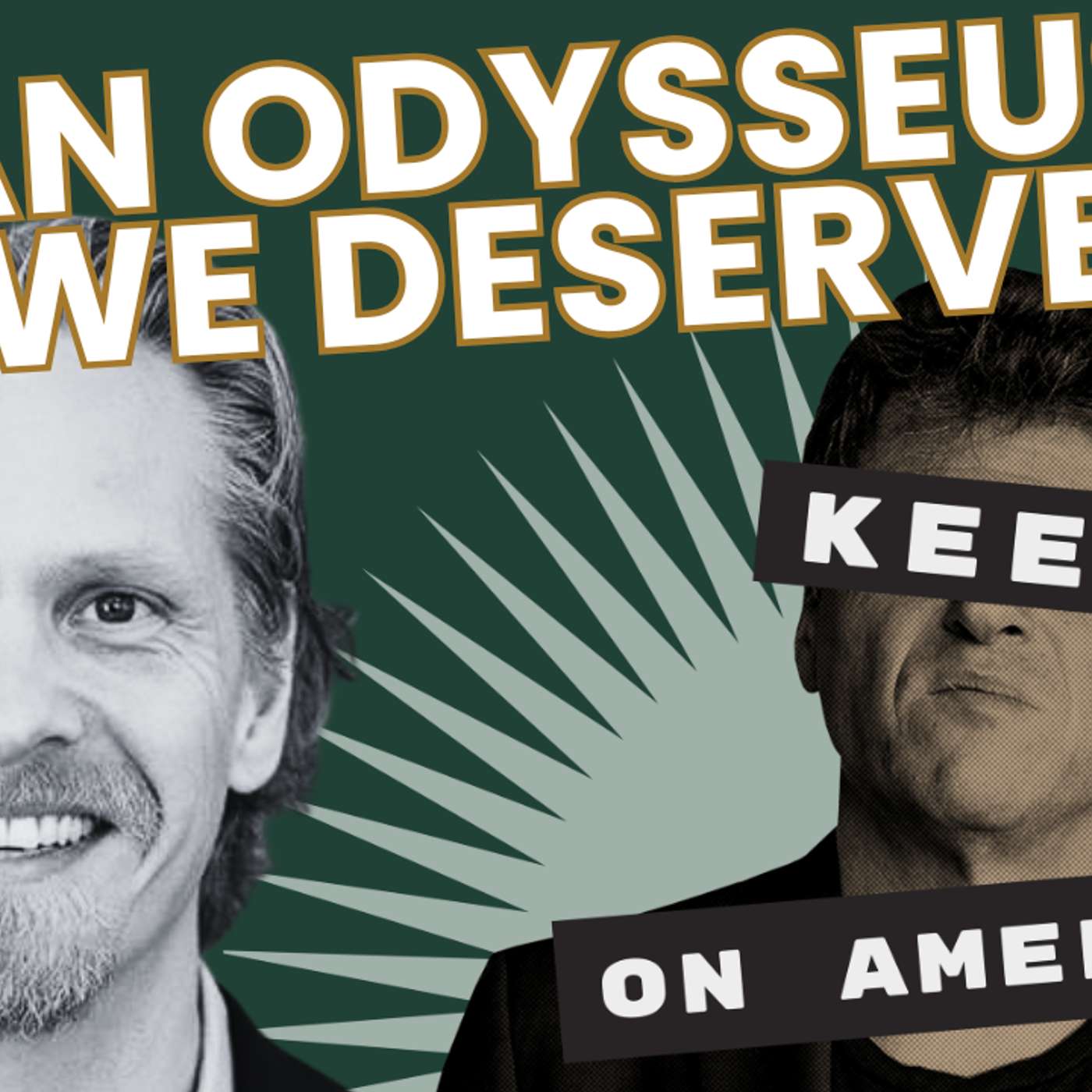


“I want someone who has regrets. I want someone who’s learned the hard way. I want someone who understands that life is made of those messy compromises.” — Joel Christensen on the Odysseus he hopes to see in Matt Damon
Christopher Nolan’s The Odyssey is out — the controversial movie of the year, much of the controversy raging before anyone had seen a frame. So, before either of us had seen the epic, I talked to the CUNY classicist Joel Christensen, author of the timely Why Odysseus? Survivor, Scoundrel, (Anti)hero.
What, I asked Christensen, did he most dread about Hollywood’s treatment of his beloved Odyssey? His answer: a hero too noble to be interesting. The Odysseus of the epic is a survivor, a scoundrel, an antihero — the master sergeant who does what needs to be done, from engineering the Trojan Horse to making sure Hector’s infant son doesn’t survive it. Christensen’s worry about Matt Damon came down to one word: too likeable. What he wanted instead was a man with regrets — De Niro in Raging Bull rather than anybody noble.
So did Christensen get the Odysseus he wanted? Below is his review, written after seeing the film when it came out.
Postscript: Joel Christensen’s Verdict on the Film
Nolan’s Odyssey is not Homer’s Odyssey. This should be clear to anyone. Nolan faced an almost impossible task well: ancient audiences knew the story already. Modern audiences do not, so he created a ring structure with the beginning union of Penelope and Odysseus anticipating the reunion at the end, also introducing plot elements like the dog Argos and the pin by which Penelope will recognize Odysseus.
The film is not Homer. Homer’s power is poetry; the film’s is image. Some of the images are striking: the scene when Circe turns his men into animals is the most arresting in the whole movie, showing everything that can be done with visceral imagery and a slight adaptation (Circe here is a survivor of sexual assault).
The changes made to the plot such as omitting the Phaeacians, Nestor, Laertes, the bed and more are not as jarring as some of the general decisions. Calling “Zeus’ Law” “do unto others…” makes an understandable translation to a Christian context, but it is somewhat nonsensical for Homer. Depicting a mutilated Helen is a strange decision that I am struggling with.
What the movie gets right is making humans responsible for their own suffering. In a novel take on Odysseus as a traumatized warrior, the hero spends seven years with Calypso eating Lotus to forget the loss of his men. Damon, too likeable, regrets the trick of the Trojan Horse after witnessing the slaughter during the sack of Troy. We find out as well that the “sea people” from history, bringing an end to the “civilization” are actually the Greeks returning from the Trojan War and suffering for the transgressions they committed there.
Is this ending an echo of Zeus’ plan to end the race of heroes in the Trojan War? Is it an allegory for our civilizational collapse in the future thanks to technology, environmental catastrophe, and fascism? Any potential social critique dissipates with the movie’s end. The traumatized veteran turns out to be merciful and kills only some of the suitors, showing many mercy. Then, guilty of violating “Zeus’ Law”, Odysseus happily goes into exile with Penelope, leaving Telemachus to be king.
There’s no way to make Homer’s Odyssey into a film and convey all its ambiguity and depth. That would be an unfair expectation. Nolan’s film is a compelling spectacle and it makes me wonder more about how it reflects who we are as an audience. Do we need the hero to be ultimately good, even if he messed up? Are we so simple that we need to hear about Zeus’ Law and the Sea People so repetitively? I fear that in this age where fiction and fact are so hard to disentangle, that we long for narratives that are just simpler.
We don’t get the Odyssey we want; we get the one we deserve.
Five Takeaways
• A Complicated Man: The Translation Problem. Every word of Homer carries echoes no English can hold, and the fights over Nolan’s dialogue replay the fights over translation. Emily Wilson detonated a controversy by rendering polytropos — poly, many; tropos, turn — as “a complicated man,” alluding at once to Odysseus’s travels and the many forms of his character; Daniel Mendelsohn’s “man of roundabout ways” does the work too, if you can stop thinking about rotaries. Even the objection to Tom Holland’s Telemachus saying “dad” collapses on inspection: Telemachus uses the colloquial form in Homer. And the “authentic” dialect purists want was an artificial amalgam that no ancient Greek ever spoke.
• The Culture Wars Come for Homer. Nobody remembers a brouhaha over Wolfgang Petersen’s Troy — a pretty bad movie, Christensen notes — but Nolan’s Odyssey generates more controversy than a scholar can track daily. Lupita Nyong’o’s Helen is attacked as inauthentic by one side and as cultural appropriation by the other; since 2015, classicists have watched the Western tradition weaponized by the alt-right while their own field argues about who owns it. Christensen’s advice channels the epic itself: between Scylla and Charybdis, take Scylla. You’ll lose six men. The alternative is losing the ship — and if the story doesn’t persuade in three hours, nobody will remember the armor anyway.
• The Valence of Violence. Modern audiences are more accustomed to represented violence than any in history — you don’t need Natural Born Killers when Twitter serves unverifiable clips from Gaza and Iran. The question Christensen brings to the film is what the violence is for. Uberto Pasolini’s The Return gave Ralph Fiennes’s Odysseus a steady, untroubled thump of arrows; the epic’s own slaughter of the suitors, read closely, approaches Tarantino-adjacent parody. And the hardest tests are the atrocities the adaptations always cut: the mutilation of the goatherd Melanthius, and Telemachus hanging the enslaved women. Does the violence glorify the hero — or show what even the best of us are capable of?
• Keep Penelope Ambiguous. The great interpretive question of the Odyssey is when Penelope knows the beggar is her husband — the suitors, dead in the underworld, are convinced she was in on it all along. The epic grants her remarkable intelligence and agency, then reins it in: Agamemnon’s ghost praises her by way of insulting all women, and she vanishes from the text. Christensen’s advice to Nolan wouldn’t be Margaret Atwood’s Penelopiad, which centers the women’s voices; it would be more screen time and total ambiguity — no access to her mind, a wife who matches her husband in wits and may even have outwitted him. Though based on Nolan’s arc, he doubts we’ll get a woman at the center.
• Survivor, Scoundrel, (Anti)hero. Christensen’s worry about Matt Damon was simple: too likable. Odysseus is the master sergeant — the one who takes the hard orders, tricks Achilles into the war, engineers the Horse, and makes sure Hector’s infant son doesn’t survive to rebuild Troy. The ancient hero is neither good nor ...
00:00:31 Andrew Keen: Hello, everybody. On July 17 I'm gonna start again, Joe.
00:00:37 Joel Christensen: K.
00:00:38 Andrew Keen: Just to be clear about what we're saying. Hello, everybody. On July 17, the big news is that Christopher Nolan's new movie I'm gonna stop one more time. Hold on. It's a cool beer. It's a cool beer. I'll just hear. Right? Not too much. Yes. Okay. Ready? One more time. Hello, everybody. It is no. Hello, everybody. On July 17, Christopher Nolan's new blockbuster movie, The Odyssey, is out. It promises to be a remarkable cultural event. It's already getting a lot of press, all sorts of articles about what it means to us in symbolic terms, historical terms. And I thought that we might talk to an expert on the Odyssey. My guest today is Joel Christensen. He's at CUNY Graduate Center. He's written all sorts of books on antiquity. And his book, Why Odysseus, came out last week. I'm actually talking to Joel just before either of us have seen the film. Joel, you're seeing it on Thursday. Is that right?
00:01:51 Joel Christensen: Thursday. Yep.
00:01:52 Andrew Keen: How excited are you, Joel?
00:01:54 Joel Christensen: Well, I'm not quite sure. I'd say excited, interested, intrigued, maybe relieved to sort of get through it after hearing about it for so many months. But I'm definitely getting to the point where if I could advance the clock a little bit, I'd do it. So I guess excited is fair. Scale of one to 10, probably crossing eight into nine at this point.
00:02:15 Andrew Keen: No. That's pretty high. Do you feel, you and your academic colleagues, perhaps a sense of ownership. You wrote in 2013, Homer, a beginner's guide. As I said, this new book just came out on why Odysseus, of course, presumably published in association with the movie. Do you have a sense of ownership? I mean, if Nolan, in your view, at least profoundly misrepresents Homer and Odysseus, would you be disappointed?
00:02:46 Joel Christensen: I think it's fair to say I would be disappointed. You know, the most recent movie that came out, based on the Odyssey was the Pasolini's The Return, that came out in 2024. And if I get you know, on the one hand, you know, it's good for people to be interested in Homer and to wanna learn more about it. But on the other, it's really, you know, confounding at times to see how people reread it. And so I'll be looking for in particular, whether or not the events at the end of the epic actually show up in the movie because they rarely do, when Odysseus actually gets home after Penelope and he meets his father and reunites with his people. So it's something like ownership. It's more deep investment. You know, you spend your life studying something that people raise an eyebrow about, and then suddenly everybody's talking about it and stop the same thing. It can be a little alienating.
00:03:35 Andrew Keen: You're high currency, I'm sure, at your cocktail parties. So just reminding us, Joe, before we talk about what you would and wouldn't expect of the movie and the characters, remind us of the main characters. Of course, everybody, I would assume, knows about Odysseus, but there are many other characters. You mentioned Lady Penelope. Then there are other less major characters like Telemachus and Circe. Right. How would you describe all these characters?
00:04:05 Joel Christensen: Well, I think, you know, the Odyssey is a bit different than the Iliad in that it has a small, much smaller cast characters. So it's Odysseus, but we don't actually see Odysseus until about one fifth of the way through the epic, because the first part of the story is about his son Telemachus, who's never actually met his father. He's sitting alone in Ithaca waiting for his dad to come home. Athena comes and sends him along on a journey in news of his father. And so we have Telemachus, his mother Penelope, who had just married, Odysseus and, had Telemachus before Odysseus went off to war. And then there's a whole group of shadowy figures called the suitors, who are young men from Ithaca and surrounding islands, who've come to seek Penelope's hand to lead the city in Odysseus' absence because no one's heard word of him, in almost a decade. So those are the main players. And then you flush out Odysseus' family. His father Laertes shows up near the end of the epic. There are enslaved people who are part of his household who are important to the story, like Eurycleia, who was his nurse, Eumaeus, the swineherd. And then you have people he visits along the way. So he ends up with Circe in book 10 of the epic. Calypso has been hiding him for seven years. The Phaeacians who entertain him and bring him home. And then, for those who are interested in deeper cuts of myth, Telemachus does visit, you know, Agamemnon sorry, Menelaus from, the Iliad, Nestor from the Iliad, and Odysseus takes us through a tour of fantastic figures like Cyclops, the Sirens, and other figures who are really popular sort of the history of art. But the main three figures to remember are Odysseus, Telemachus, his son, and his wife, Penelope.
00:05:50 Andrew Keen: How did you get all into all this, Joel? You've dedicated your professional life to studying, antiquity and of Homer. What was it about Homer that made you so deeply interested?
00:06:04 Joel Christensen: Well, to tell you the truth, I actually despised Homer for a fair amount of time. Growing up, in rural Maine where I did in the eighties, it was still the case where in public school, you would listen you would read The Iliad and The Odyssey as part of English class. In translation, I just didn't get it. Didn't I thought it was kind of tedious. I found Achilles annoying. Odysseus, you know, I just I don't really care much about his story. But I was really interested in storytelling in general and fantastic narratives. And one of my sort of obsessions was in how stories work, why people are so motivated by them, and why we spend our lives sort of with these fictional characters in our head sort of guiding us from place to place or comparanda, you know, mirrors for our own lives. So it wasn't really until I was in college and I took Greek, just to flush out a classics major. Then I read the Iliad for the first time in Greek, and that blew me away. There was something about it that was different from anything I'd ever read before. And I've read a good deal of Latin, Virgil, sort of the Roman epic counterpart. But from the first few lines of the Iliad, I just felt it viscerally, that this language, this content was different from anything I've studied before. And so, you know, then innocently, I was like, you know what? I'll spend some time in my senior thesis trying to figure out how Homer works. And that turned into a dissertation, went over to graduate school, and now, you know, a handful of books, you know, twenty five years later, and I am what I do. So it was a
00:07:36 Andrew Keen: So you don't hate the guy anymore? You, would you say you love Homer or you're ambivalent about him?
00:07:42 Joel Christensen: No. I'm not ambivalent. I love the Iliad and the Odyssey. And I think, you know, the course of the work that I've done really starting, with my friend writing introductory books has really been about trying to answer the question I had for myself, Explain why Homer is important, how it's different to others, and really sort of dedicate, you know, my, time to explaining that or unfolding it, inviting people into the conversation.
00:08:08 Andrew Keen: Where did you go to, university?
00:08:10 Joel Christensen: So I went to Brandeis University in, Waltham, Massachusetts. I ended up teaching there again for some time for about nine years in 2016 to 2025. And I've been lucky enough as a high school student to go to school that still offered AP Latin. And so I showed up on campus in 1997 with a good deal of Latin in my head and the idea that you should study Greek if you want to know Latin better. And then the flip the script flipped over a few years.
00:08:37 Andrew Keen: So is your example, your life, an argument that kids should still learn Latin or Greek in high school and university?
00:08:46 Joel Christensen: Well, I'm not gonna say that people should, emulate me and follow my path. But I do think there's something important about sort of rich engagement with narrative and language and understanding how they function. I mean, you know, the past ten years or so, we've heard constantly about the death of facts. Right? And about, you know, the curation of identities online. But we spend such little time studying how language and storytelling works. And I think at the core of what I'm interested in, it's that. And so the honest case is I'd love if everybody read Homer. But I think you can get to the same place, by engaging with sort of complex narratives in a sustained way, studying language, and really stepping back from, the busyness of the modern world, and engaging in narrative and poetry in a deep way.
00:09:39 Andrew Keen: You said earlier, Joel, that when you read it in high school, it was in translation. It didn't resonate. It only began to resonate once you learn Latin and Greek and read it in the original if it that was indeed the original. That was an interesting piece in the Financial Times recently with one of your classicist colleagues, Emily Wilson, who is a well known, almost a celebrity translator now of Homer. Should we be reading this in Greek and Latin? I mean, does Homer make any sense in English, whether it's a more contemporary, edgy translation from somebody like Emily Wilson or even something that came out of the nineteenth or twentieth centuries?
00:10:24 Joel Christensen: I mean, my honest answer is yes. It would be great if everyone
00:10:28 Andrew Keen: I hope you're always honest with me, Joel.
00:10:30 Joel Christensen: Yeah. I will always be honest. But I, you know, I need to expand on that, because there are a couple problems. Like, one, nobody in the ancient world read the Iliad and the Odyssey. In antiquity in first round of performances, or first generations of these epics lives, they would listen to in episodic form, sometimes in performance, and people would spend their lives thinking about the text and engaging with the narratives. And so it's really hard to find an, analogical experience in the modern world because you need the community of interpretation as well, and then the sort of revisiting it. But you're not asking, that question. If you wanna start with translation, I'll go back to there in a minute. I mean, the real hard thing about translating, Homer is that the words in an oral poetic tradition gather deep meaning. So the famous, you know, controversy to start out Emily Wilson's translation of The Odyssey is when she refers to Odysseus as a complicated man. And people have, you know, freaked out about that. They've said, well, this is too modern. But the word complicated, what she translates is complicated, is almost impossible to translate in English. We can take apart the two parts of the compound. Poly means many. Tropos means turn or way. We get tropic from it. But when you put it together, it both alludes to Odysseus's travels throughout the world, but also the many forms of his character. And so that's just one example of how every almost every word you translate, in a line of Homer has different echoes connected to it. And when you make a choice to move it into English to one word or another, you're losing something. And so translators have to make these hard choices. And so when I turn to a translation, I find it completely unfamiliar. It's not my Homer. It's not what I remember, because I'm almost naturally making one choice or the other in the valence of a wider semantic field of the word. So for polytropos, a more recent translation by Daniel Mendelsohn calls him a man of roundabout ways, which does the work kind of, but, you know, in the anglophone world, when you say roundabout, too often makes you think of a rotary. Right? You're going around in a circle. And it's that inability to control sort of the association of translations that can make it really hard.
00:12:56 Andrew Keen: Yeah. And just to remind everyone, the subtitle of your book, this is not a literal translation of the Odyssey, but, nonetheless, these are the words you or your editor have chosen about Odysseus is survivor, scoundrel, antihero. We'll come to that in a few minutes. So, inevitably, we're gonna make judgments for better or worse about Odysseus, which is what makes him interesting. In that conversation with Wilson, she laid out two arguments, I guess, for reading the book or rereading it or rethinking it or rewatching it. One is that it shows a completely different world. On the other hand, of course, it points to the universalism of the human condition and how things haven't changed much over the last two or three thousand years. Which of those arguments in your view, Joel, do you think is more relevant in terms of thinking and watching Odysseus? That the world of Homer and, and this fictional character, maybe fictional, maybe slightly nonfictional, of Odysseus, is utterly foreign or actually rather familiar?
00:14:03 Joel Christensen: I mean, I'm not quite sure that I can take those two options apart. But I'll do it because I think that depending on who and when you are in life, they each have their own service. In general, for the broader population, for most people I'd recommend the Odyssey to, I would go towards that latter one because most people are trying to get some different way of viewing themselves with their world, some extension, either confirmation, denial, expansion of their own experiences. And then there's an extent to which if a narrative is too foreign, if it doesn't give you enough that allows you to connect with it or to project yourself into the narrative or it's into yours, you can't make a connection. Like, the best example of this I can think of most personal one, is for a while, I was really into Dune before the movie came out. Decade or half ago, I wrote an article about it. I tried to get my wife to read the book many times, and she'd pick it up, and she'd be like, I'm three pages in. I don't know half the names of any of the people going on here. I just don't care. Right? I mean, to get into a narrative and enough to make a connection with it where you think with it, you need to have enough familiarity. On the other hand, part of the power of that familiarity is understanding its difference at the same time. So I think Emily pulled a great trick on us by giving us that dichotomy because it's a false one. Right? You know, part of the value of identifying something that's universal and near so about humankind, is being able to trace it beyond yourself. And so what I think is most powerful about the Odyssey is it has that potential. If you engage in anachronism, if you let it invite you into the narrative, it lets you feel and see yourself in it. But if you learn to also comprehend its difference, to get into the different world that it's representing, there's something about it that if not comforting, is at least, enlarging, which is to understand that we are part of this larger human arc, and that so much of what we think is unique about us, is actually constant over time.
00:16:13 Andrew Keen: Joel, a few months ago, we did a show with, literary theorist who argues that the definition of humanity is our ability to tell stories. That's who we are as a species. Is at least Homer and the popularity or the relevance of his two great works, the Odyssey and the Iliad, does that prove our obsession with storytelling? It's the first story in the Western tradition. It's before Socrates. It's before the Bible. Does it speak of our intrinsic curiosity with telling stories? You noted earlier that nobody read this in the beginning, that Homer may not have even written it himself. This was played out, in live form in a kind of theater.
00:17:03 Joel Christensen: Yeah. I mean so I would absolutely go with the literary theorist, and there are cognitive psychologists and literary theorists who agree that, you know, storytelling is uniquely human and it's actually, something that knits us together from individuals into sort of collectives. And what's fascinating about The Iliad and The Odyssey is that it both comes at the beginning what we see as western tradition, but it's also coming at the end of a period of really deep storytelling that reaches back several centuries. So it's really at this funnel moment where you're moving from one period to another. And if you read the poems carefully, they see themselves as that, as between, you know, myth and history. But if we're thinking of them as, artifacts, you know, that's something we could dig up and think about what it means to be human, I wouldn't stop there. I would go back farther. Right? I mean, the Gilgamesh poems, for example, are another fascinating testament giving us, you know, two thousand years of priority over the Iliad and the Odyssey of how interested we are in some of the same themes. Right? And what mortality means, how friendship, reflects on that, the relationship between people and the rule, and the importance of journeys. And so I think the Iliad and the Odyssey are a wonderful example, in a particular place and time. But I would you know, it'd be great if we had even more of that. I think the fact that they got to such great length and have remained such important touchstones, and, you know, from Greece to the modern day, is a testament of its own to their appeal. But that's a bit of a circuitous argument there.
00:18:40 Andrew Keen: A roundabout argument. You're supposed to speak like Odysseus. I don't know what the reviews are gonna be like. Be interesting to see, Joel. But one thing is for sure is there's gonna be all sorts of controversy. Already, Nolan has had to deal with a backlash over casting. Now there'd be no doubt conservatives who argue that it's not authentic enough, that the women or the men are not represented as they were in antiquity, and there'll be perhaps people more progressive who will argue that this represents some sort of patriarchy. Should we be careful about that? Is that something that bothers you if too much? I mean, you're in the university, so you're much more familiar with me about the culture wars going on these days. Should we be careful on that? Would you if Nolan had called you out and said, Joel, what should I, shouldn't involve in this work? The, to borrow from, the narrative, the what is it? The Scylla and the, Charybdis. Yeah. How to navigate between these two extremes? Cool.
00:19:47 Joel Christensen: Well, let's be clear. When it comes to Scylla and Charybdis, like, one of them, you lose six of your men. The other one, you lose the entire ship. And so I think the lesson there of what's really after Nolan is you're gonna take some pain. The question is, do you wanna lose the whole campaign? And so no. I mean, it is a bit bewildering because I've been thinking back to the lack of controversy, when, Wolfgang Petersen's Troy was, released. Now to be fair, most of the choices casting in that depictions were fairly safe by comparison, but Troy was a pretty bad movie. I don't remember any of the brouhaha. Right now, so much is getting written about the Odyssey and potential controversies about it that I even can't even keep track on a daily basis. So if Nolan had come to me, I would have said, you know, well, first, I would have asked why are you interested in this? Right? What is the gravity that's pulling you to this story? And then I would have said, no matter what you do, someone's going to be angry about it. And you have choices. Right? The choice he made clearly from the images, is not trying to be authentic in a historical way, which is one I'm fine with because it's impossible, because the epics represent three to four different distinct archaeological periods. And there's really no way you could be accurate to a fantasy of the past. So there's that. But he's also trying you know, in his casting choices, he's shown that it's impossible to please everyone. Right? Because on the one hand, you have people who say, well, you know, Lupita Nyong'o can't be Helen because Helen wasn't black. And people get into arguments about what race looked like in antiquity, and there's no winning there. But on the other hand, you have Greeks saying, wait. I thought we were supposed to acknowledge people's culture, and their access to it. How is this not cultural appropriation when some things are? And what it really shows is, how much of a flare up point the Odyssey and Homeric literature has become for the culture wars that you allude to. Because this isn't a new thing. I mean, since 2015, 2016, colleagues in my fields have been writing about how, the western tradition is being weaponized by the alt right or fascist or however you want to characterize them. So just wanting to tell a story that other people care about for whatever reason they do, put Nolan in a difficult position. And then in addition to that, he has to deal with all the art and generic problems, moving an epic into a shorter film, representation issues, and telling a good story, which regardless of how accurate your armor is or how great your casting is, If you don't tell a story that's persuasive to audiences in three hours or less, everybody's gonna forget all of that.
00:22:44 Andrew Keen: Yeah. You're not Pasolini or Bertolucci or Visconti or Christopher Nolan. And a lot of money's gone into this. What about the question of modern dialogue? He's also had to defend, his modern dialogue in the movie, apparently, after, again, quote, unquote, trailer backlash. I mean, he didn't really have any choice on that. I mean, had he used the what he would at least claim to be the authentic Greek of antiquity, he would have alienated most of the audience. It would have seemed an utterly foreign film, wouldn't it?
00:23:17 Joel Christensen: I think there's no win here. And so I'll start from the back and then get to the forward. The modern part of this, I mean, first of all, the Homeric dialect was never spoken. It is an amalgam dialect that was artificial even to ancient audiences. So it can represent some colloquialisms or vernacular, but it's really, you know, it's not what people think it is. It's a very different dialect.
00:23:41 Andrew Keen: So is that would be like, the way we twenty first century people, listen or watch or read Shakespeare?
00:23:50 Joel Christensen: Yeah. Except the difference is that Shakespeare was more or less vernacular at his time. Right? It's a raised register for us now because we've you know, our language has grown up under the shadow of Shakespeare. But at that time, a lot of the ribald stuff, a lot of the jokes, they were taken up from the street in London. Right? And so it's something you know, it's more like, you know, imagine Elizabethan Londoners listening to the Latin Vulgate of the Bible. Just some of them being able to grasp that some of them couldn't. But, again, ancient Greece could mostly listen to it. And so, translators make very different choices when they are adapting the Iliad or the Odyssey for this very reason. Someone like Emily Wilson decided to not stick with all of the forms of Greek epic, but aims for a slightly higher literary register, so that you know you're reading literature. Daniel Mendelsohn in his very recent, version that came out last year tries to keep all the repetitions and the forms that make Homer seem alien like Richmond Lattimore did. And then the translation I've actually taught with the most, Stanley Lombardo's translation, leans into it being vernacular because he wants people to learn the story. So when, you know, Tom Holland calls, Odysseus dad, he's using a word, you know, that could exist in Homer.
00:25:18 Andrew Keen: And how Holland, of course, is Telemachus.
00:25:21 Joel Christensen: Yeah. You know, as Daniel Mendelsohn himself mentioned on Twitter, in the Iliad and Odyssey or in the Odyssey, Telemachus does call Eumaeus the swineherd [word unclear — likely the Greek "atta"], which means dad. Right? It is the, colloquial form. So it's possible. But at the same token, you know, if we went and saw an Odyssey movie by Nolan that he used raised Shakespearean elocution for, you know, it would not have the same purchase on the imagination. You know, we come to expect in sword and sandals epics for all the actors to have, you know, some type of British accent. But clearly, Nolan has decided at some point he wanted to keep, you know, the images foreign, but the language, close enough to audience in a way that they wouldn't be thinking about. Of course, what he didn't anticipate is that, of course, is that people were thinking about the language, in a way that would complicate his decision.
00:26:23 Andrew Keen: Joel, you mentioned sword and sandal epics. There will be violence. I'm sure there's a great deal of violence in this movie as there is in the book, The Odyssey and The Iliad. We had a couple of weeks ago the great film critic David Thomson on the show who is very critical of Hollywood. He thinks that Hollywood in movies like The Godfather has glorified violence to such an extent, normalized it, that now we take Trump for granted. I don't wanna make this about Donald Trump again. It's a rather boring subject. However, are you concerned about the centrality or the absence of violence in this book? I mean, that world was a deeply violent one. This is a story of warfare between men. So in your view, not having seen the movie yet, what should and shouldn't the role of violence be in this film?
00:27:20 Joel Christensen: So I think there are two issues that I'll separate in answering the question. The first is with the difference of hearing violence as opposed to physically viewing it and witnessing it. The second is what is the violence represented in the Odyssey and what is its tone? The first one, I mean, look, we are as viewing audiences accustomed to violence on screen in a way that I think no audience has been in the history of time. And it's not just in the movie screen anymore. Right? I mean, when Natural Born Killers came out, Oliver Stone, I was old enough to go to the movie and old enough to read all of the lamentations about, like, its representations. And but, you know, if we move on, to the modern world, like, we don't have to go to the movies to see terrible violence. Right? You go on Twitter and you're assaulted with violent clips from Gaza, from, Iran. You don't know where it's coming from. You can't tell what's real anymore. And so we've become accustomed to a visual apparatus of violence, that, you know, I think it probably has devalued what we see and how we, process it. But if it is as, permeating as it is, I'm not quite sure how we escape it or point out to a single movie's representation of it. When it comes to the Odyssey, you know, I think that ancient audiences were familiar with physical violence personally in a way that most of us aren't. We see it precariously on screen, but few of us have actually been to war, and seen, you know, bloody wounds and their aftermath. We've seen it. It's still something distant. And so the question is, what is the violence in the Odyssey trying to do? Right? I think that if we go back to The Return from a few years ago when we have, Odysseus, as Ralph Fiennes, slowly and deliberately shooting the suitors one by one with the arrow, I think the steady thump of that, was really effective in showing both his lack of concern for the violence. Like, he does he's not bothered by it. He's not touched by it, and it's deadly impact. But if you read the violence of book 23 [sic — Book 22] closely, I think it could approach a Quentin Tarantino type of, you know, exalting violence almost to the moment of, parody. And so my question, what I'll be looking for is what is the valence of the violence in the epic? Is it there to glorify the hero, or does it show the complicated nature of it? Does it show him as having multiple sides? And I'll also be interested to see if and how they depict the violence against noncombatants. So big question about the Odyssey and its interpretation is how we're supposed to handle the mutilation of the goatherd Melanthius, who has his testicles and penis cut off, shoved into his ears and mouth, and then he's murdered. And how are we supposed to understand the hanging of the enslaved women by Telemachus, in book 23 [sic — Book 22]? So I'll be looking at the broader arc of violence, and the extent to which that it's there to show to sort of show Odysseus as a hero, in problematic terms, or how much of it's really about showing the, the difficulty and challenges of returning home, in dealing with the life in which people are willing to bring violence to you rather than something you just mete out towards others.
00:30:52 Andrew Keen: The big hit last year in Hollywood when it comes to historical movies, Joel, I'm not sure actually it was a Hollywood film, but it did very well and won a series of Oscars was Hamnet, [unclear] Maggie O'Farrell's wonderful book, novel about Shakespeare and his wife. Maggie was actually on the show, not talking about Hamnet, but her latest book a couple of years ago. Can we expect, given our age of culture wars, that the female and the point of Hamnet, of course, is that Shakespeare takes a back seat in many ways. His wife is the heroine of the narrative, and she was the star of the film, and she won the awards. Could we expect the same of this film? It wouldn't be surprising in a sense given the nature of Hollywood and perhaps what audiences are taking for granted these days.
00:31:46 Joel Christensen: Well, I mean, if you're talking about the centrality importance of Penelope.
00:31:50 Andrew Keen: Yes. Exactly.
00:31:51 Joel Christensen: I think it's possible. I mean, one of the great interpretive questions of the Odyssey is when Penelope knows that Odysseus has come home. You know, the our interpretation of her character, is radically different if we think she suspects in the first moment the disguised beggar comes in or if it's a little later. And in the poem itself, the suitors after they die go to the underworld, and they think she was in on the game all along. But the epic doesn't let us think about that. The problem with that is that, you know, the cultural position or attitudes about women have changed since ancient Greece. What's remarkable about the Odyssey is how much, independence, intelligence, and agency it gives to Penelope, but it ultimately reins it all back in. Because the beginning of book 24, Agamemnon is in the world of the dead, and he looks up at Penelope and says, Odysseus is so lucky that he has such a great wife. Too bad that she that all women are really like my wife, Clytemnestra, who murdered me, and that no matter how great any woman is like Penelope, she'll always have to deal with the implication of that story. And then Penelope disappears from the text. So I think if we're updating it from the modern world and we wanna give Helen, sorry, Penelope her agency, the question is, will we go the direction of someone like Margaret Atwood does in her adaptation, The Penelopiad, which centers the experience of the voices of all of the female characters in the poem, against the sort of male dominated world. What I've seen so far of the previews, it seems pretty unlikely. We're gonna get a heroic Penelope, for sure. Someone who's matched to Odysseus in wits. But based on Nolan's movies as an arc, I don't see him making a woman a central character.
00:33:46 Andrew Keen: We had Atwood on the show again a few years ago, and, of course, she's very much in fashion with her Handmaid's Tale and its relevance in our age of patriarchy and trad wives. Do you think that I mean, again, if Nolan had called you out and said, Joel, what should I do with lady Penelope? Do you think your advice would have been to make her more or less central? I mean, again, make it more or less contemporary. Should she be presented as a rebel trad wife, a smart trad wife, not even a wife, maybe just a woman?
00:34:17 Joel Christensen: No. I would probably advise to sort of, to thread that needle as much as possible. I think the power of Penelope in fact, I think the power of these traditional characters is their ability to act as, resonators for audiences. So and so I would give her more screen time, than she gets perhaps this in the perhaps in the epic, but I would keep her as ambiguous as possible. Don't give us an insight into her mind. Force us to work to understand what she's doing and force Odysseus to work, to make her pay attention to him. I think the power there is not in changing Penelope's world and not in making, you know, Mycenaean Greece some sort of feminist paradise, but instead of showing that what's exceptional about her is that she matches her husband in intelligence and that she outwits the suitors and everybody else and may even have had the opportunity to outwit her husband. And so that makes it a more dynamic and interesting story. But I think you'd still have to reflect some of the harder questions about what does she know about the enslaved women, what's her relationship, with the servants of the household, and, you know, is she actually at any given point, flirting with the idea of living on with one of the suitors?
00:35:38 Andrew Keen: There are universal themes in this, of course. We've talked about this already, Joel, putting on your generalist cap. There are only a certain amount of stories and the Odysseus narrative seems to somehow encapsulate all of them, honor, truth, journeying, reinvention. Is there anything it misses?
00:36:00 Joel Christensen: Is there anything it misses? That's what isn't in the Odyssey that should be there? Let's see.
00:36:06 Andrew Keen: It doesn't If Homer called you out and said, Joel, how should I rewrite my Odyssey?
00:36:11 Joel Christensen: What's not here? No. I think the fairest answer I could give is what the Odyssey doesn't provide, it's actually leaving to its companion piece, the Iliad. I think they're very much complementary narratives. The Iliad asked the question of, you know, how do you die and what's worth dying for? And the Odyssey asked, well, what do you do after war? What are the costs of survival? And how do you know who people are? And so I think the thing that is probably missing the most in the Odyssey that it gets near the end is more about the relationship between a ruler and his people and between an individual and his community. The Odyssey is exceptional in showing that your identity doesn't come from yourself. Odysseus' identity, he can tell his own story, but he can't really return home until he reunites with his son, his mother figure, his wife, his father, and his people, but we're not left with much about his people. The what the Odyssey leaves us is a story that can be read as being extremely individualistic. And this is how I think it gets picked up by Lord Tennyson, even to an extent by James Joyce. It's one of the reasons I think it's so popular in the twentieth and twenty first century as it speaks to our concerns about who people are in their environment and in their families. But what I think is really missing there is a larger question about politics. What are Odysseus' responsibility to his responsibilities to his people? Is he accountable for leaving them with no one to rule them for many years? And should we take the suitors' issues with Odysseus more seriously than we do?
00:37:47 Andrew Keen: Is that one of the reasons you think that Socrates was very ambivalent about Homer?
00:37:52 Joel Christensen: You know, I think Socrates was well, first of all, which Socrates? Like, the Republic
00:37:58 Andrew Keen: Well, but the only so I mean, most of us know Socrates through Plato. So
00:38:01 Joel Christensen: it's just
00:38:02 Andrew Keen: Plato. Yeah.
00:38:03 Joel Christensen: So there are two really interesting things about Socrates and Odysseus. In the early dialogue, the Apology, which is, you know, Socrates' defense speech, he says that, you know, since he's gonna be killed by the Athenians or asked to drink hemlock, he's excited to go down to the underworld and spend time with other people who are wrongly accused like Palamedes. And in that dialogue, Socrates affiliates with someone who is falsely accused by Odysseus and treats Odysseus as a type of villain. When, Socrates talks about Homer in the Republic, his concern isn't that there's something wrong with Homer. His concern is that people are too stupid to understand allegory and will take the wrong lessons from Homer. So one of the points he brings up is if you don't teach people that you're not supposed to take the Iliad literally, they will think it's okay to commit treason against your commander in chief like Achilles does and to just leave, the army. But on the other hand, at the end of the Republic in the Myth of Er, when Socrates is looking at how people are reincarnated and what happens in your like, into your soul, he leaves the final word to Odysseus. Odysseus gets to choose his future life upon reincarnation, last of all people, and he chooses to have a life of a regular person who's not involved in politics. And so I actually suspect, I have no way of proving this, that the reason Socrates, leans away from Odysseus so much is he's a little too much like him.
00:39:37 Andrew Keen: Interesting. Well, to end, let's leave the final word like Socrates did to Odysseus. As I said, your new book, it's already out as we speak. Why Odysseus? Survivor, scoundrel, antihero. Tell us about this man, Joel. You've written a book about him. Who was he, or why Odysseus? And what should what would you like to see on screen? What should, what should Odysseus be like, in this movie? Of course, Matt Damon is Odysseus. I wonder whether he'll keep his beard. I assume he will.
00:40:18 Joel Christensen: So one of my concerns when I first heard that Matt Damon was cast as Odysseus, was whether or not he would be too likable to be Odysseus. Right? You know, Odysseus is a very different character from one story to another. But what's consistent about him, is that he is someone who will do what needs to be done to get home, to end the battle, to move to the next stage. Like, he is someone I sometimes when I used to teach him at UT San Antonio where lots of people had experience with the army, I always described him as the master sergeant. He's the one who takes the hard orders, who goes out there, and ensures that things happen. He's the one
00:40:58 Andrew Keen: So he's the survivor. That's the survivor, Adam. [as spoken]
00:41:00 Joel Christensen: That's the survivor. That's the survivor. And because of that survivor aspect, he gets associated with less than noble behavior. He's the one who makes sure that Astyanax is killed, Hector's young son, ending the line of Trojans. He's the one, who tricks Achilles to come to war. He's the one who's involved in convincing people to get in the inside the Trojan horse and then tricking the Trojans, to accept it. So he's willing to do these things that we think are morally questionable. But at the same time so that's a scoundrel part of it. But the antihero part, is that Odysseus represents, what is most true about the ancient hero, which is that it's neither good nor bad qualification. In the ancient world, a hero is anyone who's part of a specific generation. And what it means is that it could quintessentially, is that you suffer and you cause suffering because of your own actions. People have this misunderstanding that heroes, were in Homer and elsewhere in ancient Greek culture have no ability to make their own decisions. That everything is fated. But if you read Homer carefully, people are always making their own decisions, and they're usually bad ones. And so with Odysseus, one of the reasons I think we keep going back to him is his ability to adapt, his willingness to survive, and his quasi moral nature reflects more of what is true, intuitively about what it means to be a human being. At the core level, he, unlike Achilles, is mortal. He has to make the hard choices. And especially for those of us in middle age, to understand, he has to make compromises in order to live and compromises with friends, with family, with members of the city. Life is a messy thing. So when I'm looking at Odysseus on the screen, I don't wanna see the stoic Odysseus who can resist all temptation to go home. I don't wanna see some heroized Odysseus, who's done great things and earns glory. I want someone who has regrets. I want someone who's learned the hard way. I want someone who understands that life is made of those messy compromises. And the important thing is to be able to get up the next day and keep moving. So that type of compromise character who has depth and who also shows what even the best of us are capable of, which is sometimes inexplicable evil. And so
00:43:37 Andrew Keen: So that's the scoundrel. That's the antihero in your mind in Odysseus. So maybe I wouldn't say I mean, Marlon Brando, of course, isn't around anymore, but certainly someone more Marlon Brando like than, than No.
00:43:51 Joel Christensen: I think of, you know, some of the classic years of De Niro's films. Right? When he played, the boxer in Raging Bull, for example. Right? Someone who has gone through it. And, you know, we have this desire in modern storytelling to give everybody an origin story, to give everything an explanation. But the fact is in real life, sometimes bad things happen. Sometimes we make bad choices, and we can't always explain it. We don't always have time to. And that's really what I wanna see in this Odysseus. Someone who has made some bad choices, someone who is responsible in part for his own suffering, but who continues to live regardless.
00:44:33 Andrew Keen: Yeah. I agree with you, and I'm not a scholar of all this. And I suspect that we're not gonna get that. I suspect that Nolan will give us what we're all too familiar with, but we will see. Joel, you've certainly, added to my appetite for this movie. As I said, I'm seeing it on Friday, the seventeenth. You're seeing it on Thursday, the sixteenth. I'm gonna run this conversation after the seventeenth, after I've seen the film so I can give my response. And what might be nice if you have a few minutes, maybe you'll add a paragraph to our show notes about what you think of the film. So I really wanna thank you for, and remind everyone, of course, that, alongside the film, everyone's gonna go to the film. They need to pick up Joel Christensen's new book, Why Odysseus? Survivor, scoundrel, antihero. That was a great conversation. Thank you so much.
00:45:27 Joel Christensen: Thank you.