Has China Won (Again)? Kishore Mahbubani on Washington’s Four-Thousand-Year-Old Problem
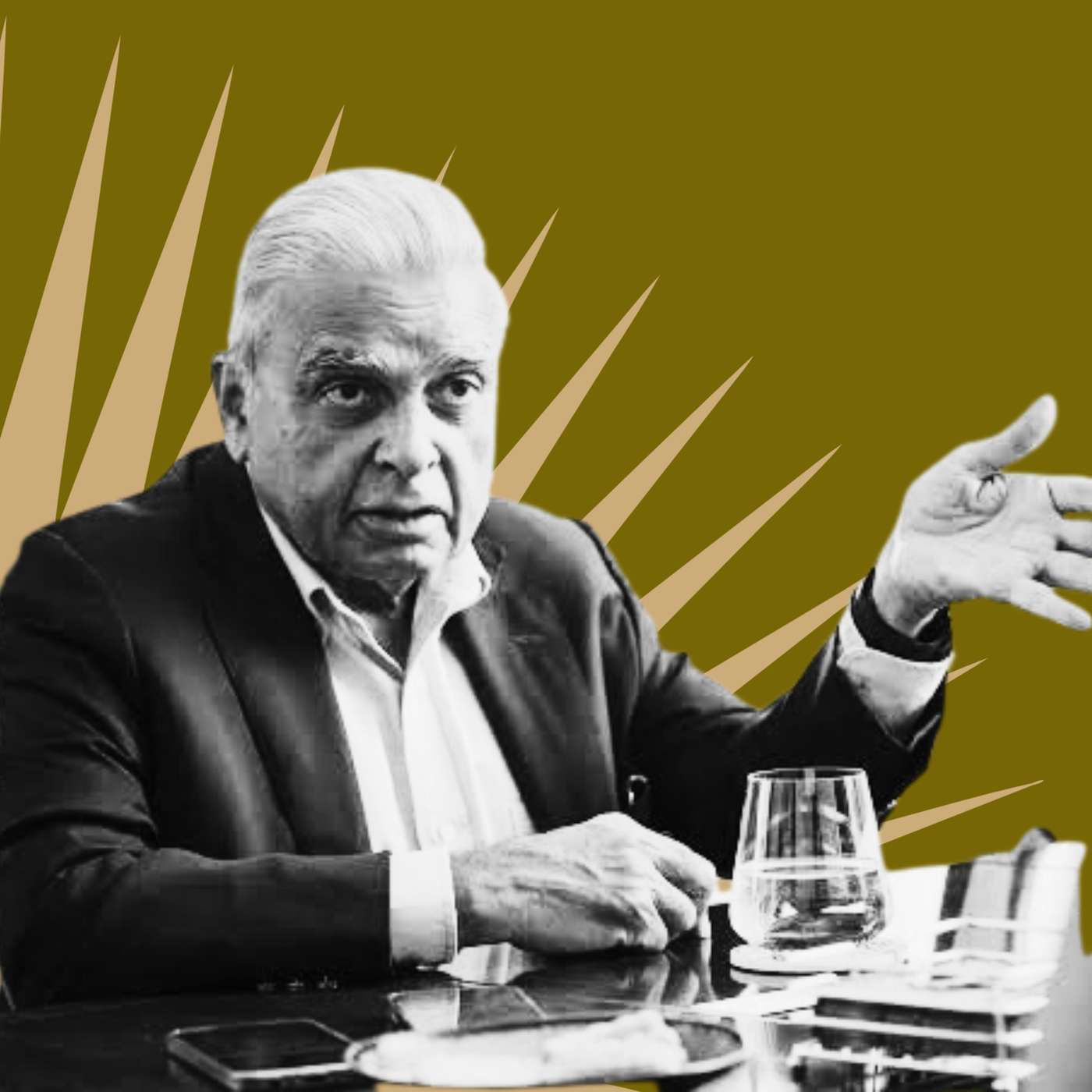


China, China. Yesterday we had the prize-winning Princeton historian Beth Lew-Williams on how nineteenth-century America turned immigrants from China into John Doe Chinamen. No name, no vote, no route to citizenship. A century of humiliation. A hundred and fifty years later, the Chinese aren’t asking anyone’s permission for anything.
Which brings me to an old friend of this show, Kishore Mahbubani. He’s a Singaporean diplomat and one of the world’s most bullish thinkers on the rise of China as a twenty-first-century superpower. His Has China Won? came out in January 2020 and has just been reissued with a new foreword.
So, six years later, has China won (again)? Kishore is far too smart to fall into such a binary trap. But he does say that nothing he wrote in 2020 needs retracting. His message then and now to Washington is that America has misidentified its opponent.
“The biggest mistake Americans make is to think they are competing against the Chinese Communist Party,” Mahbubani says. “The United States is not competing against a hundred-year-old party. It is competing against a four-thousand-year-old civilization — the world’s oldest continuous civilization.”
At the same time, Mahbubani insists, he’s not predicting the fall of America. The wily Singaporean diplomat, in fact, reminds Chinese audiences never to underestimate the Yanks. So there’ll be no winners (or losers) in the great China vs America twenty-first-century game. Like at American kids’ soccer games, everybody gets a medal.
I pushed him on what many China watchers in the West, like Orville Schell and the former Australian PM Kevin Rudd, see as Xi’s descent into totalitarianism. They are all trapped in a Western bubble, Mahbubani shot back. A hundred million Chinese leave the country as tourists every year and then freely come home again. John Doe Chinaman has, apparently, been retired (again).
FURTHER READING
• Has China Won? The Chinese Challenge to American Primacy (PublicAffairs), by Kishore Mahbubani. New edition, with a foreword by the author.
• Breakneck: China’s Quest to Engineer the Future (W. W. Norton), by Dan Wang.
• Kishore Mahbubani, author website.
• KEEN ON AMERICA episodes cited: Beth Lew-Williams on Chinese life under American racial law, and Kishore Mahbubani on the Asian century.
ABOUT THE GUEST
Kishore Mahbubani spent thirty-three years in the Singaporean foreign service, serving twice as Singapore’s ambassador to the United Nations and as president of the UN Security Council in 2001 and 2002. He was the founding dean of the Lee Kuan Yew School of Public Policy at the National University of Singapore, where he is now a distinguished fellow at the Asia Research Institute. His books include Can Asians Think?, The Asian 21st Century, Living the Asian Century and Has China Won? The Chinese Challenge to American Primacy, reissued this year with a new foreword.
ABOUT KEEN ON AMERICA
Nobody asks more awkward questions than the Anglo-American writer and filmmaker Andrew Keen. With 3,000 episodes since the show launched on TechCrunch in 2010, Keen On America is a daily conversation about the ideas, books and arguments shaping the United States. New episodes every day.
00:00 - Intro
00:30 - AK: from John Doe Chinaman to a rival superpower
02:25 - Why the book needed a new foreword
03:00 - The prediction he made in January 2020
03:20 - Tulsi Gabbard, and a call from the US embassy
04:21 - AK: what is actually at stake in this contest?
04:49 - Number one since the 1890s, and what Washington dreads
05:30 - Biden: it ain’t gonna happen on my watch
06:00 - Why the question mark stays
07:05 - AK: the engineering state against the legal state
07:49 - Against black-and-white formulations
08:30 - Not a hundred-year-old party. A four-thousand-year-old civilization.
09:30 - What America is still unmatched at: Google, Anthropic, Amazon
10:21 - AK: the thesis belongs to Dan Wang
10:35 - AK: Anthropic did not exist in 2020. How much does AI matter?
11:35 - AI as the critical new frontier
12:30 - Why everyone assumed the American lead would grow
13:00 - The lead has narrowed dramatically
13:30 - The paradox: closed society, open source
14:04 - AK: Trump, the universities, and the Manchurian candidate question
15:03 - Not a Manchurian candidate
15:40 - The most pragmatic member of the administration on China is Trump
16:20 - Rare earths, and the discovery that the game had changed
16:50 - A relationship that has stabilized, for now
17:11 - AK: who in American politics sees China clearly?
17:35 - The Overton window is moving
18:20 - Young American influencers who went and looked
19:16 - AK: and Taiwan?
20:07 - Why there will be no war
21:00 - The passport argument: 180 countries, or five
22:20 - Nominal reunification, and the diplomat’s creative solutions
23:05 - AK: Orville Schell and Kevin Rudd on a more authoritarian China
24:19 - The Fukuyama mistake, and the end of one destination
25:20 - Four thousand years of learning that a strong center means peace
26:09 - AK: he shakes his fist every time he says it
26:23 - Chaos is the nightmare, not control
26:50 - AK: are you excusing it?
27:28 - Moscow, 1976, and what a real gulag looked like
28:40 - A hundred million leave every year, and come home
29:30 - Eight hundred million out of poverty, and a feeding program in Singapore
30:39 - AK: so what game are Rudd and Schell playing?
31:03 - Trapped in a Western bubble
32:28 - From six per cent of global manufacturing to thirty
33:52 - AK: but the American share has held up
34:21 - Manufacturing share and economic share are different numbers
34:56 - AK: a hundred flowers? Is there a Chinese model on offer?
36:14 - Anyone can become American. Nobody can become Chinese.
37:30 - Why that makes Beijing the more pluralist capital
38:40 - AK: back to John Doe Chinaman. Is there resentment?
39:58 - The Exclusion Act, and discrimination acknowledged
40:23 - Rejuvenation rather than revenge
41:30 - Chiang Kai-shek’s diary: avenge the humiliation
42:46 - Closing
00:00:30 Andrew Keen: Hello, everybody. Yesterday, we had the Princeton historian, Beth Lew-Williams on the show. She has a new book out, a prize winning book, John Doe Chinaman: A Forgotten History of Chinese Life under American Racial Law. Just won the prestigious Cundill Prize for new history books. It's about the way in which, Chinese immigrants into America in the nineteenth century were treated as John Doe. They had no identity. Of course, over the last hundred and fifty years, the relationship between the United States and China and between the United States and Chinese people has changed dramatically. One man who's charted that change is an old friend of the show, Kishore Mahbubani, the Singapore-based international relations theorist. He's written all sorts of books about the rise of China and the fall of the United States. He's the author of Living the Asian Century. Has China Won? Has the West lost? That's not hard to get Kishore's message. Has China Won? originally came out in 2020, and now it's been reissued with a new foreword by Kishore himself: The Chinese Challenge to American Primacy. And Kishore, I'm thrilled, is joining us from, a rather steamy Singapore. Historically, always the same weather, Kishore in Singapore as we were discussing before we went live. Always rather hot there. What's changed, Kishore, in the last six years since you wrote your Has China Won? Why do we need a new version of this book with a new intro, a new foreword by yourself?
00:02:25 Kishore Mahbubani: Well, I mean, the most important thing that a book should do is to prepare you for the future. And in 2020, in January 2020, when the book came out, I said— and that time, of course, we didn't know in January 2020 who's gonna be the next president, of the United States. Was it gonna be Joe Biden again? Was it gonna be Donald Trump? [ed.: in January 2020 Trump was the incumbent; Biden had not yet been president] But I said in the very first paragraph of the book that regardless of who's elected as president, the US China contest would accelerate. And, unfortunately, my prediction of January 2022— January 2020 has been proven to be true. And, clearly, things that I anticipated six years ago have been realized because the US China contest has accelerated, over the last six years. And I can tell you that, as you know, people in the MAGA camp tend to be very skeptical, of views from outside. But I was very surprised last year, the US embassy called me to say that, a visitor from the US would like to meet me, and that visitor, turned out to be Tulsi Gabbard, who was then the director of national intelligence. And she said to me that she had read my book Has China Won?, and it gave her a perspective on China that did— that she didn't find anywhere else in the United States. And so the reason why this book remains relevant is that it provides a perspective on China and on the US China relationship that just is not available anywhere in the US.
00:04:21 Andrew Keen: So the book originally had a question mark, Has China Won? with a question mark. It still has that question mark. I wanna talk about whether we still need that question mark, at least in your mind. But what's the game, Kishore? What are they winning or losing? What's up— what's at stake in this contest in your view between China and the United States both in 2020 when you wrote the book and today in late 2026?
00:04:49 Kishore Mahbubani: Well, I think, what is at stake is something very, very fundamental. Because the United States as a country has got used to being the number one power in the world for over hundred and thirty years now. Since the 1890s, as you know, when the US emerged as the number one power in the world. So from the, you know, the United States point of view, losing the primacy in the global system is something that, policymakers all over Washington, DC dread. And the, as you know, President Joe Biden once said very openly and very publicly, he said, as you all know, China is growing its economy very fast. China wants to be the number one economy in the world. And Joe Biden added, it ain't gonna happen on my watch. So you can see that no American president wants to be president of United States when he becomes the number two economy in the world. And here, I want to emphasize, you raised the question of the question mark. The question mark still remains relevant because one must never, never underestimate the United States of America also. And, you know, you mentioned earlier that I had spoken about the fall of America. Actually, I've never spoken about the fall of America. In fact, when I speak in China, I tell, the Chinese audiences that whatever you do, never, never underestimate the United States of America because, clearly, it is a country that is remark— that has shown a remarkable ability to adapt and to change and to grow. So— but this is why the contest, US China contest is so amazing because you have on both sides two formidable powers at contest with each other. And no one can tell you now, by the way, who's gonna win, which is why my book portrays both the strengths of China and the US and the weaknesses of China and the US.
00:07:05 Andrew Keen: You wrote an interesting piece for Bloomberg recently where you're featured in a piece on— in Bloomberg about China can no longer be stopped. I'm sure you're familiar, Kishore, with the thesis, of one Canadian-based journalist that suggests that China is the engineering state and America is the legal state or America is run by lawyers, China by engineers.
00:07:32 Kishore Mahbubani: Yes.
00:07:33 Andrew Keen: So in their own spheres, they're both winning. China is the leading engineering state. The United States is the lay— leading legal state, so to speak. What do you make of that thesis? Are they competing as engineers or lawyers?
00:07:49 Kishore Mahbubani: Well, I mean, you know, it is common in Western discourse to try and simplify things into a black and white prism. Okay? So it's easy to say, hey. You know, US is run by lawyers and China is run by engineers. But, actually, the differences are much deeper and more complex than that simple black and white formulation provides. I can tell you, for example, that one of the key points I emphasized also in the new preface that I've written for the new edition, that the biggest mistake that Americans make when they look at China, they think they're just competing against the Chinese Communist Party, which is full of engineers. Actually, the United States of America is not competing against a 100 year old party. It's competing against a 4,000 year old civilization and Chinese civilization is the world's oldest continuous civilization. It's got civilizational muscles that are formidable, absolutely formidable and what the United States needs to do is to understand the deeper and longer history of China which is what my book tries to do in giving Americans a realistic portrayal of where China's real strengths are. And in the case of the United States of America, I think it's also an, unfair to say that it's just run by lawyers because what makes the United States such a remarkable society is that you have the most amazing entrepreneurs in the world. I mean, you create companies that didn't exist ten to twenty years ago, and they end up becoming by far the world's largest companies, you know, whether it's Google or Anthropic or Facebook or Amazon.com. You know, America's ability to produce these great companies is clearly something that no other society has been able to replicate. So there are differences between the United States and China, but the differences are vast and complex and cannot be reduced to a simple slogan that says, United States is run by lawyers and China is run by engineers.
00:10:21 Andrew Keen: And, of course, the Chinese Canadian journalist who made that argument is Dan Wang whose book was a best seller last year. One thing that's strange—
00:10:34 Kishore Mahbubani: He writes very well, by the way.
00:10:35 Andrew Keen: Yeah. And it's an excellent book. More— I think it's more complex and sophisticated sometimes than the way it's presented. Coming back to 2020 versus today, you talked about Google, and you also talked about Anthropic. Back in 2020, Google was a very powerful company. But back in 2020, Anthropic didn't even exist. Now it's on the brink of be— of having a— somewhere between a $1 and $2 trillion IPO in the next few weeks or months. Kishore, one of the areas, the battleground, so to speak, of this intense conflict or perceived conflict between China and the United States is AI. What's changed over the last six years? How important is AI, and how do you place it in this historic rivalry, economic, political, cultural between the United States and China?
00:11:35 Kishore Mahbubani: Well, I would say AI is absolutely critical. You're absolutely right. The AI contest didn't exist in 2020. When the book was published, Anthropic certainly was nowhere near where it is today.
00:11:49 Andrew Keen: It didn't exist. I mean, the people who worked for Anthropic actually worked for OpenAI. There was no such company.
00:11:56 Kishore Mahbubani: Exactly. But this is exactly my point about— this is what the United States is amazing at producing these great world beating companies in a few years' time. And, no, as you can see, no other country is doing it. But in— and AI is definitely a very critical new frontier in the US China contest. And I can tell you up to, a year or two ago, it was assumed that the United States would always have a commanding lead over China in this area and partly because in many ways, of course, American society is very innovative. America is an open society. America has the best universities in the world. So you name it. America's got the depot— deepest capital markets of the world. And the United States had massive advantages over China, and everyone assumed that the lead between the US and China in AI would grow rather than narrow. But as you know, what's happened in the last twelve months has been the exact opposite. The lead between US and China has narrowed dramatically. And the fact that the lead has narrowed dramatically, again, reinforces a key point that I make in my book, Has China Won?, that never, never underestimate China. Because, you know, in its own way, the Chinese society is also very talented and very innovative. And you can see that even though, the American universities in many ways are ahead of Chinese universities, American think tanks ahead. Still, China is able to catch up and also, by the way, provide United States a real run for its money. And, you know, the— and here is something that I found very surprising that China, which is a closed society, has gone for what we call open source AI, and America, which is an open society, has gone for closed source AI. They're one of the big paradoxes.
00:14:04 Andrew Keen: Yeah. And I don't know what that tells us about both closed societies and open source technology. Kishore, you mentioned universities. What's your— American universities being the leading universities in the world for innovation? Everyone wants to still attend them. Since you wrote that book, of course, in 2020, the U— America has changed, especially the university system. Donald Trump, especially in his second term, has gone after the university. Some people believe he's undermining not just them, but American innovation, his attack on immigrants, tariff policy. What's your take on Trump Two in terms of this Chinese challenge to American primacy? Might, as some people suspect, he'd be a kind of Manchurian candidate put into power by foreign powers to undermine the American project?
00:15:03 Kishore Mahbubani: Well, I definitely don't think he's a Manchurian candidate. I think the story is more complex than that again. You know, I think, President Trump, as you know, is as determined as President Joe Biden, to preserve American primacy. But at the same time, when it comes to dealing with China, the most surprising thing about the Trump administration is that the most pragmatic member of the Trump administration on China is President Donald Trump. You know, it's strange because he's surrounded, as you know, by many China hawks. The Trump administration, as usual, got the usual number of China hawks who want to adopt a much more hawkish policy towards China. But I think President Trump acknowledges that the, playing field within US and China has changed. I think he recognized that when the Chinese— as you know, as I explained in my preface, when the Chinese resorted to the high tariffs imposed by the— Trump administration by cutting off the supply of rare earths, magnets, and minerals, the Chinese demonstrated that they also have a powerful retaliatory weapon to use against the United States. And President Trump, being a geopolitical realist, accepted that this is a different game now, which is why if you notice that it's actually quite remarkable that in the year 2026, the US China relationship seems to have stabilized somewhat, and you've had a successful visit, by President Xi to Washington, DC and a successful visit by, President Donald Trump to Beijing. So, you know, it's quite remarkable that the relationship is now temporarily stable, but that reflects the pragmatism of President Trump. But as you know, his administration hasn't changed, and he continues to have many hawkish figures.
00:17:11 Andrew Keen: Although there are many hawkish figures also on, in the Democratic Party in the United States, it's very hard to find anyone really politically who isn't hawkish. Who in the United States when it comes to politicians or public figures, do you think has a more perhaps realistic, fairer sense of China?
00:17:35 Kishore Mahbubani: Well, I think— I know. I'm sure you heard of the phrase Overton window. And I— my sense is that the dialogue on China within the United States is gradually changing. There is now a recognition that all efforts to stop China's rise are futile. You cannot stop China's rise in return because there's a strong civilization that's coming back. And at the same time, I noticed that many young Americans, especially young American influencers, who have gone to China and seen the reality of China and seen— they— when they arrive in China, they're amazed to discover that the infrastructure of China in terms of its railways, its roads, its bridges, its cities, you know, amazing. Its modern technology in many ways is more advanced than the United States of America. So many of the young people, in the United States actually are leading, a kind of counter trend that says, you got to understand the real China, where it is coming from, and how it cannot be stopped anymore. And if that becomes the consensus— and that's the goal of my book as you know. The goal of my book is to persuade the United States and China that you cannot stop each other. Both of you are very powerful countries. None of you can stop each other. You've got to learn how to get along and live with each other as equals.
00:19:16 Andrew Keen: Yeah. And, of course, you're giving that take. You're the referee, I guess, from Singapore. What about Taiwan, Kishore? I know you— as somebody living in Singapore and having this lifelong interest in both China and the United States, sort of careful observer of the situation in Taiwan. We've done many shows over the years about Taiwan, some more optimistic than the other. Since 2020, of course, there have been international wars in Ukraine or the Ukrainian war has continued, wars in Gaza, but no war in Taiwan even if some people were fearful of it, back in 2020. Has anything changed over the last six years? Are you more or less optimistic over Taiwan?
00:20:07 Kishore Mahbubani: Well, and I am relatively optimistic that there'll be no war over Taiwan. And the reason why there'll be no war over Taiwan is because the Chinese government is confident that time is on its side. Time is not on the side of Taiwan. You know, countries around the world, you know, there are 193 countries in the world. And if you exclude, US and China, there are 191 other countries in the world. And the 191 other countries in the world have reached the conclusion that China's rise is unstoppable, that China is gonna become— is already the number two power, and its relative power is gonna keep on increasing over the next decade or two because, as you know, the Chinese have made some powerful in— long term investments in their economy. And, so as the rest of the world acknowledges that China has arrived, they have no desire whatsoever to step up their ties with Taiwan. And, you know, when I go to Taiwan, incidentally, Andrew, when I speak to the Taiwanese people, I tell them that you are very lucky that you have a passport that says Republic of China on the cover, which means that Taiwan is part of China when you say Republic of China. But I say, if the Taiwanese people threw away the Republic of China passport and replaced it with the Republic of Taiwan passport, the Taiwanese people will suddenly find that today they can travel in over 180 countries. Tomorrow, they— they'd be lucky. They can travel to five or six countries. Nobody's gonna recognize the Republic of Taiwan. And so the Chinese know that time is on their side. And as a result of that, there's no reason, no urgency for them to go to war over Taiwan. But at the same time, they also have to make it very clear that if by chance any Taiwanese government decides to declare independence, then that would be suicidal, of course, and the Taiwanese people know this, then the China will declare war on Taiwan. But I don't see that happening anytime soon at all because the Taiwanese people realize that they don't want a war with China. So— and that's why if you leave the people of China and Taiwan alone, I'm sure they will find over some— over some time a kind of modus vivendi between the two. And there's— you know, as a former diplomat, I can tell you there are many creative solutions whereby you can end— you can engineer a nominal reunification between Taiwan and China, where the Taiwanese people continue to enjoy the free lifestyle that they have today. There are ways and means of solving the Taiwan problem without having to go to war.
00:23:05 Andrew Keen: Yeah. And, of course, the idea of time on its side is a quality that perhaps the Chinese in civilizational terms have, whereas the Americans, don't. Kishore, as you know, I live in San Francisco. A few weeks ago, I went to, an event, of China experts, some of the people there, some of the leading experts in America, Orville Schell, very much of a historically a liberal China analyst. Kevin Rudd was there. Former Australian prime minister now runs the Asia Society on the East Coast. They're all— and you know this better than I do. They're all extremely concerned with this— what in their view is the shift towards an increasing authoritarianism in China, in Xi's China. Even somebody like Orville Schell, who historically is a liberal on the— a man of the left. Do you share their concern? Are people like Rudd and Schell right to warn us about this increasingly totalitarian nature of China? Has China changed in the last six years since you wrote Has China Won?
00:24:19 Kishore Mahbubani: Well, I mean, I know Orville Schell, and I know Kevin Rudd. And by the way, Orville Schell and I had a fascinating debate, at the Asia Society, and the video was very widely viewed because you could see in the debate between me and Orville Schell, two very different perspectives on how China should be viewed. And the fundamental difference comes to this. You see, the fundamental mistake that many in America and the West make is to assume that all societies have one destination. And this is, you know, the Francis Fukuyama mistake that we have reached the end of history and all societies eventually are gonna become liberal democracies. Now that assumption was valid over the past two hundred years when one civilization dominated world history namely western civilization but today as you know we are seeing the end of the era of western domination of world history and we are seeing the return of Asia and the return of Asian civilizations and each Asian civilization has got its own DNA, its own political traditions, its own political customs and it is gonna— and they're gonna succeed on the basis of adhering to their own political customs. So in the case of China, for example, the Chinese have learned after four thousand years of, ups and downs that Chinese society thrives and does well when the center is strong. Because when the center is strong, there's peace, there's stability, and the people flourish.
00:26:09 Andrew Keen: And I have to— for people just listening to this and not seeing Kishore, every time he says the center is strong, he shakes his fist. So you have some imagery to go with that idea. Go on, Kishore.
00:26:23 Kishore Mahbubani: That's right. And, you know, so when the center is weak and order breaks down, the Chinese people suffer. So from the Chinese people's point of view, the biggest nightmare is not tight central control. The biggest nightmare is chaos, and they've experienced this so often, including in the century of humiliation that they suffered from 1842 to 1949 when China was very weak.
00:26:50 Andrew Keen: Yeah. And that goes back to the John Doe. But, Kishore, and I take your point, of course, and we're talking in very broad terms. But, are you excusing then this shift towards an increasingly authoritarian, some people might even say totalitarian China? Are you suggesting that, this is a good thing that— for everyone, particularly the Chinese people? I'm not sure all Chinese people would agree, especially those who are being persecuted by this regime, those who were in prison, those who fearful to speak out because of the increasing surveillance of the state?
00:27:28 Kishore Mahbubani: I'm very glad you're raising these questions, Andrew. Very, very glad. Because your questions show that western concepts cannot capture the reality of China. Now when you use words like authoritarian and totalitarian, I can tell you, I was in Moscow in 1976 when there was a real authoritarian totalitarian communist party running the Soviet Union. And I can tell you when you went into the supermarkets, huge supermarkets in Moscow, there were hardly any products there. People were suffering. They had a very poor standard of living. And in the days of the Soviet Union, the Soviet government never allowed a single Soviet citizen to travel overseas as a tourist. Because what happened was that when the Soviet citizens left Soviet Union as a tourist, they defected. They sought asylum. They ran away. Right? Because they're running away from a communist gulag. Now I think it's important for your audience to know that each year, over 100 million Chinese, 100 million, leave China freely. They fly out. They travel around the world, and instead of running away from the communist gulag of China, which is the way the West portrays it, they fly home, and they're happy to go home. And so this is not the Chinese— the Chinese system is not the communist gulag that Western terminology tries to describe. There's no question that there are many restraints on the freedoms in China. That's very clear. But these are restraints that have been there, a part of the Chinese DNA for a long time. And at the end of the day, is the Chinese people who are gonna transform the system. So you should ask yourself the question, why 100 million Chinese leaving China freely and going back to China freely? Because there's an implicit social contract between them. And if you look in terms of the Chinese people's standard of living, first, you have to rec— recognize that the largest poverty reduction program in human history has been carried out in China. 800 million people have been rescued from poverty. When I— in my memoirs, Living the Asian Century, I describe how when I went to school as a child at the age of six, I was put in a special feeding program because I was technically undernourished. And I lived in a house without flush toilet. I've experienced—
00:30:05 Andrew Keen: We actually did a show, you and I, a few years ago on this.
00:30:09 Kishore Mahbubani: Yeah. So I— I've experienced poverty, and the greatest liberation you can give to any human being is to liberate them from poverty. And from the Chinese people's point of view, this is a fact that every American should know that the improvement in the standard of living of the Chinese people in the last forty years has been the best improvement in four thousand years of Chinese history.
00:30:39 Andrew Keen: Okay. So I take your point, Kishore. Again, you're painting in very broad strokes. What game then are people like Kevin Rudd and Orville Schell playing? Are they just China hawks opposed to China, or are they being encouraged to make these anti Xi pronouncements by some political interest or other? Because somebody like Schell has always been a great friend of China.
00:31:03 Kishore Mahbubani: Well, you're right. Orville Schell was a great friend of China, but Orville Schell also believed that as China progress and develop, it will become a replica of a western society and a large part of my life work, Andrew, and I'm, as you know, I've been writing about this for years and years now. The key point I want to make is that non western civilizations like Chinese civilization, like Indian civilization, like Islamic civilization are not gonna become replicas of Western civilization. That's such a basic fundamental point that many Western minds cannot accept because the Western mind has been trapped in a Western bubble that believes that there is only one route to development in human societies. But the twenty first century, we are moving from a mono civilizational world to a multi civilizational world and any western mind that is trapped in a western bubble cannot understand this world and cannot understand that the Chinese—
00:32:17 Andrew Keen: So I take your point. So Rudd and Schell, to borrow your language, they're trapped in a western bubble. Is that your analysis?
00:32:28 Kishore Mahbubani: Absolutely. Absolutely. And by the way, this is true not just of Orville Schell and others like him. It's true of the liberal intelligentsia here, within America and in Europe. Although in Europe, of course, they're now beginning to realize that they have to wake up and understand the new China, that is emerging. And let me just give you one other statistic that I think everyone should know to understand how the world has changed fundamentally. China's share of global manufacturing was roughly 5 or 6% in the year 2000. Now it's close to 30%. And by 2030, it could hit 45%. Now this is— the reason I want to emphasize that statistic is that you're dealing with a new reality of a very powerful China that is not going to bend to western wills or western whims on how it should organize itself, which is why, by the way, you know, if you look at the— again, the vast majority of Asian countries, none of them would even dream of going to China and saying, oh, why don't you adapt your society and transform and become more western? And we— they— no Asian society believes that China will become a replica of a western society because they realize China will remain a Chinese civilization.
00:33:52 Andrew Keen: Kishore, it's interesting you bring those numbers up. My understanding is that America has remained— America's share of the manufacturing— the world manufacturing economy has remained relatively stable over the last twenty years. And what's declined where China has gained so dramatically is over Europe. So China has very— certainly, when it comes to Europe, China has won. There's no doubt about that, certainly in economic terms.
00:34:21 Kishore Mahbubani: But by the way, on the United States, I would say, please double check your figures. Between 2000 and 2025, US share of global manufacturing has gone down.
00:34:33 Andrew Keen: But as dramatically as Europe.
00:34:36 Kishore Mahbubani: That's a very important distinction. The US share of the global, GNP hasn't gone down. The US share of the world economy has remained stable. The European share of the world economy has shrunk. China share of the world economy has grown, but share of the world economy and share of world manufacturing are two very different figures.
00:34:56 Andrew Keen: Yeah. It's a good point. In terms of what we were talking about earlier, this idea of a game, Has China Won?, you— we've talked about the idea, the notion, the conceit, I guess, in the West that everyone was becoming western, the Fukuyama thesis. Wasn't really Fukuyama's thesis, but this idea of the end of history where everyone was moving towards a liberal society. You've noted, Kishore, that China's different. I take your point. I don't think anyone would argue with that. Is it, offering a model for developing countries in Asia, in Africa, in Latin America? Is there a game, a competition between, quote, unquote, the American model and the Chinese model, or are you arguing in this book and in your work that, to borrow some language from your old chair— from China's old chairman, Mao, let a thousand [as spoken: hundred] flowers bloom, there— there'll be many models in the twenty first century. Every country from China to Korea to Japan to India will have their own model.
00:36:14 Kishore Mahbubani: Well, I— I'm really glad you raised that question because, many American writers keep saying that, China's goal is to replace the United States and become the dominant global power and, you know, create his own system and so on and so forth. But here, there's a fundamental difference between the Chinese mind and the American mind. The American— the Americans believe— and by the way, this is a wonderful belief in the United States that anybody can become American. And that's why you have, you know, like, the heads of, Google, Sundar Pichai, the head of, Microsoft, Satya Nadella. They were all born outside the United States, and they become very American. Now I can tell you that while Americans believe that anybody can become American, and Americans also believe that they should serve as a role model for the rest of the world, the Chinese do not believe that any non Chinese can become Chinese. In fact, the Chinese get very puzzled if any non Chinese goes to China and says, knock on the door and say, hey. Can I also become Chinese? And they say, no. I'm sorry. You cannot become Chinese. It's only Chinese. It can be Chinese. And the Chinese do not believe that their model is a universal model that should be applicable to all societies. Paradoxically, the Chinese are much more open minded in acknowledging that different societies have different histories, and each society has got to find its own way to modernize, change, grow, and develop within their own civilizational parameters. And so in that point— and from that point of view, the Chinese perspective on the world is more liberal than the American perspective because the Americans assume that if societies succeed, they're gonna be in some way or another become replicas of America. But the— when— and therefore America should be seen as the shining city on the hill that everyone should replicate. The Chinese do not see Chinese civilization as a city on the hill that the rest should replicate. In fact, they'd be very puzzled, if other societies try to replicate what China has done. And so the Chinese accept diversity and accept the fact that the rest of the world is very different from them.
00:38:40 Andrew Keen: Let's end where we began with, Beth Lew-Williams' book, John— John Doe Chinaman: A Forgotten History of Chinese Life under American Racial Law. She suggested that the experience of Chinese people in nineteenth century America wasn't that different from African Americans, and Chinese people experienced the form of Jim Crow, second class citizens at best. As we move into the twenty first century, do you think that as China and America both become great powers, world powers, and compete as you've argued, I don't think many people would disagree with you on that. Do you think that people in China, political leaders, will be able to forgive America for their treatment of Chinese people in the nineteenth century? The fact that much of the industrial revolution, for example, in the United States, especially in the West, was built on Chinese labor, but many Chinese people didn't have political rights. They were treated, as I said, as, at best, second class citizens. Is there still a degree of resentment in China, about the way in which America has treated Chinese people?
00:39:58 Kishore Mahbubani: Well, I think she's right. The— there was definitely racial discrimination against the Chinese. And as you know, sometime in the 1890s, the US Congress passed an act called the Chinese Racial Exclusion Act [ed.: the Chinese Exclusion Act, passed in 1882].
00:40:13 Andrew Keen: Yeah. And I'm glad we talked about it with Beth. That was the key, legislative feature of what— of the policy.
00:40:23 Kishore Mahbubani: Yes. And, of course, the Chinese definitely suffered discrimination and all that. But I can tell you this, that the Chinese, leaders and Chinese people, while they want to make sure that China is never humiliated in the way that it was humiliated in the century of humiliation from 1842 to 1949, the Chinese are not out to seek revenge or to try to, you know, say, you know, you gotta, make amends to me for what you did in the nineteenth century to Chinese citizens and so on and so forth. That is not the goal of the Chinese. The— what the Chinese want to do, their primary goal is to see a grand rejuvenations— rejuvenation and renaissance of the Chinese civilization. And if they can achieve that and if they can show that Chinese civilization is not inferior to any civilization in the world, then they would believe that's the essential goal that they want to accomplish, for China. And I can tell you the sense of determination in China to achieve that goal is phenomenal because most Americans don't— do not know anything at all about the century of humiliation that China suffered and how much it's scarred the Chinese people. And I can tell you I recently learned a new fact which surprised me. You know, Mao— Mao Zedong took power in China because he defeated Chiang Kai-shek. And Chiang Kai-shek, as you know, was supposed to be the pro American person in the— in the Chinese civil war. But, you know, Chiang Kai-shek, every morning when he wrote in his diary— oh, sorry. He was, every day— every morning when he wrote in his diary something, in the top corner, he would say— he would write three words, avenge the humiliation. So overcome the humiliation. But that doesn't mean that you're gonna try and, conquer or attack other societies. You want to re— rebuild your society to make it very strong and powerful so they can no longer be humiliated.
00:42:46 Andrew Keen: Maybe your next book can be called Avenge the Humiliation, Kishore. As always, it's an— a real honor. Really fun to talk to you. You're not shy to express yourself. I'm not sure everyone will agree, but, you represent a very important position. The— your book, Has China Won? The Chinese Challenge to American Primacy, came out in 2020. Now it's been updated. There's still a question mark. Although, perhaps in six years when you come out with the third edition, there won't be a question mark. As always, Kishore, lovely to talk to you. Best of luck with all your work. And, I'd love to catch up with you maybe in the new year when China's position with the United States will be even stronger. Thank you so much.
00:43:36 Kishore Mahbubani: Thanks, thanks a lot. Thanks for having me on your program again, Andrew.