Cashing In on Chaos: Finn Brunton on Polymarket, Polycrisis and the Casinoification of American Life
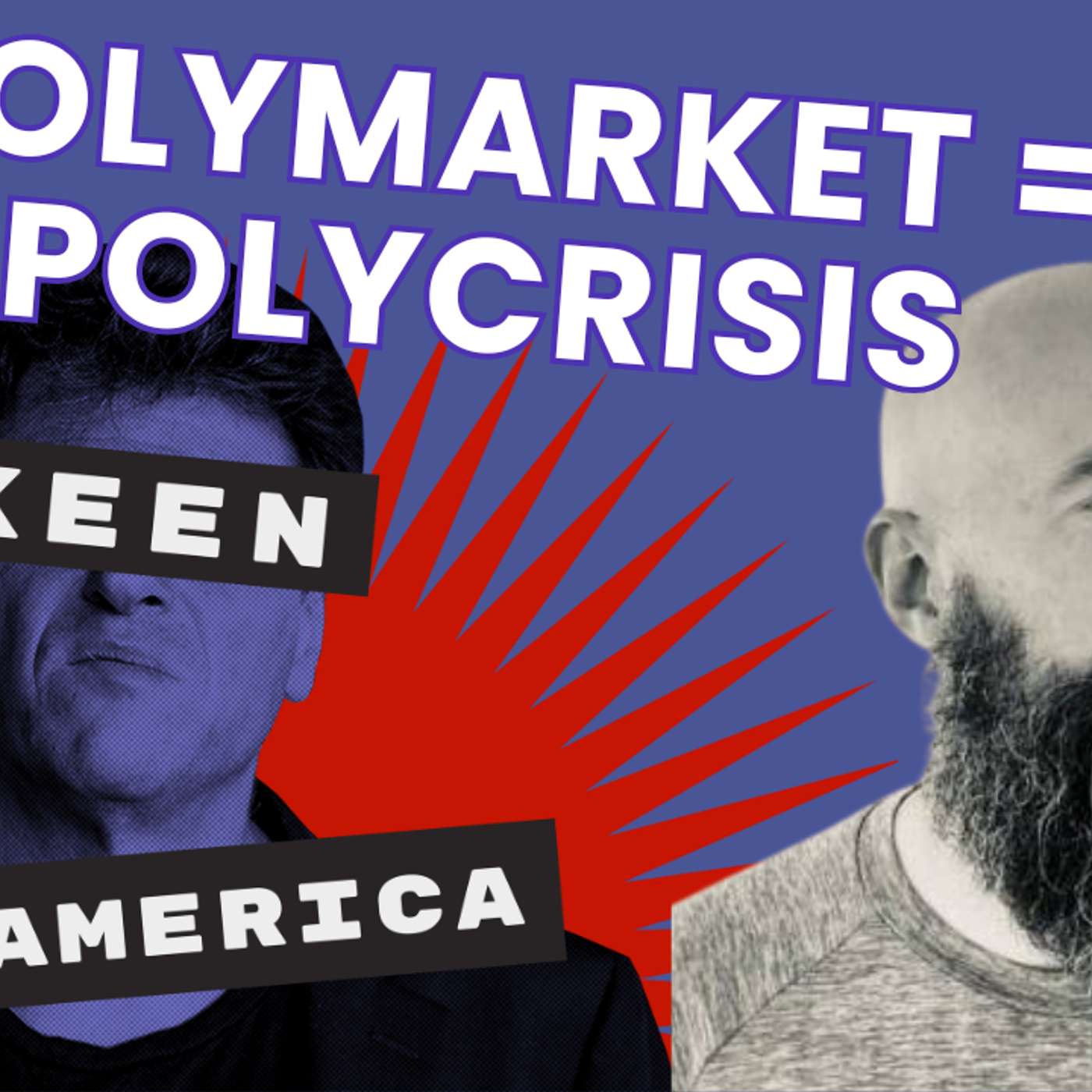


“If a society cannot find a way to deal with something that is actively melting it from within, then that is a terminal symptom.” — Finn Brunton
A couple of days ago, Donald Trump Jr.’s investment firm, 1789 Capital, led a billion-dollar funding round in Polymarket. As today’s guest, the fintech expert Finn Brunton, notes in an insightful Harper’s essay this month, prediction markets like Polymarket and Kalshi are transforming America into an always-on gambling den. No wonder, then, that the Trumps are such gleeful participants in what Brunton calls “the casinoification of modern life.” From the father’s Taj Mahal in Atlantic City to the son’s Taj on everyone’s phone. “Trade on Anything” as Kalshi promises (or threatens) us.
In “The Chaos Machine,” Brunton introduces us to two visionaries of prediction marketplaces. On the one hand, there’s the idealistic Robin Hanson, who dreamed of prediction markets as machines for truth with experts betting real money and generating trustworthy odds about the future. And then there’s Tim May, a self-described crypto-anarchist, the “bad guy,” according to Brunton, who invented the idea of BlackNet as an anonymous marketplace designed to destroy institutional trust from within. Brunton warns that today’s prediction marketplaces have bet on May, rather than Hanson. They are insider-trading machines where the smart money is always on the other side of the table.
It’s no wonder that Donald Trump Jr.’s investment firm is called 1789 Capital. By investing in prediction marketplaces, they are accelerating an anarchic French rather than institutionally trustworthy American-style revolution. These BlackNet operations are both the cause and effect of today’s destruction of trust. Polymarket is the polycrisis. It is cashing in on chaos.
Five Takeaways
• From Papal Bets to Polymarket. Prediction markets are centuries old — people have wagered on wars, weather, elections, and popes — but the modern idea belongs to the economist Robin Hanson, the hedgehog (per Isaiah Berlin) with one big idea: turn expert opinion into a market. Since experts are famously bad at prediction (Philip Tetlock’s research), make them bet: specify the outcome precisely, let the odds be anonymous, and people must wager what they really believe rather than what fits in or stands out. Hanson’s markets were meant for specialists — internal corporate markets synthesizing insider knowledge into actionable odds — not Surowiecki’s cow-weighing crowds. However disputed, Brunton insists, it was “a fundamentally positive idea”: a machine for honest consensus about the future.
• The Casinoification of Modern Life. Polymarket founder Shayne Coplan credits Hanson outright — then flips him. The modern slogan: “monetize any difference in opinion.” The sportsbook has been absorbed and joined by elections, crude prices, and missile strikes — anything anyone will bet on. The tragedy, per Brunton: an idea about synthesizing expertise became “the spread of gambling into every aspect of contemporary living.” And the experts who do bet are now effectively insider traders — a possibility Hanson, contrarian to the last, actually welcomes, but which has made the platforms “rip-off machines in which people who know what’s going to happen… exploit suckers.” The data is unambiguous: a handful of whales win; everyone else loses. The platforms’ defense — we just give people what they want — is, Brunton notes, the classic play of buying time against regulation, perfected by YouTube a generation ago. Meanwhile New York’s subway ads sell the flattering fantasy that you’re not gambling; you’re deploying your sophisticated read of the news. No wonder the Trumps are gleeful participants — from the father’s Taj Mahal in Atlantic City, as Andrew puts it, to the son’s Taj on everyone’s phone.
• Tim May’s BlackNet. The essay’s second character is the late Tim May: cypherpunk pioneer, gleeful provocateur, “idealist of the dark web” in Andrew’s phrase — and, Brunton says flatly, “a bad guy” whose politics were racist and violent. May’s gift was seeing the worst use of every technology, and his masterwork was BlackNet: an anonymous marketplace for secrets — exams, health records, trade secrets, classified plans — whose deeper purpose was to destroy institutional trust from within. Create a world where no one inside any institution knows whom to trust (a Leninist move, Andrew observed), and the institutions dissolve. Brunton’s thesis in one line: prediction markets present themselves as the fulfillment of Hanson’s vision, but they are really the fulfillment of May’s. The evidence is already tabloid fact: the operator of Trump’s teleprompter betting on the words of future speeches; a US soldier arrested in April for wagering on operations he knew were coming.
• Polymarket & the Polycrisis. These platforms are worse than casinos: at least the Nevada State Gaming Commission checks that the roulette wheel isn’t rigged, while prediction markets are “so thoroughly crooked and corrupt in their current setup” that Brunton — who still cherishes Hanson’s original promise — doesn’t know where regulation would begin. Andrew’s coinage-pairing landed: Polymarket and Adam Tooze’s polycrisis are siblings — nested, interlinked crises producing unmanageable volatility, with betting as a way of “interacting with a future that otherwise feels completely out of your control.” Hence Brunton’s students on Polymarket: not just addictive app design but “a weirdly rational decision” for a generation with no faith in pensions, home ownership, or the long-term dollar. Lambos or food stamps. The house rule stands: the smart money is always on the other side of the table — and the winners-take-all arithmetic mirrors the broader digital economy.
• Betting on Hanson Over May. Prediction markets, Brunton argues, are the heirs of crypto twice over: the next stop for fevered capital, and — like the Trump family’s World Liberty Financial, which horrifies even the Cato Institute — a mechanism for relatively untraceable corruption, a natural extension of the family casino business. Andrew’s twist on the firm’s name: 1789 Capital is accelerating an anarchic French rather than institutionally trustworthy American-style revolution. His warning is the episode’s pull quote: platforms designed to dissolve institutional trust, monetize interference with journalism, and sow paranoia are a solvent, and a society that cannot deal with what is melting it from within shows “a terminal symptom.” But he ends with a fix, and it is refreshingly concrete: KYC. Impose the know-your-customer identity rules we demand of banks, and “you immediately eliminate 95% of the bad actors” — official insider bets become visible, and the markets might even get smarter. A partisan of anonymous speech, Brunton draws the line at anonymous betting on information. Andrew’s closer: he’s still betting on Hanson over May — Kant over Hobbes. And his verdict: Polymarket is the polycrisis. It is cashing in on chaos.
About the Guest
Finn Brunton is Professor of Science and Technology Studies and of Cinema and Digital Media at the University of C...
00:31 - Introduction: Trump Jr. buys into Polymarket
02:11 - Prediction markets 101: from papal bets to Polymarket
03:34 - Robin Hanson, the hedgehog with one big idea
06:05 - Beyond the wisdom of crowds: markets for experts
09:16 - “Monetize any difference in opinion”
12:37 - The casinoification of modern life
14:28 - Insider trading: the colossal oversight
15:42 - The funnel: whales, suckers, and the house
16:56 - Playing for time against regulation
19:02 - Enter Tim May: the bad guy
22:48 - BlackNet: a black market for secrets
24:20 - Destroying institutional trust from within
27:07 - Hanson’s vision, May’s fulfillment
28:31 - Teleprompter bets and soldiers’ wagers
29:12 - Worse than casinos: nobody checks the wheel
31:24 - Polymarket and the polycrisis
34:16 - Why the young gamble: a weirdly rational despair
37:08 - The smart money is on the other side of the table
40:24 - The heir to crypto: untraceable corruption
42:29 - A terminal symptom?
46:48 - The magic bullet: KYC
49:00 - Betting on Hanson over May
00:00 -
00:00:31 Andrew Keen: Hello, everybody. It's Thursday, September 3rd, 2026. A couple of days ago, both the Wall Street Journal and The New York Times reported that Donald Trump Jr.'s firm, his investment firm, led a billion dollar funding round for Polymarket, which is a networked or distributed gambling site, if that's a fair way of putting it. And it seemed to me as if that probably suggests that Polymarket will fail, which, in ironic terms, of course, speaks to the nature of Polymarket. Maybe, Donald Trump Jr. gave away the plot. Anyway, when it comes to these distributed networks, there's a very interesting piece in this month's Harper's Magazine, The Chaos Machine: Prediction Markets and the Triumph of Crypto-Anarchy by my guest, Finn Brunton, who teaches this sort of thing, in the cinema and computer science departments at UC Davis. [ed.: Brunton is Professor of Science and Technology Studies and of Cinema and Digital Media at UC Davis.] He's joining us from Michigan where he's visiting his wife, but he normally lives in Davis, California, up the road from me [unclear]. A very nice piece in this, month's Harper's. Perhaps for our non-technical audience, you might describe what a prediction market is. Of course, Polymarket comes to mind as well as Kalshi. They're the Avis and Hertz, if you like, it seems, the prediction market, economy at the moment.
00:02:11 Finn Brunton: Absolutely. Yeah. Thank you for having me. Prediction markets are actually a really old idea. They arguably go back centuries because the essence of a prediction market is simple. It's, you and I will make a bet on some future event. And the notion is that if we get enough people making bets on some future event and the bets are for something that really counts for real money, then we will start to arrive at more and more accurate pictures of the future. Right? We'll start to get odds, and then we can actually use those odds to get the reasonable best guess that a market is willing to make about what's going to happen. So people have conducted, sort of proto-prediction-market bets on the outbreak of war, on peace, on the weather, on the election of presidents, on the election of popes. Right? We have a long history of people making these kinds of bets somewhat informally. The really important moment for our story happens when this guy named Robin Hanson, who's an economist and a very interesting character. Yes. Exactly. There he is, the man himself.
00:03:26 Andrew Keen: There he is on Gemini [unclear], and I know there are two main characters in your narrative. One is Robin Hanson. Tell us about him.
00:03:34 Finn Brunton: Yeah. So Hanson is, you know, I don't mean this in a diminishing way. I think it's true of many interesting intellectuals. Hanson is a guy who's really been focused on one idea for his—
00:03:46 Andrew Keen: You call him a hedgehog as opposed to—
00:03:48 Finn Brunton: A fox. Yeah. Yeah. And Isaiah Berlin's idea. Right? The hedgehog knows one big thing. And Hanson has written about lots of different things, had lots of different ideas, but the through line to everything has been the idea of the prediction market as a formalized tool, as a way of synthesizing expert opinion. So the basis for this is the notion that, okay. We ask a bunch of experts about, what is going to happen in some specific political situation. Right? Will China invade Taiwan? You know? God forbid. We set specifications around that. Right? We say, okay. By the end of twenty twenty-seven, under the following conditions, what counts as an invasion? We lay all of those specific qualifiers out, and then we ask a bunch of experts what they think. Often, expert opinion turns out to be wrong. And this is not just obviously Hanson's research. Many people have pointed out, most notably that a great, researcher named Philip Tetlock, who's based at UC Berkeley [ed.: Tetlock is now at the University of Pennsylvania; he was formerly at Berkeley], that there are many problems with expert opinion. Experts know a lot about things, obviously, but they're often not necessarily good at making predictions based on what they know. So Hanson's notion was, what if we turn this into a market? Instead of having a bunch of us write, like, white papers about what we think is going to happen, you know, in the future of Chinese politics and their relation to Taiwan. Instead, we say, okay. Place your bets. Give us odds. The following outcome specified to some degree of detail will take place by such and such a time. You win, you lose. The idea is that the more you build these markets, the larger they get, the more experts they get, the more precise the questions are, the clearer and more refined odds will be about future outcomes. This way you can kind of cut through some of the noise of expert disputation and debate. Right? If you let the odds be anonymous, then you avoid the problem of experts who are going to want to fit in with everybody or take a contrary position. Instead, they are going to have to bet what they really think is going to happen. Hanson's—
00:06:05 Andrew Keen: Would it be fair to say, Finn, that this is really part of the whole wisdom of the crowd argument that's been around for certainly, when it comes to the Internet, it's been around for many years. James Surowiecki, of course, wrote a famous book on this. I mean, it seems, Hanson's work is an outgrowth of the wisdom of the crowd theory, isn't it?
00:06:31 Finn Brunton: It is, but with a specific distinction, which is a useful one for understanding the prediction where prediction markets meant wrong, in my opinion, which is that Hanson's idea is similar, except that the crowd is not, you know, any random generic group of people who've come together to estimate the weight of a cow, you know, or the number of jelly beans in a jar or whatever. Yeah.
00:06:56 Andrew Keen: It's the weight of a cow, I think, that was always a bull, that is always used as the example.
00:07:02 Finn Brunton: Yeah. Yeah. That's always sort of the sort of, version the commonly told version of this idea. What distinguishes Hanson's version was his focus on the idea of trying to involve experts. Right? So rather than everyone who wants to place a bet gets to place a bet, a lot of Hanson's core arguments were premised on, we are going to get together people who really know what they're talking about. And then and this is where you can see it start to shift a little bit. Then number one, we will presumably get more accurate information about the future based on the odds that these people arrive at, but, also, we can see if they are any better at estimating the future than anybody else. And that's where it sort of gets back into wisdom of the crowd's territory. Right? It's a way of saying, okay. You claim to know a lot about, say, you know, this industry. Well, put your money on the line. Right? Tell us what you think is going to happen, and we can actually come up with specific parameters, and there's no ifs, ands, or buts about the outcome. So this is the notion that he wanted to advance. Right? And there's lots of arguments we could have about it, but at the core, it was a fundamentally positive idea. Right? It was the idea, okay. We can better synthesize the knowledge that we have and then produce actionable odds, and then we can try to make plans.
00:08:27 Andrew Keen: So coming back to this idea of [unclear]— of actionable odds. I mean, the subject today of your Chaos Machine are betting sites like, this Polymarket and, Kalshi. Kalshi's tagline is "Trade on anything," but some people might say what they're really doing is allowing people to bet on anything. What's the difference in terms of maybe Hanson's theory or the wisdom of the crowd's theory between distributed betting platforms like Polymarket and Kalshi and traditional top-down gambling systems that offer odds on everything from who's gonna win the next election, to whether the Earth will survive the next fifty years.
00:09:16 Finn Brunton: Yes. Yeah. No. So the thing about these is that they are explicitly inspired by these modern prediction markets are explicitly inspired by Hanson's work. Right? Like, Coplan the I mean, Coplan. The founder of Polymarket, is, he credits Hanson outright. He's like, I read these papers, and then I realized, like, this was this incredible, you know, business opportunity. But the approach that they're taking is fundamentally different. Right? So modern prediction markets, one of the slogans of them, I think, sums it up nicely, which is we are going to find a way to monetize any difference in opinion. Right? We're going to make any difference in opinion into a betting opportunity. So this is an industry play, whereas a lot of the work that Hanson had done was around things like, I will set up a prediction market inside your company. So people within your company will bet on future events related to your industry. So that way you're getting, like, all of the ideas of the people who are specialists in your field, and then you're getting a set of odds where you can say, okay. It seems like our experts are, you know, giving us five to one that, you know, there's going to be this breakthrough in microchip fabrication, so we need to prepare for that as a business. Instead, what Polymarket and Kalshi offer is we can bet on anything. We can bet on anything at all. And this produces a totally different dynamic, not just from Hanson's original vision, but from gambling as such. Right? No longer is it just, you know, are the Steelers gonna win. Right? No longer is even what's the point spread.
00:11:01 Andrew Keen: Yeah. I mean, currently, on Polymarket, you can bet on whether who's gonna win the women's US Open, baseball, all sorts of other sporting related bets.
00:11:13 Finn Brunton: Yes. Yeah. And you can see the way in which those have the all of that, like, existing sportsbook stuff has been absorbed by prediction markets, but then alongside it are who's going to win a presidential election? What's going to be the value of a barrel of crude twenty-four hours from now, seventy-two hours from now? When will, an Iranian missile strike Israel? Right? Like, a spread of things on which to bet in which any uncertainty that someone is willing to take a bet on becomes fair game for these networks.
00:11:53 Andrew Keen: So, Finn, what I don't understand, you keep on talking about experts. But if I wanna go and bet on Polymarket or Kalshi, let's say I wanna bet on who's gonna win, the US Open, on Polymarket. I don't have to be an expert on tennis. In fact, probably the less I know about tennis, the more fun I'll have. So why is this issue of expertise so important? Why does it assume or why does Hanson assume that only experts bet? Isn't it a speculative venture? It goes to your head, and you're just doing it, as the British say, as a flutter, as a bit of fun.
00:12:37 Finn Brunton: Yes. Indeed. Right? This is, for me, not to be too dramatic about it, but this is one of the kind of tragedies of prediction markets. Right? Is that they've taken an idea which we can dispute about its overall utility or whether it really lives up to its promise, but at least a really interesting idea, which is this focus on using a market as a way of helping experts assemble their opinions together and then give us some kind of clear outcome that we can make a decision from, and instead has turned it into the spread, the casinoification of modern life. Right? The spread of gambling into every aspect of contemporary living, into everything that we could conceivably be gambling on. So in this way, it also produces the crazy thing that we're seeing with prediction markets now, which is that there are experts betting on prediction markets, but those people are effectively doing insider trading. Right? The people who actually know what's going on are also betting on these markets and in many cases, making quite a lot of money, but they are doing so based on specialized knowledge that they have that the general public doesn't. So we've essentially created the inverse—
00:13:52 Andrew Keen: I don't wanna, Finn, I don't wanna sound too dumb here, but isn't that obvious? I mean, if you have a platform like Polymarket or Kalshi where in your piece, you talk, for example, about an Israeli journalist, called, Fabian, Emanuel Fabian, who got involved in a controversy because people were betting on when and where Israel would bomb Iran. [ed.: The Polymarket contract concerned whether Iran would strike Israel on a given date.] Isn't it obvious that some people, maybe not everybody, but many people would use it to take advantage of insider knowledge and make some money out of it?
00:14:28 Finn Brunton: It's not a dumb question at all because you're right. It seems like an obvious thing that everyone should have prepared for, that everyone should have thought about. I mean, Hanson, who is, you know, in love with this idea and a contrarian by nature, has said that, actually, the insider trading is fine and should even be welcomed because it means that people who really know what they're talking about are betting on the outcome, so we're getting, you know, better information about the future as a result. But the fact is that this was if this was a colossal oversight. Right? It has effectively made prediction markets into rip-off machines in which people who know what's going to happen, who possess insider knowledge are able to exploit suckers. It's built a system—
00:15:19 Andrew Keen: And just to come back, I don't wanna turn this into another conversation about bashing tech. But— This is all very convenient for platforms like Polymarket and Kalshi because they can stand back and say, well, it's nothing to do with us. We can't control everyone who's making bets on our platform. So, they're the ones who are really profiting from this, aren't they?
00:15:42 Finn Brunton: Yes. Yes. They absolutely are. I mean, this is part of why I think they really exemplify prediction markets really exemplify the, you know, the current state of the tech business, which is to find a bunch to build a funnel, to find to bring a bunch of suckers in and take their money and then spit them out the other end. Right? They're incredibly exploitative. And we actually have a lot of data about prediction markets, obviously. Like, scientists love studying this kind of thing. It's very data-rich. It's very interesting. And we can prove that the money on Polymarket is being made by a handful of whales who make smart bets, know the bets that they're making, are often presumably playing on information that they possess. And then a lot of the money is being taken away. I mean, it's a classic casino arrangement.
00:16:32 Andrew Keen: Well, what's the demand of this? I mean, you can go on Polymarket today and bet on who's gonna win the, US Tennis Open. What would happen if one of the players, involved in the tournament in New York bet? I mean, they would be in trouble from the tennis organization, but it is that legal?
00:16:56 Finn Brunton: I mean, the unsatisfying answer is that this is all still being worked out. The more realistic answer is that it shouldn't be, but a lot of what is happening right now is the same thing we see in other areas of the tech industry, which is essentially playing for time against regulation. Right? Like, doing the same move we've seen with other major platforms. So saying like, well, I mean, we're doing something innovative. We're making money.
00:17:27 Andrew Keen: Yeah. We're giving people what they want. People wanna bet. It's not our fault if people wanna bet.
00:17:32 Finn Brunton: Exactly. People wanna bet. They wanna I mean, I was in New York recently, and the number of ads for prediction markets was amazing. And a big part of it was premised not on the idea that you were gambling, but on the idea that you were, like, participating with your sophisticated knowledge of a situation. Right? You are able to, like, you know, bet on your insights about the news and so on. But at heart, this is the same play that we have seen with plenty of other businesses. Right? We are going to just do something that seems blatantly wrong, and then we are going to wait for regulators to catch up with us, by which time we will hopefully be large enough that we will be able to forestall that or negotiate—
00:18:15 Andrew Keen: [unclear] AI companies, of course, but even now mainstream companies like YouTube did that. You know? YouTube turned a very convenient blind eye to the fact that most of the videos put up in the beginning of YouTube were stolen. And by the time everyone had caught up with them, they were so dominant in the industry that it no longer mattered. So just to come back to this piece, which is excellent, The Chaos Machine, it's a kind of intellectual history of prediction markets. So on the one hand, we have this Robin Hanson, who we might think of as an idealist. I mean, and then you introduce somebody else who perhaps we might think of as a realist. Is that fair? Who is the [unclear] in your narrative?
00:19:02 Finn Brunton: Yes. Yeah. So I was really I was so happy, to see the ways that all these things tied together. It's very convenient as a writer, you know, as you know, when you get this kind of, like, neat interconnection that already exists. So Robin Hanson, among many other areas of his interest, was part of this kind of loose confederacy of early tech people in the nineties who were really interested in what could be done with cryptography. Right? So cryptography, the technology that allows you to encipher messages so that you can send secret messages that can't be read by others. Hanson was on these mailing lists alongside a guy named Timothy C. May. And May is a really significant figure, I think. Really, his importance is really poorly understood. Yeah. So May was enormously influential in the development of cryptocurrency. He was the founder of He—
00:20:01 Andrew Keen: He died in 2018. Yes. Timothy C. May, known as Tim May. So what was May saying that was so different from Hanson?
00:20:14 Finn Brunton: So May's great knack. Right? Like, he was, I think I can comfortably say he was a bad guy. He did really bad things. He was a pretty like, he his interest in cryptography was very much based in his particular politics, and his particular politics were racist and violent. However, the essence of his argument, which he called crypto-anarchy, was to apply these technologies to lead to the collapse of all existing institutions and their replacement by this, like, sort of vision of, like, a nerd warlord state. Now the reason why May is interesting for us is that he had this gift, and the gift was to see the worst way that people would use things because that's what he was attracted to. That's what he was interested in. So we have these, like, running stories of people coming up with these amazing proto-Internet technologies and then coming to May, and May would be like, oh, you know the number one thing people are gonna wanna use that for is like stealing intellectual property. Right? So you should prepare for that. You should build for that. You shouldn't— [unclear].
00:21:29 Andrew Keen: A prophet and— An idealist almost of the dark web.
00:21:34 Finn Brunton: Yes. Yes. Very much so. Right? He really was. He was an idealistic speculative visionary whose, like, great excitement was the vision of, like, the coming social collapse that cryptography would produce, which he could then—
00:21:49 Andrew Keen: [unclear] devilish quality. He rubbed his hands when most of us get all upset when we imagine the dark web or the anarchy of the Internet.
00:21:58 Finn Brunton: Yeah. He was a gleeful provocateur, and I characterize him so negatively because I think we really we because of his relevance to the history of cryptography, people really often overlook, like, his fascination with, you know, with, like, racist white supremacist projects, with all these very negative things.
00:22:19 Andrew Keen: I take your point. I mean— Yeah. I'm like you. I'm not a great fan of—
00:22:25 Finn Brunton: Yeah. White racism.
00:22:26 Andrew Keen: But then, I mean, those two things don't necessarily go together. You're an authority on crypto-anarchism, and this is one of the things that interests you, I think, about this story. Not all crypto-anarchists are also extreme right-wing racists, are they?
00:22:48 Finn Brunton: No. No. Not remotely. Not at all. And this is part of the challenge of dealing with May's legacy. Right? Is he named it. He came up with so many of the fundamental ideas. He developed so many of the kind of underlying arguments, but he did so for, in my opinion, really, really bad reasons and kind of wrestling with that legacy and recognizing that we can and should continue to fight for privacy online for the things that cryptography could do while also dealing with that thread in its history. That's part of the challenge of continuing to fight for cryptography today. But the crucial thing about May for the prediction market world is that his, like, knack for seeing the worst outcome for something led him really early on to speculate and then formalize this idea that he called BlackNet. And BlackNet would be the information marketplace specifically for stolen or classified or secret data. Right? He was like, what's the most valuable thing that you can have on the Internet? Well, it's data that other people don't want you to have or data that could be worth a lot of money because it's secret. It's not supposed to be released. So he started to say, well, one of the things that we can do with the Internet once we have, like, proper cryptographic tools in place is build a black market for information.
00:24:13 Andrew Keen: And then— It's funny. Given he was a racist, I would have thought he would have called it white net and talked about a white market rather than BlackNet.
00:24:20 Finn Brunton: Yeah. I mean We are we're talking about a guy who is, like, interested in the idea of how you could have totally anonymous online communities of white supremacists who could use technology to ensure they were not being infiltrated by, like, other people. Like, these are nightmarish ideas. But yeah. So he so the core of this vision was, okay. People are going to want a way to monetize secret information that they possess. So let's build tools so that they can do that. Right? Students and teachers are going to want to sell tests and exams. Right? Health care people are going to wanna sell information they're not supposed to share with insurers. Like, obviously, trade secrets. Right? We're watching these cases right now playing out between, like, OpenAI and Apple. Right? Like, tech companies want access to other tech companies' trade secrets, strategic plans, and so on. And then, of course, you have government data. Right? Classified information, military plans, etcetera. You name it. So May said, okay. We need a mechanism for this because people are going to want to make money off of the secret information that they possess. However, the crucial point for us that ties these two threads together, May's story and Hanson's story, the story of prediction markets, is that May ultimately his ultimate goal with this was not just to, like, help people sell secrets. His ultimate goal was to find ways to destroy institutional trust because that, he knew, because he's a very smart guy, was one of the most effective routes to his vision of crypto-anarchy. Right? If you want to start to, like, wreck the current institutional structure, wreck the system of political society, then one of the best ways to do that is to destroy your institutions from the inside out. How do you do that? So it's a it's—
00:26:08 Andrew Keen: A Putin-esque, or even a Leninist-like, destruction—
00:26:16 Finn Brunton: From inside. You create a scenario in which the people inside these systems never know if they can trust anyone else inside their own systems. Right? You destroy the ability of the institution to function from within.
00:26:32 Andrew Keen: And that— it's the creation of a broad culture of paranoia.
00:26:37 Finn Brunton: Yes. Yes. Yes. It is. It is. It is. And you—
00:26:40 Andrew Keen: Is that what you see now as prediction markets as places of paranoia? Because most people know, I mean, even people who enjoy using these platforms, that half the anonymous people are or certainly a significant proportion of the people on these platforms, are, if not dishonest, certainly not what you think they are.
00:27:07 Finn Brunton: Mhmm. Mhmm. Mhmm. No. They are these are like, this for me is what makes the prediction market so fascinating is that it presents itself as the fulfillment of Hanson's vision, but it's really the fulfillment of May's. Right? It's a market in which trust starts to fail on every side. Right? If you are gambling on the market, then you have no way of knowing if the people you're gambling against have rigged the game. Right? If they have inside information, if they know something that you don't know. You also have no way like, there's other ways in which the markets can be fixed that you always have to suspect. However, increasingly, in life, you no longer know in your company, in your institution, if you work for the government. You no longer know if the other people around you aren't covertly profiting from the information, which indeed also sets up a sense not only can I trust them, but, well, maybe I should be making money from this too? Right? Like, we've seen examples like the guy who runs Trump's teleprompter gambling on the words that he's going to be using in future speeches. We've seen people in the military betting on the outcomes of upcoming military events.
00:28:23 Andrew Keen: About this. Yeah. A US soldier was arrested in April for—
00:28:30 Finn Brunton: Mhmm.
00:28:31 Andrew Keen: The stuff that happened in Venezuela. People know exactly what's gonna happen. So, Finn and I'm sure most people are gonna be thinking this. I mean, a few days ago, Kalshi's banned George Santos from the platform. I don't know quite how they ban him. He probably can go on anonymously. But doesn't all this support the argument that platforms like Kalshi and Polymarket should themselves be banned. Is that the only antidote to the crypto-anarchism of Tim May? Or, certainly, if not banned, much more carefully regulated.
00:29:12 Finn Brunton: Yes. Yeah. That's what I was going to say. I think the part of the challenge with this is that these prediction markets are deliberately trying to occupy a gray area. Right? Like, they are you know, on one level, it could not be more obvious that they are functioning de facto as casinos. Right? Like, their primary—
00:29:33 Andrew Keen: [unclear] than casinos. Because when you go to a casino, you assume I mean, sometimes the house is, of course, corrupt, but you assume that when the ball goes around the roulette table, that someone isn't controlling where it's gonna land or that they know where it's gonna land before you do.
00:29:54 Finn Brunton: Yes. Yeah. No. You do. I mean, you and you can and maybe this is actually a nice way to link this to this question of banning or regulation is that even in a casino, which is, you know, a pretty horrible predatory business, you can still rely on the fact that the Nevada State Gaming Commission has people who are checking on things and making sure that even if the game that, like, even if the games are not fair, they're not rigged. You know? That even the that there's some set of guardrails built in. The challenge with prediction markets is that they are they do offer interesting opportunities, but they do so in a way that is so thoroughly crooked and corrupt in their current setup that I don't quite know how you would begin to regulate them to make them more functional. And I should put my cards on the table here and say that I you know, there's many, many things that I would disagree with Robin Hanson about, but I actually still have a certain attachment to the promise of a carefully organized, tightly regulated, tightly run prediction market to be able to produce meaningful information about future events. I think that's a really cool idea. I don't know how we would make the problem that Polymarket has become into something that looks more like that now. I'm not even sure where we would begin.
00:31:24 Andrew Keen: And in many ways, it's a symptom rather than a cause of all the chaos in the world. There was an interesting piece, I read recently about people are going into prediction markets to bet on the weather and— The climate. It's almost part of this broader narrative of our crisis of the what some people call I mean, there's Polymarket. Another economist described the current situation as a polycrisis. I wonder if— Polymarket and polycrisis are part of the same phenomenon.
00:32:04 Finn Brunton: That's, I think, a really, really good—
00:32:07 Andrew Keen: That was Adam Tooze, of course, the economist who came up with the term of polycrisis or at least has claimed it. And he writes extensively about, the environment, energy, all the things that are making us so uncomfortable these days.
00:32:24 Finn Brunton: And I think, I mean, I think it's actually a really useful comparison because one of the points that I think Adam Tooze is making with that coinage and circulating that idea is it's a way of talking about a situation in which it's never just the one crisis. It's never just the one problem because they are all interconnected. Right? They're all it's not just that they're all happening simultaneously. It's that they are nested and linked, and they tend to feed into each other in different ways, which is another way of saying that our situation has become unmanageably volatile. Right? And I think to your point that one interesting way to look at Polymarket, Kalshi, and others as symptoms is that they are expressions of a scenario where it's like the sense of not knowing what's coming next becomes so debilitating that in a way, there's something weirdly attractive about trying to make a little cash off of the chaos, you know, of putting in your bets as a way of interacting with a future that otherwise feels completely out of your control.
00:33:40 Andrew Keen: Yeah. I mean, when you [read] the Decameron, which was, a book about the experience of the terrible plagues in the Middle Ages in Florence. But the it wasn't a it's a book or the stories of how we behave in apocalyptic circumstances. And it seems as if, as you're suggesting, Polymarket and Kalshi are maybe, I mean, I guess, in a part in a sense, maybe the cause of our apocalyptic age. But as much, if not more, they're a mirror of it, a symptom of it.
00:34:16 Finn Brunton: Mhmm. Yes. Yes. I think these are a good way of understanding these is that these are manifestations of a volatile, low-trust society. Right? And more than that as well, I think it's interesting to look at gambling in general as I can personalize this a little bit in that I have a fair number of students that I know who, because of my work on this, they're like, oh, yeah? Polymarket. I gamble on Polymarket. And I'm like, you do? Tell me more about it.
00:34:51 Andrew Keen: Big problem. More teens are getting hooked on gambling, especially platforms like [unclear] and Polymarket. So— But some people might say, well, if these people are stupid enough to gamble on it and gamble with people who already know the answer, then they deserve to lose their money.
00:35:08 Finn Brunton: Yes. But the reason why I wanna frame it this way is to say that without discounting, you know, the addictive design of modern apps, especially apps that are on-ramps to gambling, it's also in a perverse way a weirdly rational decision because a lot of younger people that I know, they have no faith at all that, like, if they work a job, they're going to get a pension. You know? They have no faith at all that if they don't think they're ever going to, like, buy a house, you know, and, like, accumulate equity and an asset that they can cash out in later life. For a lot of them, they have no faith that, like, the US dollar is going to be consistently valuable over the long term. And I put it in those terms to say, if you feel like the future has no if you feel like if you played it safe, if you are a safe, responsible person who made good decisions, then you will be rewarded with stability and prosperity. If you don't believe that at all and if you, in fact, have good reason not to believe that, then why not? You know? Why not gamble? Why not, like, just start, like—
00:36:20 Andrew Keen: Betting on that. Your point— although, I think that's become a bit of a cliche too, these days, certainly amongst university kids.
00:36:28 Finn Brunton: Yes. And I'm not saying that it's right. But—
00:36:31 Andrew Keen: Finn, in the way you're presenting this, and I think it sounds correct to me, the intelligence is being able to figure out what is and isn't real or the intelligence of knowing on these platforms whether you're dealing with inside traders or not. And that involves it's not just arbitrary. It's not just second-guessing. It requires intelligence, and there are some people able to navigate, negotiate that.
00:37:08 Finn Brunton: Yes. I mean, I think that is accurate, but, also, I think the, you know, the kind of old rule in, finance, right, is that, if, you know, you should always, like, essentially that, like I think the best way to put it is a very crude one, which is that, like, you don't have the alpha, right, where alpha is, like, the, you know, the information about what's coming next, about the smart bet. Right? You do not have access to that, and you should plan accordingly. And I think, likewise, the assumption in that is worth making with prediction markets is that the smart money is always on the other side of the table. And we can see that. Right? We can actually—
00:37:55 Andrew Keen: See the again, it's the old cliche that if when you're playing poker and you're sitting around the table and you're looking for the fall guy, it's likely to be yourself.
00:38:07 Finn Brunton: Yes. Yes. Precisely. And out of that, it's not just, you know, advice about how to, like, you know, bet smart on these things, but it's also because I don't think that's possible for most cases. And, again, we have objective data that shows that the vast majority of the gains are reaped by a very small number of players, and everyone else is more or less losing money for it.
00:38:29 Andrew Keen: So it's like the broader economy in a sense, certainly the digital economy, where you have a tiny group of winners, OpenAI, Anthropic, Google, and then everybody else is losing.
00:38:38 Finn Brunton: Yes. Yeah. Yeah. Yeah. I think it's a so it's but I think it's useful for us to then kind of reflect on that and say, yeah. Again, these things seem symptomatic of a larger cultural economic crisis. You know, as people used to say in the sort of fever days of, buying and selling cryptocurrency, right, Lambos or food stamps? You know? And the odds are high that you're going to end up on food stamps, but the Lambos are a small possibility, so it's worth playing nonetheless. Like, that I think to your point, the, I don't know that this is a useful or hopeful piece of advice, but what you describe, that sense of, like, having an trying to cultivate an awareness of knowing when things might be real, or when they're not is obviously one of the primary twenty-first century instincts. But with that, maybe has to come a dawning sense, like, a growing awareness that most of what you encounter is probably not real. You know? It's probably, like, rigged or set up in some way.
00:39:48 Andrew Keen: Except for you and I, of course.
00:39:49 Finn Brunton: Yes. Yeah. No. No. We are We're—
00:39:52 Andrew Keen: We're more real than real. You're an expert on, digital cash. Your last book was called, appropriate enough, Digital Cash: The Unknown History of the Anarchists, Utopians, and Technologists Who Created Cryptocurrency. Is are the prediction markets are they the next chapter in digital cash? Have they come out particularly of crypto? Is it then surprising that characters like Donald Trump Jr. are investing in Polymarket?
00:40:24 Finn Brunton: Yeah. I mean, the yeah. It's a really good question. I think they are, in many ways, the heirs to the crypto fever, but in two different primary ways. And the first one is that you can really see a lot of the contemporary tech economy as a series of moves to try to find, right, the next explosive growth area of capital, the sort of next area where you can make wild overpromises and then eventually under deliver. But by that point, the investment money has moved on. And prediction markets obviously AI is hoovering up a lot of that now, but prediction markets are an interesting slice of that but the other larger area is that crypto turned out to be really good for money laundering. Right? Crypto turned out to be really good as a mechanism for enabling corruption. We see that especially with its adoption in the Trump administration right with World Liberty Financial and all the rest of it and we've got—
00:41:25 Andrew Keen: [unclear] on Trump coins and even with, libertarian groups, conservative libertarian groups in Washington, DC, like the Cato Institute who are horrified with what— The Trump people are doing with it.
00:41:39 Finn Brunton: Yeah. No. Exactly. Exactly. And so I think prediction markets are also the heir, like, crypto is actually still working very well for that purpose, but prediction markets are offering another really useful way to do that. On the other hand, with Trump and his family specifically, right, like, they've, you know, they've been on and off in the casino business for quite a long time. So you can see the way in which moving into this new area of enabling gambling, is makes a lot of sense for their family business. But, yes, the prediction markets offer a really straightforward set of mechanisms for, you know, insider trading in the sense of a mechanism for corruption that is relatively untraceable. So it's worth keeping it as well.
00:42:29 Andrew Keen: A lot of people are gonna be thinking this, Finn. You call it the Chaos Machine. Seems like the victory of crypto-anarchy. I don't think we have a lot of crypto-anarchists, certainly, in our audience. I'm the I'm anything but a crypto-anarchist. Does this require the opposite of crypto-anarchy, the state to fight back? I mean, we talked earlier about whether or not Polymarket should be either regulated or maybe and Kalshi, whether they should be shut down. There are some countries where, then they're not allowed. What's your thinking? I mean, this is a short piece in Harper's. Maybe you'll write a longer book on it. What does it tell us? I mean, is this the great struggle of the twenty-first century between, Timothy May's crypto-anarchism and the state, and it and the ball is in the court of the state to actually push back against these platforms and regulate them before these crypto-anarchists essentially undermine as May wanted the state itself, and then we have complete anarchy?
00:43:43 Finn Brunton: Yeah. I think the I think it's worth looking at platforms like these as warning signs. Right? Like, these are, you know, we can say very similar things about a number of recent developments in the tech world, but these are all elements where if a coherent society with trustworthy institutions in which people have a democratic say over their situation, if those things want to survive, they have to find ways to recognize the threats of these sorts of the what I describe in the piece is the solvent of these platforms. Right? These platforms that are designed to basically dissolve institutional trust, to monetize interfering with journalism, right, to monetize indeed the production of false or mendacious news, right, to sow paranoia within organizations. We need to recognize that this is actively dangerous to, like, the structure of social cohesion, to the ways that we under we are able to understand the world around us and arrive at collective decisions, which, again, could not be more of a tragic irony relative to what Hanson originally wanted prediction markets to be. So this is all my way of saying, I always hesitate to provide, like, a policy prescription, but I think if a society cannot find a way to deal with something that is actively melting it from within, then that is a terminal symptom. Right? That's a sign of—
00:45:29 Andrew Keen: Actually, that after his book, The End of History, Fukuyama wrote a book on trust and low-trust societies. So— Issue of trust is really important. One finally, is there one seems again, I mean, I hope I'm not being too dim here. But the obvious solution on a platform like Polymarket or Kalshi is if I'm gonna take a bet with someone, about whether or not, I don't know, Israel's gonna bomb Iran or who's gonna win the US Open at the weekend. I wanna know who they are. So it's one way to reform Polymarket or Kalshi rather than just shutting them down is requiring users to not hide behind their anonymity. It's the old, again, cliche. There's only one thing, worse than not allowing anonymity on the web. It's complete anonymity.
00:46:27 Finn Brunton: So—
00:46:28 Andrew Keen: Isn't that isn't the opportunity, given the distributed nature of digital life in the twenty-first century, is it requires us to, so to speak, put our cards on the table in terms of identifying ourselves. So I'm willing to take a bet with someone if they can identify themselves, and I know who they are.
00:46:48 Finn Brunton: Yes. Yes. So this, I think, if there is one, like, magic bullet that could really resolve a lot of the downsides of these platforms in a single stroke. It's actually really straightforward, and it's KYC. Right? Know-your-customer regulations, which are the same things that we hold many financial institutions to. Right? They're things that we actually apply to a lot of different kinds of organizations. The major driver of so much of the crisis that is being produced by prediction markets is the in is enabling the anonymity of betting. If we simply had much stricter rules around identifying yourself and making your bet, then it's not just that we would, you know, immediately eliminate all of these problems with, like, officials who have access to classified information betting on that information because it becomes immediately apparent. But then, also, at the risk of sounding too optimistic after this whole conversation, it actually lets us make much better bets because then we could actually look at a prediction market betting field and say, oh, all of the guys who are betting on this side of it are, like, you know, foreign policy experts, and all the guys betting on this side of it are, like, weird Twitter bros who have, like, an ax to grind about this one topic. I think I know where the smart money is going, and I can, like, place my bets accordingly. I think the idea of eliminating the anonymity of betting like, I'm actually a big partisan and advocate for enabling in making it so that people can be anonymous, so that anonymous speech is possible, so that anonymous activity is possible, [unclear] blah blah blah, all those things. However, when you're talking about something like betting on information that you know, anonymity is just going to be like, it's only going to foster this kind of behavior. So, yeah, holding them to a rigorously high know-your-customer requirement. That's all it takes. We can talk about gambling addiction. We can talk about all the other issues with regulation. But if you start with KYC, you immediately eliminate 95% of the bad actors that the system has produced.
00:49:00 Andrew Keen: In other words, Finn Brunton, you're still betting ultimately on Robin Hanson over Tim May. He's the bad guy. Hanson's the idealist. You're betting on Kant over Hobbes, perhaps— Tim [May], evil guy. We will see. Very interesting conversation. The piece is out, by Finn in, this month's Harper's— always an excellent read. The Chaos Machine: Prediction Markets and the Triumph of Crypto-Anarchy by my guest, Finn Brunton. Finn, I'll have to get you back on the show to talk more broadly about the crypto-anarchism at the heart of the, or the crypto-anarchism at the heart of the digital money industry. Thank you so much.
00:49:47 Finn Brunton: Thank you. This was a pleasure.